Part 2 · Coding as a Laboratory · Chapter 6
Loops as Cycles of Observation
"A human researcher grows weary after repeating an observation ten times. An algorithmic loop will repeat it ten billion times with microscopic precision — unless you give it the wrong boundary, in which case it will bake four cupcakes instead of five." — Agent Spark's Lab Notes, Entry #088
  +========================================================================+
  |                   THE FIRST AXIOM OF AUTOMATION                        |
  |                                                                        |
  |   A loop does not simply repeat work; it establishes a cycle of        |
  |   observation. Every cycle possesses an origin, an increment, and      |
  |   a boundary. If your boundary is off by one, reality will diverge.    |
  +========================================================================+
The mystery
The Great Five-Cupcake Fiasco
Saturday morning at The Quantum Cupcake Kitchen was usually filled with the pleasant aroma of Madagascar vanilla, caramelized sugar, and freshly warm blueberry muffins.
Today, however, the air was thick with the scent of impending bureaucratic disaster.
Standing on the customer side of the polished glass counter was Mayor Bartholomew Bumbleton, President of the Municipal Science Council. He was tapping his gold pocket watch with an impatient, rhythmically tapping fingernail. Behind him stood four very hungry, very solemn city council members in pressed blue suits.
"Five cupcakes, Chief Scientist," Mayor Bumbleton boomed, adjusting his monocle. "That was our official civic requisition. Exactly five vanilla cupcakes, smothered in pink strawberry frosting, each garnished with rainbow star-sprinkles. The town council meeting commences in precisely eight minutes. Are they ready?"
"Right on schedule, Mayor!" you said confidently, flashing a thumbs-up.
Behind you, suspended from an overhead gantry by a humming magnetic rail, hovered Agent Spark. Spark had donned a miniature paper chef's hat angled jauntily between its twin reception antennae. Its articulated robotic manipulator held a pressurized titanium frosting nozzle.
"The automated conveyor system is operational, Chief Scientist!" Spark announced, its LED visor pulsing a joyful bakery-pink. "I have calibrated the robotic arm. The digital conveyor belt is loaded with freshly baked golden sponges. Requisition: Five cupcakes. Preparing to run the decorating loop!"
You turned to the terminal and typed the instructions for the automated arm:
# Chief Scientist's Bakery Conveyor Script
for cupcake_number in range(1, 5):
    apply_pink_frosting(cupcake_number)
    dispense_rainbow_sprinkles(cupcake_number)
    box_cupcake(cupcake_number)
"Execute loop!" you commanded.
CLACK-WHIR-CHUG!
The stainless steel conveyor belt lurched into motion. The first cupcake slid into position under the nozzle.
SQUIIIIIRT! FZZZZT! A swirl of glossy strawberry frosting landed on Cupcake 1, followed by a shower of crunchy rainbow stars. A mechanical claw scooped it cleanly into a pink pastry box.
SQUIIIIIRT! FZZZZT! Cupcake 2: frosted, sprinkled, boxed!
SQUIIIIIRT! FZZZZT! Cupcake 3: frosted, sprinkled, boxed!
SQUIIIIIRT! FZZZZT! Cupcake 4: frosted, sprinkled, boxed!
The conveyor belt gave a soft ping, the electric motors whirred down, and the machinery came to a complete, tranquil halt.
Mayor Bumbleton leaned over the counter and looked into the pastry box. He squinted through his monocle. Then he pulled out his gold fountain pen and pointed it into the box:
"One... two... three... four."
The Mayor looked up, his bushy eyebrows knotting like stormy thunderclouds. "Where is the fifth cupcake?"
You blinked, leaning over the counter. "What do you mean? The order was for five cupcakes!"
You glanced down at the conveyor belt. There, sitting quietly under the inactive nozzle at the end of the line, sat Cupcake #5. It was completely bald. No pink frosting. No rainbow stars. Just a lonely, unadorned sponge muffin staring blankly up at the ceiling.
                   THE CRITICAL CUPCAKE CONVEYOR DISCREPANCY

     [ CUPCAKE 1 ]       [ CUPCAKE 2 ]       [ CUPCAKE 3 ]       [ CUPCAKE 4 ]       [ CUPCAKE 5 ]
     ┌───────────┐       ┌───────────┐       ┌───────────┐       ┌───────────┐       ┌───────────┐
     │  FROSTED  │       │  FROSTED  │       │  FROSTED  │       │  FROSTED  │       │   BALD    │
     │ SPRINKLED │       │ SPRINKLED │       │ SPRINKLED │       │ SPRINKLED │       │  (BARE!)  │
     └───────────┘       └───────────┘       └───────────┘       └───────────┘       └───────────┘
      Index: 1            Index: 2            Index: 3            Index: 4            Index: 5 (?)

     Status: BOXED       Status: BOXED       Status: BOXED       Status: BOXED       Status: IGNORED!
"Chief Scientist!" Mayor Bumbleton sputtered, his face turning the exact shade of the strawberry frosting. "There are five members of the council! Am I supposed to tell Councilwoman Henderson to eat a plain dry muffin while the rest of us enjoy rainbow stars?! This is a civic outrage!"
Agent Spark hovered down between you and the Mayor, its LED visor spinning with dizzying yellow question marks.
"Wait! Malfunction! Does not compute!" Spark stammered, its manipulator waving the frosting nozzle in distress. "I wrote range(1, 5)! Five is right there in the code! Look at line 2: 1, 5! Five is the number of cupcakes requested! Why did the conveyor belt stop at four? Did the machine get tired? Did we run out of sprinkles?!"
"No, Spark," you said quietly, a lightbulb suddenly illuminating in your mind as you stared at the numbers. "The conveyor didn't run out of sprinkles. We just committed the most notorious, celebrated blunder in all of software engineering."
"We did?" Spark squeaked. "What is it called?"
"It is called the Off-by-One Error," you whispered. "And to understand why it happened, we have to travel back fifteen hundred years to ancient India and meet the mathematicians who invented the number zero."
Unplugged lab
The Fencepost & Cupcake Counting Lab
Before we fix our code, let us pick up physical objects and experience the difference between counting items and counting intervals.
                THE HISTORIC FENCEPOST CONUNDRUM

     Post 0          Post 1          Post 2          Post 3          Post 4
       ║               ║               ║               ║               ║
       ║═══[SEC 0]═════║═══[SEC 1]═════║═══[SEC 2]═════║═══[SEC 3]═════║
       ║               ║               ║               ║               ║

     COUNTING POSTS:     5 posts needed!
     COUNTING SECTIONS:  Only 4 fence sections exist between them!
Required Laboratory Equipment:
- 5 small paper cups or muffin liners (these represent our cupcakes).
- 5 colored tokens, buttons, or coins (these represent our frosting swirls).
- 4 craft sticks, pens, or strips of cardboard (these represent the fence sections or conveyor steps).
- A strip of paper tape or a ruler marked from 0 to 5.
- Your Chief Scientist Lab Notebook and a pencil.
Phase 1: The Fencepost Dilemma
Suppose a farmer needs to build a wooden fence along a path that is 4 meters long. Every meter requires a wooden fence section, and every section must be supported on both ends by a vertical post.
- Lay down your 4 craft sticks end-to-end on your table. That is a fence 4 sections long.
- Place a small cup (a "post") at the very start of the first stick.
- Place a cup at every junction between sticks.
- Place a cup at the very end of the last stick.
- Count the cups: How many fenceposts did you use?
Great minds of the lab
Brahmagupta, Aryabhata, and the Revolution of Zero
To understand why computer science starts counting at zero, we must travel back across fifteen centuries to the ancient observatories of India.
             ANCIENT INDIAN ASTRONOMICAL CYCLES (UJJAIN, 628 CE)

                            THE CELESTIAL YUGA LOOP
                                 ┌───────────────┐
                                 │   ORIGIN: 0   │ <── Brahmagupta's Shunya
                                 └───────┬───────┘     (Zero as True State)
                                         │
                    ┌────────────────────┴────────────────────┐
                    ▼                                         ▼
           [ Earth Rotation ]                        [ Lunar Revolution ]
              360 Degrees                                27.3 Days
                    │                                         │
                    └────────────────────┬────────────────────┘
                                         │
                                         ▼
                           Cycles Repeat Perpetually:
                           Step 0 ──► Step 1 ──► ... ──► Reset to 0
The Astronomers of the Sacred Observatories
In the fifth and seventh centuries CE, Indian scholars at great intellectual centers like Ujjain and Pataliputra were conducting some of the most sophisticated astronomical observations on Earth.
Aryabhata (476–550 CE) was a legendary mathematician and astronomer. Sitting under the clear desert night sky, he tracked the cyclical movements of the planets, the Moon, and the constellations. While European thinkers of the time still believed that the Sun orbited a flat, motionless Earth, Aryabhata calculated that:
Digital sandbox
The Bakery Conveyor
Let us explore our companion laboratory: web_minigames/03_bakery_conveyor/index.html and its Python engine in sandboxes/chapter_06_bakery_conveyor/conveyor_loops.py.
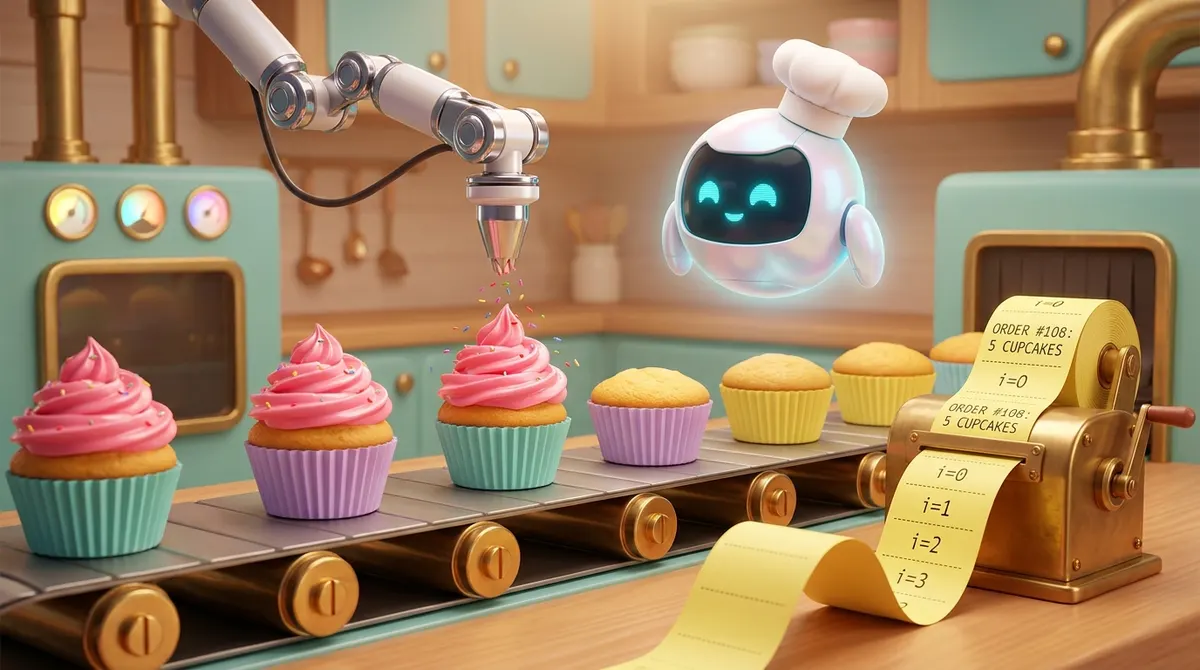 Figure 6.1: The Quantum Cupcake Kitchen proving ground interface, showing the interactive conveyor belt, loop parameter inputs, and the real-time diagnostic receipt printer.
   +========================================================================+
   |                QUANTUM CUPCAKE CONVEYOR CONTROL PANEL                  |
   +========================================================================+
   |                                                                        |
   |   CUSTOMER TICKET: Order #101 | Requested: 5 Strawberry Cupcakes       |
   |                                                                        |
   |   LOOP PARAMETERS:                                                     |
   |     Start Index: [  0  ]     Stop Bound: [  5  ]     Step: [  1  ]     |
   |                                                                        |
   |   Formula: for i in range(start, stop, step):                          |
   |                                                                        |
   |   Conveyor Belt Track:                                                 |
   |   [Slot 0]       [Slot 1]       [Slot 2]       [Slot 3]       [Slot 4] |
   |   (Pink/Stars)   (Pink/Stars)   (Pink/Stars)   (Pink/Stars)   (Pink/Stars)|
   |                                                                        |
   |   [ RUN CONVEYOR LOOP ]                     [ PRINT RECEIPT ]          |
   +========================================================================+
Deep dive · Ages 10+
Python Under the Hood
Let us inspect the Python architecture in sandboxes/chapter_06_bakery_conveyor/conveyor_loops.py to see how our receipt audit engine detects Off-by-One bugs:
#!/usr/bin/env python3
"""
Chapter 6 Laboratory Engine: The Bakery Conveyor Loop
Concepts:
- Loops as repeating cycles of observation
- Loop boundaries: range(start, stop, step) vs while conditions
- Off-by-one errors as concrete receipt telemetry
"""

from dataclasses import dataclass
from typing import List, Dict, Any

@dataclass
class CustomerOrder:
    order_id: int
    requested_cupcakes: int

@dataclass
class BakeryReceipt:
    order_id: int
    requested: int
    decorated: int
    indices_visited: List[int]
    is_accurate: bool
    diagnostic_message: str

class BakeryConveyor:
    def __init__(self):
        pass

    def run_for_loop(self, start: int, stop: int, step: int, order: CustomerOrder) -> BakeryReceipt:
        """
        Simulates decorating cupcakes using a Python for loop with range().
        Generates empirical receipt telemetry comparing requested vs produced.
        """
        decorated_indices = []

        # Step 3: Execute the loop cycle
        for i in range(start, stop, step):
            decorated_indices.append(i)

        total_done = len(decorated_indices)
        is_accurate = (total_done == order.requested_cupcakes)

        # Step 4: Diagnostic Observation & Bug Telemetry
        if is_accurate:
            diag = (
                f"Order #{order.order_id} fulfilled perfectly! "
                f"Exactly {total_done} cupcakes decorated."
            )
        elif start == 1 and stop == order.requested_cupcakes:
            # Detect the classic Off-by-One signature!
            diag = (
                f"Off-By-One Error Detected! Customer requested {order.requested_cupcakes}, "
                f"but range(1, {stop}) only produced {total_done} iterations because Python stops "
                f"BEFORE {stop}! (Try range(0, {stop}) or range(1, {stop + 1}))"
            )
        else:
            diff = total_done - order.requested_cupcakes
            diag = (
                f"Discrepancy: Expected {order.requested_cupcakes}, "
                f"but loop produced {total_done} (Difference: {diff:+d})."
            )

        return BakeryReceipt(
            order_id=order.order_id,
            requested=order.requested_cupcakes,
            decorated=total_done,
            indices_visited=decorated_indices,
            is_accurate=is_accurate,
            diagnostic_message=diag
        )
Chapter 6 Summary & Next Frontier
In this chapter, we unlocked the awesome leverage of automation:
- We learned that a loop is an automated conveyor belt that repeats observations with zero fatigue.
- We walked in the footsteps of Brahmagupta and Aryabhata, discovering why zero is the true mathematical origin for cycles and coordinate systems.
- We diagnosed the notorious Off-by-One Error (OBOE) and mastered Python's half-open interval .
- We safeguarded against runaway infinite loops by always advancing counter state toward boundary conditions.
Our conveyor belt can now bake thousands of cupcakes without breaking a sweat. But what if a cupcake is burnt? What if a customer wants sprinkles only if the frosting is chocolate, but coconut flakes if the frosting is vanilla?
Turn the page to Chapter 7: Conditionals as Decision Trees, where we leave straight roads behind, navigate an alien obstacle course, and discover how George Boole turned human logic into the branching veins of digital intelligence!
Like what you see?
Register for free to run the experiments, make predictions and solve the bug-detective cases. Your work is saved on your device and syncs to your account.