Unit 6
Craft heritage
Research a local craft, from pottery to block printing to bamboo work, and try the technique with your own hands.
Read
Hands that remember
Walk through a pottery lane in any Indian town and you will see something surprising. A potter spins a lump of wet clay, and in less than a minute it has become a pot with a smooth neck and an even rim. Ask her how she knows when the wall is thin enough, and she may say, "My fingers know." Ask where they learned it, and she may say, "From my mother, who learned it from hers."
That answer is the heart of this unit. A craft is not only an object; it is a body of knowledge, held in hands, tools, materials and habits, and passed from one generation to the next. This unit asks you to research one local craft, understand how it works, and try a small piece of it yourself.
What makes a craft a "heritage"?
Heritage means something inherited and worth keeping. Craft heritage has several layers.
- Materials: what the craft is made from and where those materials come from, such as river clay, wood for blocks, or bamboo from a nearby grove.
- Tools and techniques: the steps, in a fixed order, that turn material into an object.
- Designs: patterns and shapes that mean something to the community, such as a lotus, a peacock or a tree of life.
- People and learning: who makes the craft, how they learn it, and how the craft earns a living.
- Use: what the object is for, from storing water to wrapping a bride to carrying vegetables.
Take away any layer and the craft changes. A craft is a system, not just a thing.
Three crafts, three ways of knowing
Pottery
Pottery is shaping clay and hardening it with heat. The basic stages are the same worldwide.
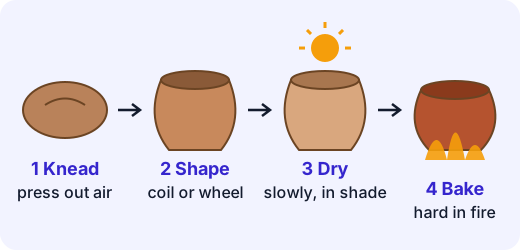
- Knead the clay to remove trapped air. Air pockets can expand when the pot is heated and crack or burst it.
- Shape it, either on a spinning wheel or by hand, using coils, pinching or slabs.
- Dry it slowly, out of direct sun. Clay shrinks as water leaves it, and if one side dries faster than another the pot warps or cracks.
- Bake (fire) it in a kiln or open fire until it is hard. Traditional terracotta is fired at moderate temperatures; the clay changes chemically and can no longer turn back to mud.
A person who makes pots is a potter (in Hindi, kumhar or kumbhar). Different regions have different clays, shapes and decorations: the black pottery of Manipur, the glazed blue pottery of Jaipur, the terracotta horses of Bengal and Tamil Nadu. In many places, clay pots are still used for cooking and storing water because the porous walls let water seep and evaporate, which cools the water inside.
Block printing
In block printing, a design is carved into a wooden block, dipped into dye or colour, and pressed onto cloth. Towns such as Sanganer and Bagru in Rajasthan are famous for it. In a technique called dabu from Bagru, a paste of clay, lime and gum is printed on the cloth first to resist the dye, then the cloth is dyed and the paste washed out, leaving a pattern.
Block printing teaches several ideas at once.
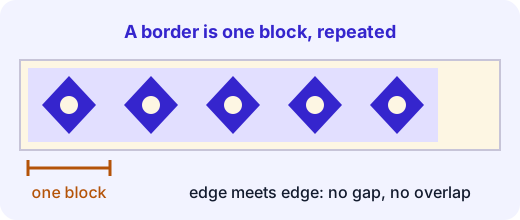
Repetition. One carved block can make a long border, because the printer lines each stamp against the edge of the previous one.
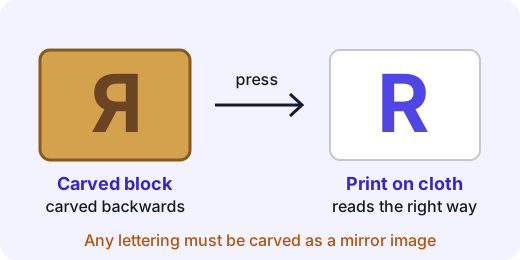
Mirror images. Pressing a block makes a flipped copy of what is carved. To print the letter R the right way round, the carver must cut it backwards.
Skill in the hand. A good printer presses with even pressure, so the colour is neither patchy nor smudged. That feel is learned from years of practice, not from a book.
Bamboo work
Bamboo is a giant grass, not a tree. It grows quickly, is hollow with strong joints, and can be split along its fibres into strips. Across the north-east of India, in Assam, Tripura, Manipur and other states, and in many parts of Asia, bamboo becomes baskets, mats, fishing traps, furniture and even houses. Weavers split the stems into slender strips, then weave them in patterns: over-under, twill or hexagonal. The strength comes both from the plant and from the way the strips are woven.
How crafts carry knowledge across generations
If you wanted to save a craft, you might think, "Write a manual." But much craft knowledge is tacit: you know it without being able to say it fully. How do you describe the exact feel of clay that is ready to shape? Crafts have other ways of carrying knowledge.
- Apprenticeship. The learner watches, then helps, then makes. First tasks are simple; hard ones come later.
- Tools. A carved block, a potter's wheel, a loom or a knife shape how the work is done, and they are passed on and improved.
- Patterns and motifs. A repeating design is a record that keeps its shape from one generation to the next.
- Stories and sayings. Proverbs and songs often carry tips for the work and rules for the workshop.
Misconception: "Traditional crafts never change." In fact, crafts change all the time. New colours, new tools and new customers have shaped every craft. What stays is the knowledge of how the material behaves. A craft is alive when people can still learn it and adapt it.
Researching a local craft
To research a craft, use several kinds of source.
- Ask a person. The best source is a maker: a potter, weaver, printer or basket maker in your town or family. Introduce yourself politely, explain why you are asking, and ask permission before taking photographs or recording.
- Watch. Notice the tools, the order of steps and what the maker does with their hands.
- Read and look. A library, a museum or a reliable website can tell you the history and the region.
- Compare. What is the same as in other places? What is different?
A useful set of questions:
Topic Example questions Materials What is it made from? Where do you get it? Steps What are the stages, in order? Which is hardest? Learning Who taught you? How long did it take? Design What do the patterns mean? Who chooses them? Today Who buys it? What has changed? What worries you? Write down what you hear in the maker's own words and thank them. Their time and knowledge are a gift.
Practising a small piece
Research is richer when you also use your own hands. You can try:
- a pinch pot from clay (a lump pressed into a bowl with the thumbs),
- a block print with a potato, rubber, or foam block, carved by an adult or with a safe tool, or
- a small woven mat from paper or palm-leaf strips.
You will quickly feel why the maker says "my fingers know". Your first piece will not be perfect, and that is part of the lesson.
Example. A learner presses a block 8 cm wide, with no gaps, six times in a row. The border is cm long. If she leaves a 1 cm gap between neighbouring prints instead, there are five gaps, and the length is cm. Counting the repeats and the gaps is how printers plan a pattern.
Why it matters
When a craft disappears, the objects are not the only thing lost: a whole way of understanding a material is lost with them. When a craft is learned, valued and paid for fairly, that knowledge keeps moving. Crafts carry knowledge across generations, and you can become one link in that chain.
Activity
Research and practise a craft
Pick one local craft, learn about it from a maker or a trustworthy source, and make a small piece yourself. Plan for about 90 minutes in total, over two or three sessions.
You'll need
- A maker to interview, or a library, museum or reliable website
- Notebook and pencil
- For a pinch pot - a lump of clay (air-dry or natural) about the size of an orange, a bowl of water, and a cloth
- For a block print - a potato or a thick rubber or foam block, washable paint or ink, a sheet of cloth or paper, a brush or sponge, and a pencil
- For paper weaving - strips of paper or thin cardboard, 20 cm long and 2 cm wide, 10 or more strips in two colours
Steps
- Choose a craft that exists near you, such as pottery, block printing, bamboo or cane work, weaving, wood carving or metalwork. Write one sentence on why you chose it.
- Research it. Find a maker, or ask an adult to help you contact one, or use a library book or a reliable website. Prepare at least five questions (materials, steps, learning, design, today). Ask permission before recording or taking photographs.
- Write what you learned under four headings: materials, steps (in order), who learns it and how, and what the designs mean.
- Practise a small piece. Pinch pot - roll the clay into a ball, press your thumb into the centre, then pinch and turn to thin the walls evenly, and smooth the rim. Block print - an adult cuts the shape (or you trace and carve a soft block with a safe tool); remember that letters must be carved backwards; press the block on paint, then print it five times edge to edge. Paper weaving - lay strips of one colour side by side, then weave strips of the other colour over and under.
- Look at your piece. What is uneven or too thick? What would a maker do differently? Try the piece again and note what improved.
- Write a short paragraph: how does this craft carry knowledge from one generation to the next? Include one thing you could only learn by doing.
- Thank the maker if you spoke to one, and share your piece and what you learned with someone at home.
Safety
- A grown-up does all cutting and carving with knives, craft blades or sharp tools. Learners use only safe, soft tools.
- Do not eat or taste clay or paint. Wash hands after using clay, paint or dye.
- Dry clay dust should not be breathed in, so wipe surfaces with a damp cloth instead of sweeping.
- If you visit a workshop, go with an adult, stay out of the way of kilns, fires and sharp tools, and follow the maker's instructions.
- Cover the table and wear old clothes for paint or dye.
Keeping a log of the activity is for registered learners. Register to do this.
Quick check
Craft heritage check
Eight questions about materials, techniques and how crafts pass on knowledge.
1.What kind of plant is bamboo?
- A tree with a wooden trunk
- A giant grass with a hollow, jointed stem
- A climbing vine
Choose one
2.Why does a potter knead the clay before shaping it?
- To change its colour
- To press out trapped air that could crack the pot when it is fired
- To make it harden faster
Choose one
3.Match each craft to the main material it works with.
- Pottery
- Block printing
- Bamboo work
Match each to: Clay hardened by heat · Strips split from a grass stem · A carved wooden block and dye
4.Put the stages of making a clay pot in order.
- Knead the clay
- Dry it slowly in shade
- Shape the pot
- Bake it in a fire or kiln
Put these in order
5.A block 8 cm wide is stamped 6 times in a row, edge to edge with no gaps. How long is the printed border, in centimetres?
Answer with a number
6.Which of these help a craft carry knowledge from one generation to the next?
- Apprenticeship: watching, helping, then making
- Patterns and motifs that are repeated and copied
- Tools such as carved blocks, passed on and improved
- Never letting anyone else watch
Choose all that apply
7.You want to learn how a local craft is really made. Which source is best to start with?
- Politely ask a maker, watch them work, and ask permission before recording
- Guess from a photograph
- Copy a paragraph from the internet
Choose one
8.What is a person who makes pots from clay called? (English, or the Hindi word)
Answer with a word or phrase
Answering and checking are for registered learners. Register to do this.
Quick check
New puzzles
Use what you know about crafts in situations the reading did not show.
1.A clay pot is 20 cm wide when freshly made. This clay shrinks by 10% of its width as it dries and bakes. How wide is the finished pot, in centimetres?
Answer with a number
2.A border uses 5 prints of a 12 cm block, with a 1 cm gap between neighbouring prints. How long is the border, in centimetres?
Answer with a number
3.A printer carves the word "BAG" on a block exactly as it reads, left to right and the right way round. What will she see on the cloth?
- BAG, the right way round
- A mirror image of BAG, reading backwards
- Nothing, because the block is the wrong shape
Choose one
4.A grandmother weaves a basket by feel and finds it hard to explain every step in words. A researcher writes a manual. Why will the manual alone not pass on the whole craft?
- Much craft knowledge is tacit, learned by doing with a teacher, so watching and practising also matter
- Manuals are never accurate
- Crafts cannot be learned by anyone outside the family
Choose one
Answering and checking are for registered learners. Register to do this.
Your turn
How a craft carries knowledge
Use the craft you researched and practised. Write your answers in your own words.
- Name the craft and describe its materials and its main steps in order.
- Explain how the knowledge of this craft is passed from one generation to the next. Give two examples from your research (for example, how people learn, the tools, or the designs).
- A classmate says, "Crafts are old-fashioned and should just be replaced by machines." Give a balanced reply. What do crafts hold that machines may not, and what changes might help a craft survive?
How it's judged
- Craft description
- Passing on knowledge
- Balanced reply
Writing and submitting your answer is for registered learners. Register to do this.
Like what you see?
Register for free to answer the quick checks, do the activities and save your work. Your work is saved on your device and syncs to your account.