Unit 5
Theatre and improvisation
Make scenes up on the spot by accepting your partner's ideas and building on them.
Read
Yes, and
Two actors walk onto an empty stage with no script. The audience calls out a prompt: "A lost tourist at a tea stall." The first actor mimes pouring a cup of chai and says, "Your usual, saab?" The second actor, who has never been to this stall in his life, has about one second to decide what to do.
He could say, "I have never been here before." That is honest, and it kills the scene. Or he could say, "My usual? You remember me from forty years ago?" Now there is a story: a mystery, a history, a joke waiting to happen. No one wrote it. Two people made it up, together, in seconds.
That skill is improvisation: inventing a scene on the spot, with no script. It looks like magic. It is actually a handful of simple habits that anyone can learn.
What is an offer?
In improvisation, an offer is anything a performer adds to the scene: a name, a place, an object, a feeling, an action, a fact. Each of these is an offer:
- "Good morning, Grandmother." (a relationship)
- Pretending to carry a very heavy tray. (an object and an action)
- "It is freezing in this cave!" (a place and a feeling)
Every offer is a small gift to your partner. The scene is made out of offers, nothing else.
To accept an offer means treating it as true inside the scene and responding to it. The idea that makes improvisation work can be put in one sentence:
Improvisation means accepting and building on offers.
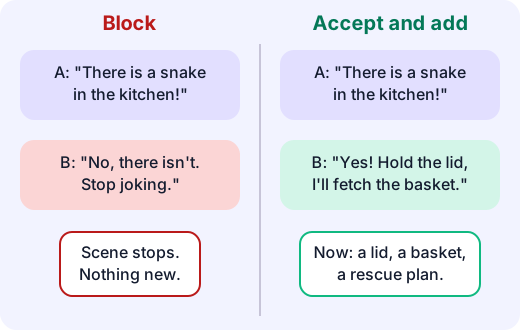
A well-known short form of this is "Yes, and". Yes means "I accept what you gave me." And means "and here is something new I add." You do not have to say those words aloud. It is a way of thinking.
Blocking and its cousins
If accepting builds a scene, then blocking is the opposite: refusing or cancelling what your partner offered.
Partner's offer Response What happens "Doctor, my feet have turned blue." "I'm not a doctor." Blocks. The scene stops. "Doctor, my feet have turned blue." "Yes." (and nothing else) Accepts but adds nothing. The partner must do all the work. "Doctor, my feet have turned blue." "Blue? Did you walk through the paint shop again?" Accepts and builds. Now there is a doctor, a patient, a history. Misconception: "Accepting means always agreeing." No. Accepting means treating the offer as true in the scene, not agreeing with your character's wishes. If your partner says, "Give me the key," you can answer, "No, I won't!" That is a great scene: the key exists, the partner wants it, and you are in conflict. What would block is saying, "What key? There is no key." The first reply respects the offer; the second deletes it.
Setting up a scene: who, where, what
New scenes often wobble because nobody knows what is going on. Good improvisers quickly establish three anchors, sometimes called the three Ws.
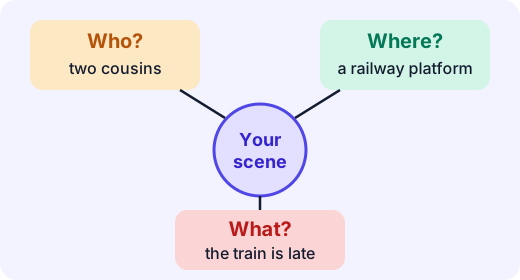
- Who are we? (cousins, a shopkeeper and customer, a queen and her minister)
- Where are we? (a railway platform, a roof during a monsoon, a school bus)
- What are we doing, or what is the problem? (waiting for a late train, hiding a broken vase)
Try to establish them in the first few lines, by showing rather than lecturing. "Cousin, I told you we should have left home earlier!" gives who (cousins) and a problem (late) in one sentence. You can also give your partner a name or relationship at once: it is the most generous offer of all.
Building the scene
Once the anchors are in place, the scene grows by a repeating pattern:
- Notice the offer.
- Accept it fully: react as the character would.
- Add one new thing: a detail, a feeling, a wish, an obstacle.
- Listen to your partner's addition and go back to step 1.
Adding one thing, not ten, matters. If you flood the scene with ideas, your partner has no room to build. If you add nothing, you leave all the work to them.
Example. Prompt: "A school bus breaks down."
- A: (miming the steering wheel) "Everyone stay calm, children!" (offer: A is the driver; the children exist)
- B: "Sir, there's smoke from the engine, and the goat is sneezing." (accepts A is the driver; adds smoke and a goat)
- A: "A goat? Who let a goat on my bus?" (accepts the goat; adds a question that raises the stakes)
- B: "It's the headmaster's goat, sir. He said you would know why." (accepts; adds a secret)
Within four lines there are a driver, a goat, a headmaster and a secret. Nobody planned any of it.
Scenes need endings
An improvised scene does not run forever. Good scenes often end when:
- the problem is solved or gets worse in a funny or surprising way,
- someone returns to an early offer (the sneezing goat comes back at the end), or
- a partner calls "scene" or both freeze in a pose.
Returning to an earlier detail is a favourite trick because it makes the scene feel planned.
Working with a group
With three or more people, the same rules apply, plus a few more.
- Share the stage. Do not take every line. Give the others a chance to add.
- Support, don't compete. The aim is not to be the funniest, but to make the scene better and your partners look good.
- Be kind. Nothing hurtful or humiliating about real people in the room. Keep it safe, and respect anyone who says they would rather not do a particular scene.
Improvisation goes back a long way. Traditional storytellers, street theatre groups and festival performers across India have always adapted to an audience in the moment. In the twentieth century, teachers such as Viola Spolin in America and Keith Johnstone in Britain and Canada wrote down exercises and rules (like accepting offers) so that anyone could learn them.
Common slips and their fixes
Slip Why it hurts Fix Planning your next line while your partner speaks You stop listening and miss the offer Listen first; react from what you heard Asking many questions ("Who are you? Where are we?") It puts all the work on your partner Make a statement: "Grandfather, this is our village!" Denying what is already established The audience loses the thread Treat all earlier details as true Being "funny" at the expense of the scene Jokes that break the world break the scene Be truthful as the character; the humour follows Try it yourself
Try it: With a partner, spend two minutes in a scene that begins with one person miming something they are carrying. The other must (1) accept it, (2) add one new fact. After each line, add only one thing. Stop when you reach eight lines. Count how many facts were added.
Improvisation is a training in listening. The more attentively you accept what is offered, the more there is to build on.
Activity
Three improvised scenes
Work with at least one partner (a family member, friend or classmate) to improvise three short scenes from prompts, then reflect on what made each scene grow. About 30 minutes. If you are alone, use the solo option in step 6.
You'll need
- At least one partner (two or three is better)
- A clear space for moving about
- A timer or clock (for the facilitator, not to rush anyone)
- Slips of paper with prompts (see step 1)
- Pencil and paper for notes
Steps
- Write six prompts on slips of paper, such as: a lost tourist at a tea stall; a broken lift; a surprise birthday that is not a surprise; a school bus that will not start; a market during a power cut; a museum guard who hears a noise. Fold them and put them in a bowl.
- Warm-up (3 minutes): stand in a circle or facing each other. One person says one sentence of a made-up story; the next begins with 'Yes, and' and adds one sentence. Do ten rounds.
- Scene one (about 2 minutes): pick a prompt. Before starting, agree the three Ws (who, where, what) in 20 seconds. Begin the scene. Each line must accept the previous one and add one new thing.
- After the scene, talk for 2 minutes: Which line made the scene grow? Was there a moment someone blocked an offer? What did you notice about the first three lines?
- Scene two: choose a new prompt and do not agree anything beforehand. Establish the who, where and what through the first lines only. Try to return to one early detail near the end.
- Scene three: a group scene if you have three people, otherwise another pair scene, with a rule: every person must make an offer in the first four lines. Solo option: speak both parts of a short dialogue aloud (for example, a shopkeeper and a customer), switching positions each line, and write down the offers you notice.
- Finish by listing on paper: three offers that were accepted well, one block, and one thing you will try next time.
Safety
- Agree before you start that nobody has to do a scene they are uncomfortable with.
- No pushing, hitting or physical contact in scenes. Mime everything, and keep to the space.
- Keep scenes kind. No mocking real people, appearances or families.
- Clear the floor of trip hazards, especially if you move around or climb on mimed objects.
Keeping a log of the activity is for registered learners. Register to do this.
Quick check
Improvisation check
Eight questions about offers, blocking and building scenes.
1.Your partner suddenly says, "Quick, the bridge is cracking under us!" Which reply accepts the offer and builds on it?
- No, the bridge is perfectly fine.
- Grab the rope! I'll hold the cart while you cross.
- Let's talk about what we are having for lunch.
Choose one
2.In improvisation, what does "Yes, and" mean?
- Always agree with everything your partner wants
- Accept what your partner offered as true in the scene, and add something new
- Repeat your partner's line twice
Choose one
3.Which of these are offers?
- Calling your partner "Grandmother"
- Miming a very heavy suitcase
- Saying, "It is freezing in this cave!"
- A great idea you think of but never show or say
Choose all that apply
4.Match each reply to what it does to the partner's offer, "Doctor, my feet have turned blue."
- "I'm not a doctor."
- "Yes."
- "Blue? Did you walk through the paint shop again?"
Match each to: Accepts and builds · Blocks the offer · Accepts but adds nothing
5.Five friends sit in a circle and build a story, one sentence each, each sentence adding exactly one new fact. They go round the circle 3 times. How many facts have been added?
Answer with a number
6.Put these in the order a pair of improvisers usually follows when building a scene.
- Accept it and react as the character would
- Return to an early detail to end the scene
- Notice what your partner offered
- Add one new detail
- Listen to your partner's next addition
Put these in order
7.Your partner says, "Give me the key." You answer, "No, I won't!" Is this blocking?
- Yes, because you said no
- No. The key exists and you have a reason to refuse, so the scene has conflict
- Yes, because a scene cannot have disagreement
Choose one
8.What is the word for anything a performer adds to a scene, such as a name, a place or an object?
Answer with a word or phrase
Answering and checking are for registered learners. Register to do this.
Quick check
New puzzles
Use what you know about offers in scenes the reading did not show.
1.Your character is Ravi. Your partner calls you "Raju" by mistake. Which reply uses the slip as an offer?
- "My name is Ravi, not Raju. Get it right!"
- "Raju is my stage name. Only my closest friends know it. How did you find out?"
- Stop the scene and start again.
Choose one
2.You planned a scene in which you are a king. Your partner starts with, "Happy birthday, Grandpa!" What is the best first line?
- "I am not Grandpa. I am the king of this land!"
- "Thank you, dear! Eighty years old today, and still I can climb a mango tree."
- Say nothing and wait
Choose one
3.In an opening line, "Grandfather, this is our village well, and it has dried up again," how many of the three Ws (who, where, what) are clearly established?
Answer with a number
4.Which opening line gives the most helpful offer to a partner?
- "Who are you and where are we?"
- "Grandfather, this is the village well, and it has dried up again."
- "Hello."
Choose one
Answering and checking are for registered learners. Register to do this.
Your turn
Explain accepting offers
Think about the scenes you improvised, or one you have watched, and write your answers in your own words.
- Describe one moment where an offer was accepted and built on. Write the two or three lines of dialogue and say what each line added.
- Write the same moment again, but with the second speaker blocking. Explain why the scene stops.
- A classmate says, "If I accept every offer I have to agree with everything." Explain why this is not true, with an example of a scene that has conflict.
How it's judged
- Accepting and building
- Understanding blocking
- Accepting is not agreeing
Writing and submitting your answer is for registered learners. Register to do this.
Like what you see?
Register for free to answer the quick checks, do the activities and save your work. Your work is saved on your device and syncs to your account.