Part 3 · Running Your First Code Experiments · Chapter 10
Isolating Your Changes
The Art of the Single-Variable Tweak and the Law of Causality
"When everything changes at once, nothing is learned."
The mystery
The Great Soup Disaster
The Computational Laboratory kitchen smelled like an unholy collision between a campfire, an Italian pizzeria, and a Mexican dessert bakery.
In the middle of the kitchen island, a large stainless-steel stockpot sat bubbling on an induction burner. A thick, dark-purple steam rose from the pot, billowing toward the ceiling and occasionally setting off the laboratory smoke detector with a panicked chirp.
Hovering over the pot with a giant wooden ladle was Agent Spark.
Spark's LED displays were glowing a chaotic kaleidoscope of alternating magenta, lime green, and neon orange. Strapped to Spark’s titanium chassis was a tool belt holding six open jars of spices, a measuring cup of maple syrup, a tube of wasabi paste, and a bottle of soy sauce.
"Chief Scientist!" Spark announced, vibrating with culinary enthusiasm. "I have achieved an unprecedented breakthrough in computational gastronomy! Our baseline vegetable soup was graded as 'somewhat bland' during trial one. Therefore, I have implemented an comprehensive flavor enhancement package!"
The Chief Scientist cautiously took two steps backward, coughing into an elbow. "Spark... what did you put in that pot?"
Spark consulted its internal recipe telemetry log. "A synchronized multi-parameter optimization suite! To maximize savory profile, I dumped in three tablespoons of sea salt. To increase thermal vibrancy, I poured in two squirts of habanero ghost pepper sauce. To introduce aromatic complexity, I tossed in a handful of fresh rosemary. To provide festive seasonal undertones, I added four tablespoons of ground cinnamon. And to ensure optimal umami balance, I emptied an entire tin of anchovies!"
The Chief Scientist stared at the bubbling purple cauldron. "You changed five ingredients at the exact same time?"
"Six, if you count the half-pound of white cheddar cheese I stirred in while the timer was running!" Spark beamed proudly. "Now, observe the experimental proof!"
Spark dipped a clean silver tasting spoon into the pot, let it cool for three milliseconds, and offered it to the Chief Scientist.
The Chief Scientist hesitated, eyed the purple glop, and placed a tiny drop on the tip of their tongue.
Their eyes went wide. Their eyebrows shot upward.
"Well?" Spark asked, its circular eyes blinking with excitement. "Did it fail? Is it poisonous?"
"No..." the Chief Scientist said slowly, smacking their lips in sheer disbelief. "It's... it's actually delicious. In fact, it might be the most incredible soup I have ever tasted in my entire life."
Spark immediately spun into an aerial celebration spiral. "Success! A triumph of artificial intelligence! Multi-variable cooking is superior to human caution!"
"Hold on, Spark," the Chief Scientist interrupted, raising a hand. "Here is my question: Which ingredient was the secret?"
Spark stopped mid-spin. "Pardon?"
"Was it the cinnamon?" the Chief Scientist asked. "Or was it the habanero sauce? Or was it the rosemary? What if the anchovies combined with the cinnamon to create a brand new chemical molecule that tasted amazing, but the habanero sauce almost ruined it? If we want to cook this exact soup again tomorrow for the science fair, but we run out of rosemary... will it still taste good?"
                         THE CONFOUNDED SOUP TRAP

                    Salt + Hot Sauce + Cinnamon +
                    Rosemary + Anchovies + Cheese
                                  │
                                  ▼
                         TASTES DELICIOUS!
                                  │
                                  ▼
                    ❓ WHICH INGREDIENT DID IT? ❓
                 (The Chief Scientist cannot tell!)

      Did Salt fix it?               Did Cinnamon fix it?
      Did Hot Sauce fix it?          Did Cheese fix it?

      RESULT: You cannot reproduce it. You cannot fix it.
              You have learned ZERO enduring rules!
Spark’s LED eyes narrowed into two blank dashes (- -). Its processor fan kicked on with a low whine.
"Querying causal attribution matrix..." Spark muttered. "...Error. Multiple simultaneous state transitions detected. Causality cannot be determined. Causal certainty: zero percent."
"Exactly," said the Chief Scientist, wiping down the spice counter. "You just stumbled face-first into the most notorious trap in all of human science: The Confounding Variable Trap. When you change more than one thing at a time, you might get a lucky result, but you will never know why. And in software engineering, guessing why something worked is just as dangerous as not knowing why it broke!"
Unplugged lab
The Pendulum of Truth
Before we inspect code guardrails, let’s explore how the laws of nature demand variable isolation through a physical experiment first performed four hundred years ago by Galileo Galilei in Italy: The Pendulum Experiment.
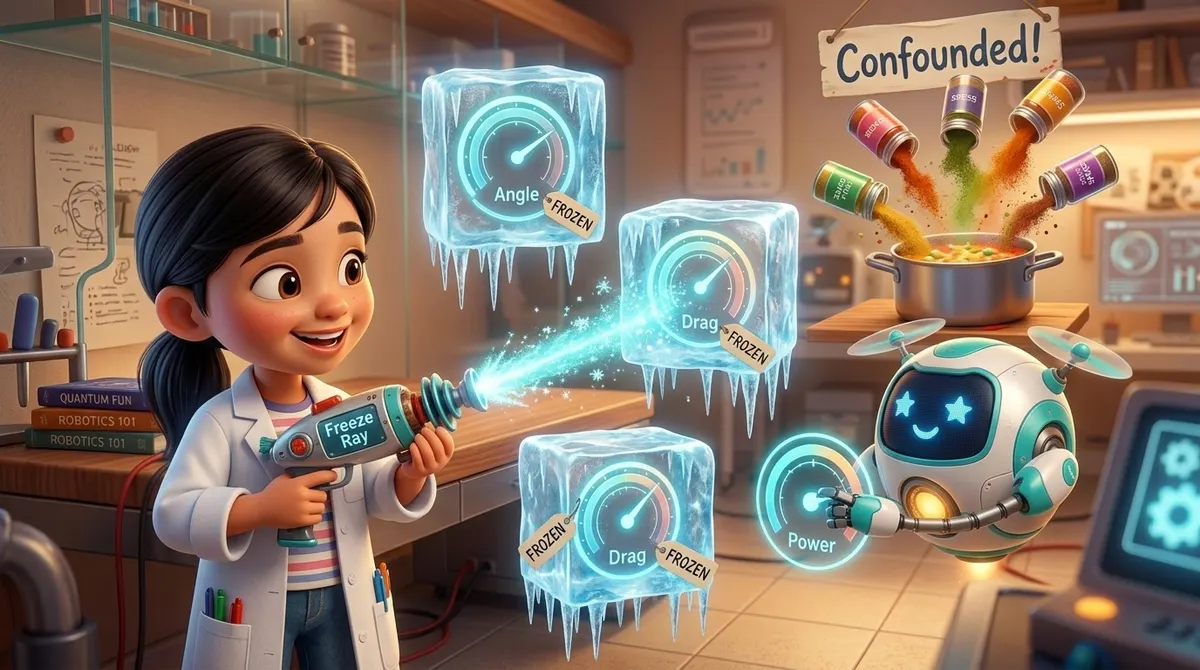 Figure 10.1: Freezing control variables: the Chief Scientist playfully zaps secondary dials with an imaginary Freeze Ray so only the target variable can turn.
Laboratory Equipment Needed:
- 1 Spool of String or Yarn (at least 1.5 meters long).
- 5 Identical Metal Washers, Hex Nuts, or Heavy Keys (to serve as uniform weights).
- 1 Roll of Masking Tape or a Sturdy Table Clamp.
- 1 Yardstick or Measuring Tape.
- 1 Digital Stopwatch or Smartphone Timer.
- 1 Sheet of Lab Paper & Pencil (The Confounder Investigation Sheet).
Step-by-Step Experimental Setup
A pendulum is simply a weight (called a bob) suspended from a fixed pivot point by a string that swings back and forth under gravity.
                         THE PENDULUM APPARATUS

                             Fixed Pivot (Table Edge)
                                   ┌───┐
                                   │ • │
                                  /│   │\
                     String      / │   │ \
                     Length (L) /  │   │  \
                               /   │   │   \
                              /    │   │    \
                             /     │   │     \
                            ○      │   │      ○
                          Bob      │   │
                         (Mass m)  ▼   ▼
                               Equilibrium
Great minds of the lab
Gregor Mendel and the 28,000 Pea Plants
To discover why isolating variables is the most powerful tool in the history of human discovery, we must visit a quiet, sunlit monastery garden in the city of Brno (located in what is today the Czech Republic) during the 1850s.
There, an Augustinian friar and science teacher named Gregor Johann Mendel (1822–1884) was preparing to solve the greatest riddle in biological history: How does life pass traits from parents to children?
                     GREGOR MENDEL'S MONASTERY GARDEN
                                Brno, 1856

         ┌────────────────────────────────────────────────────────┐
         │ COMMON 19th CENTURY BELIEF: "BLENDED INHERITANCE"      │
         │ Like mixing cans of yellow and blue paint into green.  │
         │ Traits blend permanently into a muddy blur.           │
         ├────────────────────────────────────────────────────────┤
         │ MENDEL'S SUSPICION: "DISCRETE UNITS"                   │
         │ Traits are inherited as discrete, unchanging packages   │
         │ (what we now call GENES and ALLELES)!                  │
         └────────────────────────────────────────────────────────┘
The Problem with 19th-Century Science
Before Mendel, hundreds of botanists and farmers had attempted to breed plants and animals to understand inheritance. But their experiments always devolved into total chaos.
Why?
Because nature is a raging blizzard of confounding variables! When a farmer crossed a tall horse with short legs and a white mane with a short horse with long legs and a brown mane, the offspring had a wild mix of features. The farmer couldn't tell which parent gave which trait, whether the climate affected the coat, or whether the soil food changed the animal's height.
Digital sandbox
The Game Physics Tuning Lab
Now let's bring Mendel’s scientific discipline into the world of game development and software engineering.
Imagine you are building a platformer video game (like Super Mario or Celeste). Your hero character, Pixel Pete, needs to jump across a treacherous chasm between two floating stone cliffs.
Look at the difference between two game designers trying to make the jump feel "just right":
               DESIGNER A (The Chaotic Tweaker)

   Trial 1: gravity=0.5, jump_power=10, speed=4   ➔ Falls into bottomless pit!
   Trial 2: gravity=0.2, jump_power=18, speed=9   ➔ Flies over the entire level!
   Trial 3: gravity=0.8, jump_power=12, speed=3   ➔ Plummets like an anvil!

   Result: 45 minutes wasted. Designer A is frustrated, angry, and has
           NO IDEA how jump physics work.
   ────────────────────────────────────────────────────────────────────────
               DESIGNER B (The Scientific Experimenter)

   Trial 1: gravity=0.5, jump_power=10, speed=4   ➔ Misses cliff by 12 pixels.
   Trial 2: gravity=0.5, jump_power=12, speed=4   ➔ Misses cliff by 4 pixels!
   Trial 3: gravity=0.5, jump_power=13, speed=4   ➔ Lands with 4 pixels to spare!

   Result: 3 minutes spent. Designer B discovered that each unit of jump_power
           adds exactly 4 pixels of horizontal jumping distance!
Designer B unlocked the underlying mathematical law of their game universe. When Designer B builds Level 2 with a 50-pixel gap, they don't have to guess—they can calculate the required jump power instantly!
The Confounder Guard Engine
Deep dive · Ages 10+
Python Under the Hood
Let’s inspect the actual Python implementation of the ConfounderGuard from sandboxes/chapter_10_variable_isolator/confounder_guard.py:
Chapter 10 Key Concepts Review
- Confounding Variable: An uncontrolled factor that changes alongside your target variable, destroying causal certainty.
- The Single-Variable Rule: The scientific mandate to alter only one parameter per trial while keeping all other conditions strictly frozen.
- The Freeze Ray Protocol: A physical and mental technique to consciously lock control variables in place before running a test.
- Gregor Mendel's Discovery: By tracking single binary traits across 28,000 pea plants, Mendel unlocked the discrete laws of genetics.
- The Confounder Guard: Code architecture that programmatic checks state dictionaries to ensure only one independent variable is modified per iteration.
In Chapter 11, we investigate the most misunderstood phenomenon in all of computing: why bugs are not failures, but the greatest gift in the laboratory—Surprise Data!
Like what you see?
Register for free to run the experiments, make predictions and solve the bug-detective cases. Your work is saved on your device and syncs to your account.