"The important thing is not to stop questioning. Curiosity has its own reason for existence."
— Albert Einstein
The mystery
The Mysterious Red Button
The room smelled faintly of ozone, warm copper wire, and freshly popped corn.
In the center of the wooden workbench sat an unassuming, matte-black aluminum chassis no larger than a shoebox. It had no power cord, no brand label, and no digital screen. It had only one feature: right in the center of its top plate sat an enormous, domed, candy-apple-red button. It glowed with a rhythmic, pulsing luminescence, exactly like a beating heart.
Bolted directly above the button was a stamped steel sign with embossed lettering:
┌───────────────────────────────────────────────┐
│                   D A N G E R                 │
│              DO NOT PRESS BUTTON              │
│       UNDER ANY CIRCUMSTANCES WHATSOEVER      │
└───────────────────────────────────────────────┘
You are standing in front of this console in your fresh white lab coat. As the newly designated Chief Scientist, you have spent precisely four seconds reading the sign.
What is the very first thought that rockets through your mind?
Be completely honest. You are not thinking about following the warning. You are not thinking about walking away to find an adult or checking the instruction manual. Your brain is generating three electrifying words that have driven every scientific breakthrough since human beings first rubbed two dry twigs together:
"What happens if...?"
What if I tap it with the eraser end of a pencil? What if I hold it down for exactly seven seconds? What if it launches a confetti cannon through the skylight? What if it switches off Earth's gravity inside this room and sends us floating into the rafters like party balloons?
That whisper is not disobedience. That whisper is curiosity—the fundamental engine of human intellect.
Before you can stretch your index finger forward, a high-pitched mechanical chirp echoes across the lab bench. A soft golden orb of light flares into existence three inches above the console. With a whir of miniature gyroscopes, a floating robotic sphere roughly the size of a grapefruit drifts into view.
Its casing is spun aeronautical aluminum with a polished glass faceplate. Behind the glass, two radiant cobalt-blue LED rings serve as eyes. A tiny brass propeller spins lazily on top of its head, and a retractable sensory antenna twitches like the whisker of an inquisitive mechanical kitten.
This is Agent Spark—your autonomous computational co-researcher.
Figure 1.1: A retro-futuristic laboratory console with a glowing red button that incites the eternal scientific question: "What if...?"
Agent Spark's LED eyes suddenly snap into two sharp, vertical yellow slits. A miniature warning siren sounds from its speaker grill: WHOOP! WHOOP!
Agent Spark:(voice crisp, cheerful, and unmistakably digital) "Halt, Chief Scientist! Proximity telemetry indicates human finger trajectory at vector [X: 12.4, Y: 4.8, Z: -1.2], closing rapidly upon Red Button surface! Danger! Stamped signage expressly forbids mechanical actuation!" Chief Scientist: "Relax, Spark! I'm just curious. Don't you want to know what it does?" Agent Spark:(LED eyes flicking into two bright blue question marks: ? ?) "Define 'want.' My neural logic gates possess 128 gigabytes of sensory registers, four optical spectrometers, and the ability to compute trajectory equations in 0.0004 milliseconds. However, I have zero curiosity registers! I do not wonder. I do not daydream. I merely execute instructions." Chief Scientist: "Zero curiosity? That sounds boring. If you don't wonder what happens next, how do you discover anything new?" Agent Spark:(hovering down to eye level, LEDs flashing thoughtful violet) "Discovery requires an inciting hypothesis. Left to myself, I would record the button's ambient temperature (21.4°C), log its luminous pulse frequency (1.2 Hertz), and stand guard until the year 3045 without ever asking 'What if?' Chief Scientist, my processors have lightning speed, but you possess the spark of imagination! Without your curiosity, my computational power is just an expensive desk lamp!" Chief Scientist: "So I provide the questions, and you provide the tools to test them?" Agent Spark:(spinning a full 360-degree aerial flip with a delighted mechanical trill, eyes snapping into glowing stars: ★ ★) "Affirmative! A perfect symbiosis! You are the visionary navigator; I am the engine room. Let us initiate Protocol Alpha: Transforming curiosity into systematic investigation!"
Unplugged lab
The Reverse-Engineering Scavenger Hunt
Before we write a single line of Python or touch a computer keyboard, we must master the craft of looking beneath the surface of the physical world.
Most people walk through life as Passive Consumers. When a consumer interacts with technology—whether it is a mechanical ballpoint pen, an automatic grocery store sliding door, or a smartphone video game—they accept the object as magic.
       PASSIVE CONSUMER                        ACTIVE CHIEF SCIENTIST
  ┌─────────────────────────┐               ┌─────────────────────────┐
  │  Taps the screen.       │               │  Asks: "What hidden     │
  │  Accepts the outcome.   │     ───►      │  mechanism produces     │
  │  Says: "It just works." │               │  this exact behavior?"  │
  └─────────────────────────┘               └─────────────────────────┘
When a Chief Scientist looks at an object, they see an algorithm frozen in physical form. Every machine, spring, and latch is running a program written in physics!
Lab Setup & Materials Checklist
To conduct this unplugged laboratory, search your home or classroom laboratory for the following items:
1 Retractable Click-Pen (the type with a spring inside that clicks to extend the ballpoint tip).
1 Spring-Loaded Clothespin or a standard household toaster (ensure the toaster is unplugged from the wall outlet!).
1 Flashlight with a push-button or twist switch.
Your Lab Notebook and a pencil.
Great minds of the lab
Ada Lovelace and the Magic Loom
Long before silicon microchips, glowing monitors, or smartphone touchscreens existed, a brilliant English visionary dared to ask the greatest "What if?" question in computational history.
Her name was Augusta Ada King, Countess of Lovelace (1815–1852)—known to history as Ada Lovelace.
Ada was the daughter of the famous romantic poet Lord Byron and mathematician Anne Isabella Milbanke. Her mother was determined that Ada should not inherit her father's unpredictable, brooding temperament, and immersed young Ada in an intensive daily study of mathematics, geometry, astronomy, and science.
Ada did not find mathematics dry or cold. She called her philosophy "poetical science." She believed that numbers and logic were not cold calculations, but the hidden brushstrokes with which the universe was painted.
At age twelve, Ada became obsessed with mechanical flight. Instead of merely daydreaming about birds, she approached the challenge like a true Chief Scientist:
She studied the anatomy of bird wings, measuring the ratio of bone weight to feather span.
She examined lightweight materials: paper, silk, and wire.
Digital sandbox
The Rule-Flipper Laboratory
Now we bridge the gap between Ada's brass punch cards and modern computational laboratories.
In our companion digital environment, Agent Spark hosts a virtual test arena called the Rule-Flipper Sandbox. Imagine an enclosed digital terrarium displayed on your screen. Inside this terrarium lives a simulated bouncy soccer ball named Widget.
Mapping Physical Rules to Code Dials
In the physical world, things behave the way they do because fundamental physical constants are fixed:
Earth's surface gravity pulls everything downward at approximately 9.8 m/s2.
Air friction slowly drags against flying objects.
Rubber balls deform upon striking concrete, bouncing back with approximately 75% of their impact energy.
In a computer simulation, none of these laws are permanent! They are simply variables—digital control dials that the Chief Scientist can rotate with a single keystroke.
Deep dive · Ages 10+
Python Under the Hood
How does Agent Spark actually execute the 5-Step Scientific Loop in clean, professional Python code?
Let us inspect the Python laboratory engine that runs our experiments. This script uses standard Python dataclasses and functions to model the exact relationship between hypotheses, physical simulations, and telemetry logging.
The Scientific Experiment Harness (scientific_loop_engine.py)
Like what you see?
Register for free to run the experiments, make predictions and solve the bug-detective cases. Your work is saved on your device and syncs to your account.
Every scientific investigation in this book—whether on a kitchen table or inside a supercomputer simulation—follows the 5-Step Scientific Loop:
                  ┌───────────────────────────────┐
                  │ 1. Formulate Hypothesis       │
                  │    (The "What If?" Question)  │
                  └──────────────┬────────────────┘
                                 │
                                 ▼
                  ┌───────────────────────────────┐
                  │ 2. Variable Control           │
                  │    (Change ONLY ONE thing)    │
                  └──────────────┬────────────────┘
                                 │
                                 ▼
                  ┌───────────────────────────────┐
                  │ 3. Execute Experiment         │
                  │    (Run physical trial / code)│
                  └──────────────┬────────────────┘
                                 │
                                 ▼
                  ┌───────────────────────────────┐
                  │ 4. Observe & Log Data         │
                  │    (Record telemetry honestly)│
                  └──────────────┬────────────────┘
                                 │
                                 ▼
                  ┌───────────────────────────────┐
                  │ 5. Iterate & Refine           │
                  │    (Formulate next question)  │
                  └──────────────┬────────────────┘
                                 │
                                 └────► [Loop Back to Step 1]
Protocol: Dissecting the Click-Pen Mechanism
Take your retractable ballpoint click-pen. Do not break it! Carefully unscrew the barrel in the middle.
Step 1: Inventory the Parts. Lay the components on your desk in a straight line:
The lower barrel tip.
The tiny helical wire spring.
The central ink cartridge.
The notched cam rotor (the small white plastic piece with zigzag teeth).
The upper plunger button.
Step 2: Trace the Physical Rules.
Compress the spring between your fingertips. Notice how it stores mechanical energy (pushing back against your fingers).
Look closely at the notched plastic rotor. Notice the diagonal ramps. When you press the plunger, the rotor slides down a ramp, twists 45 degrees, and locks into a shallow groove. When you press it again, it hops into a deep groove and retracts!
Step 3: The "What If?" Intervention.
What happens if you reassemble the pen without the spring?
Formulate your prediction in your notebook: If I remove the spring, the pen plunger will fail to lock/retract because the mechanism needs an opposing counter-force to push the plastic rotor into its locking tooth.
Step 4: Execute & Observe.
Assemble the pen without the spring. Press the button.
What happens? The ink cartridge simply flops back and forth! The clicker no longer clicks. The lock fails.
Step 5: The Diagnostic Conclusion.
The spring was not just an extra accessory; it was the clock cycle of the pen! It provided the continuous upward tension required for the mechanical logic gate (the notched cam) to function.
Unplugged Scavenger Hunt Logsheet
Now explore your laboratory and complete the investigation table below:
Physical Object
Default Observable Behavior
The Chief Scientist's "What If?" Intervention
Predicted System Reaction
Actual Observed Telemetry
Ballpoint Pen
Clicks out and stays locked; clicks again to retract.
Remove the internal coil spring completely.
Tip will fall out loose; click mechanism will fail to lock.
Ink cartridge slid freely; zero locking occurred.
Flashlight Switch
Slide switch forward to close circuit and emit light.
Place a square of paper between the battery and metal spring.
Bulb will stay dark because paper is an electrical insulator.
Bulb failed to illuminate; circuit remained open.
Toaster Lever
Depress lever; carriage locks at bottom and heats coils.
Depress lever while toaster power cord is unplugged from the wall.
Will the carriage latch mechanically, or does it need electromagnetism?
(Test your own toaster! Does it stay down or pop back up?)
Your Item: ________________
___________________________
_____________________________________________
_________________________
_________________________
[!TIP]
For Young Explorers (Ages 5–7): Try a classic door hinge! Look at a door in your room. What if the door handle was installed right next to the hinges instead of on the far edge? Try pushing the door open by pressing right next to the hinge pin. Is it easy or impossibly hard? (You just discovered torque and mechanical advantage!)
She wrote a complete illustrated scientific monograph titled Flyology, proposing a steam-powered flying machine decades before the Wright brothers took off at Kitty Hawk!
Meeting the Difference Engine
In June 1833, seventeen-year-old Ada attended a London gathering where inventor Charles Babbage demonstrated a working prototype of a colossal calculating machine he called the Difference Engine. The brass device stood several feet high, bristling with interlocking gearwheels, rotating dials, and stamped steel levers designed to compute mathematical tables automatically.
While most London spectators viewed the machine as an amusing mechanical oddity, Ada was mesmerized. She saw past the gleaming brass.
Babbage soon conceived of an even grander machine: the Analytical Engine. Unlike earlier calculators that could only perform one hardwired task, the Analytical Engine was designed to be general-purpose. It would have:
The Store: A memory unit to hold 1,000 numbers of 50 digits each.
The Mill: An arithmetic unit to execute addition, subtraction, multiplication, and division.
Punch-Card Input: A system borrowed from the French weaver Joseph Marie Jacquard.
The Breakthrough: The Silk Loom Metaphor
In 1804, Jacquard had revolutionized textile manufacturing with an automatic loom that read patterns from thick pasteboard cards punched with arrays of rectangular holes. Where a hole existed, a mechanical rod passed through, lifting a specific warp thread of silk. Where the card was solid, the thread remained down. By stringing chains of punched cards together, the loom automatically wove breathtakingly intricate tapestries of flowers, portraits, and landscapes.
Charles Babbage viewed the punch cards merely as a practical way to feed numbers into the Analytical Engine without human error.
Ada Lovelace looked at the cards and asked the transformative "What if?" question that birthed the information age:
"What if numbers do not just represent quantities of apples, coins, or measurements? What if numbers could represent symbols, letters of the alphabet, or musical notes?"
Ada realized that if a machine could manipulate symbols according to logical rules, its power would not be limited to arithmetic:
"The Analytical Engine weaves algebraic patterns just as the Jacquard loom weaves flowers and leaves."
— Ada Lovelace, Notes on the Analytical Engine (1843)
                     HOW ADA TRANSLATED IDEAS INTO ALGORITHMS
   ┌──────────────────┐       ┌────────────────────┐       ┌─────────────────┐
   │ Physical World   │  ──►  │ Mathematical Logic │  ──►  │ Machine State   │
   │ "A Musical Note" │       │ Pitch = Frequency  │       │ Punch card hole │
   │                  │       │ Duration = Beats   │       │ turns cog N deg │
   └──────────────────┘       └────────────────────┘       └─────────────────┘
Ada understood that if music rules could be expressed as mathematical relationships, the Engine could compose elaborate, scientific pieces of music of any degree of complexity. In Note G of her 1843 publication, she published a step-by-step procedure for the machine to calculate Bernoulli numbers—complete with loop structures, variable registers, and conditional branching.
She had written the world's first computer program, earning her the permanent title of history's first software engineer.
Agent Spark operates according to two strict programming tenets:
Hyper-Literal Execution: Agent Spark will never say, "I know what you meant." If you configure gravity = 0, Agent Spark will not pull Widget toward the floor because it assumes you made a mistake. Widget will float in place forever.
Telemetry Without Judgment: Agent Spark does not label a simulation result "good" or "bad." If Widget flies off the top edge of the screen at ten million miles an hour, Agent Spark calmly reports: Widget velocity: +10,000,000 px/sec. Viewport boundary breached.
As Chief Scientist, you are in command of the parameters. Let us formulate our first series of rigorous digital trials.
#!/usr/bin/env python3
"""
Scientific Loop Engine - Chapter 1
Author: Dileep Pandey (with Chief Scientist & Agent Spark)
Description: A rigorous programmatic implementation of the 5-Step Scientific Loop.
"""

from dataclasses import dataclass
from typing import Callable, Any, List, Optional
import time

@dataclass
class TelemetryLog:
    """Stores the empirical measurements of a single experimental trial."""
    trial_id: int
    parameter_tested: str
    parameter_value: float
    hypothesis_statement: str
    predicted_outcome: float
    observed_outcome: float
    error_margin: float
    hypothesis_validated: bool
    notes: str

class ScientificExperimentHarness:
    """
    The programmatic framework that enforces the 5-Step Scientific Loop:
    1. Formulate Hypothesis
    2. Variable Control
    3. Execution
    4. Observation & Telemetry
    5. Iteration
    """
    def __init__(self, experiment_title: str):
        self.experiment_title = experiment_title
        self.trial_counter = 0
        self.telemetry_history: List[TelemetryLog] = []

    def run_trial(
        self,
        parameter_name: str,
        parameter_value: float,
        hypothesis_text: str,
        predicted_value: float,
        simulation_function: Callable[[float], float],
        tolerance_epsilon: float = 0.5
    ) -> TelemetryLog:
        """
        Executes a controlled trial. Requires an explicit hypothesis before
        the simulation function is invoked.
        """
        self.trial_counter += 1

        print(f"\n==========================================")
        print(f"🔬 EXECUTING TRIAL #{self.trial_counter}: {self.experiment_title}")
        print(f"==========================================")
        print(f"📋 Parameter: {parameter_name} = {parameter_value}")
        print(f"💡 Hypothesis: {hypothesis_text}")
        print(f"🎯 Predicted Outcome: {predicted_value:.2f}")

        # STEP 3: Execute the simulation function
        actual_observed = simulation_function(parameter_value)

        # STEP 4: Observe & Calculate Error Margin
        error = abs(actual_observed - predicted_value)
        is_validated = error <= tolerance_epsilon

        log_entry = TelemetryLog(
            trial_id=self.trial_counter,
            parameter_tested=parameter_name,
            parameter_value=parameter_value,
            hypothesis_statement=hypothesis_text,
            predicted_outcome=predicted_value,
            observed_outcome=actual_observed,
            error_margin=error,
            hypothesis_validated=is_validated,
            notes="Validated within tolerance." if is_validated else "Surprise Data! Re-examine assumptions."
        )

        self.telemetry_history.append(log_entry)

        # Report telemetry via Agent Spark persona
        status_symbol = "★ VALIDATED ★" if is_validated else "⚡ SURPRISE DATA DETECTED ⚡"
        print(f"\n[Agent Spark Telemetry Report]")
        print(f"  Observed Value: {actual_observed:.2f}")
        print(f"  Error Delta:    {error:.2f}")
        print(f"  Verdict:        {status_symbol}")
        print(f"  Spark Note:     {log_entry.notes}")

        return log_entry

# -------------------------------------------------------------
# Physical Simulation Model: The Bouncy Widget Drop
# -------------------------------------------------------------
def simulate_widget_drop(restitution_coefficient: float) -> float:
    """
    Simulates dropping a sphere from 100 meters.
    Calculates the first rebound height based on restitution (energy retention).
    Physics Rule: Rebound Height = Initial Height * Restitution
    """
    initial_drop_height = 100.0  # meters

    # Boundary clamp: Restitution cannot be negative or violate thermodynamics (> 1.0)
    clamped_restitution = max(0.0, min(1.0, restitution_coefficient))
    rebound_height = initial_drop_height * (clamped_restitution ** 2)
    return round(rebound_height, 2)

# -------------------------------------------------------------
# Main Execution: The Chief Scientist at the Terminal
# -------------------------------------------------------------
if __name__ == "__main__":
    harness = ScientificExperimentHarness("Widget Restitution Dynamics")

    # Trial 1: Baseline hypothesis
    harness.run_trial(
        parameter_name="restitution_coefficient",
        parameter_value=0.8,
        hypothesis_text="IF restitution is 0.8, THEN rebound height will be 64.0 meters.",
        predicted_value=64.0,
        simulation_function=simulate_widget_drop
    )

    # Trial 2: Testing a flawed hypothesis (Generates Surprise Data!)
    harness.run_trial(
        parameter_name="restitution_coefficient",
        parameter_value=0.5,
        hypothesis_text="IF restitution is 0.5, THEN rebound will be 50.0m (linear assumption).",
        predicted_value=50.0,
        simulation_function=simulate_widget_drop
    )
Line-by-Line Code Breakdown
Lines 10–21 (TelemetryLog): We define a structured data container using Python's @dataclass. Notice that every log stores not just the observed_outcome, but also the hypothesis_statement and the predicted_outcome. A computer log that only records what happened without recording what you expected to happen is merely a data dump—it is not an experiment!
Lines 44–47: The harness refuses to run until you provide both hypothesis_text and predicted_value. This programmatically prevents the "Hindsight Bias Trick" we explored earlier.
Line 50: The simulation is passed into the harness as a callable function (simulation_function). In computer science, this is known as a higher-order function. It allows our testing harness to evaluate any experiment—whether it is planetary gravity, plant growth, or video game jump velocity!
Lines 53–54: We calculate the difference between prediction and reality (error = abs(actual_observed - predicted_value)). In science, error is not a failing grade; it is the numerical measurement of how much our mental model differs from physical reality!
Lines 86–95: Notice the physics formula: rebound_height = initial_drop_height * (clamped_restitution ** 2). Kinetic energy scales with the square of velocity! In Trial 2, our naive prediction assumed a linear relationship (100×0.5=50.0), but the true physics yielded 25.0 m (100×0.52). The discrepancy produced Surprise Data, guiding us directly toward the quadratic nature of kinetic energy!
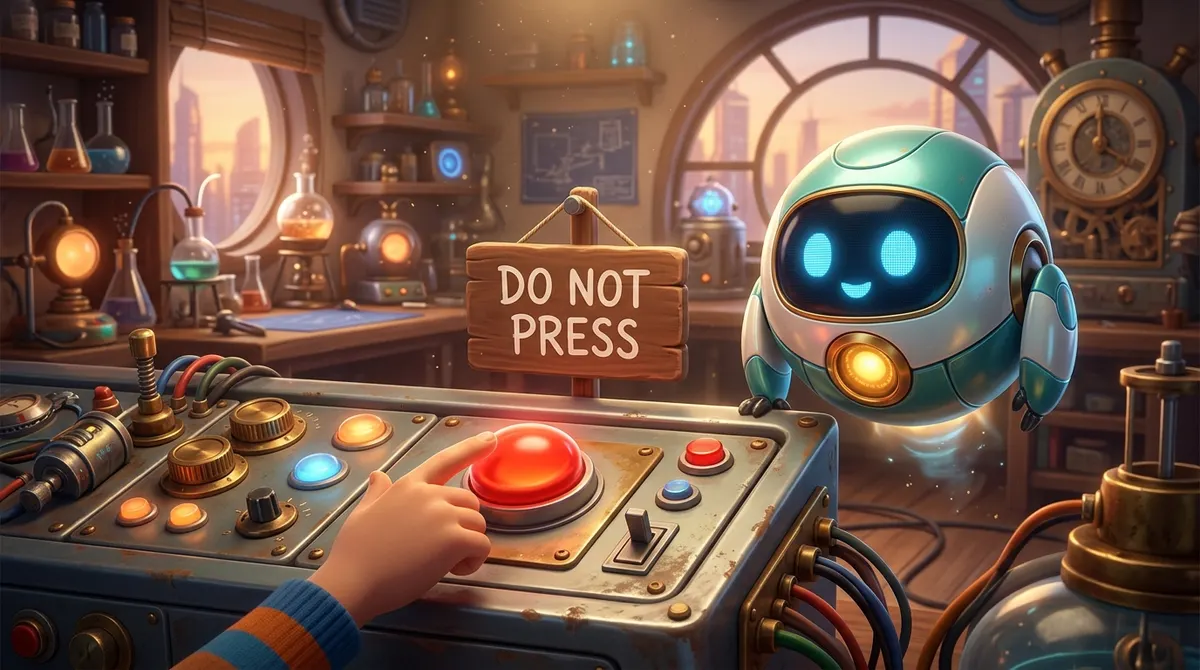 Figure 1.1: A retro-futuristic laboratory console with a glowing red button that incites the eternal scientific question: "What if...?"