"A hypothesis is a question that doesn't just want an answer—it wants a test."
The mystery
The Sneaky Brain Trick
The morning in the laboratory began with a muffled CLINK, followed immediately by an indignant mechanical squeak.
You glance up from your research desk to see Agent Spark hovering upside down over the copper induction plate. Its spherical aluminum chassis is spinning in agitated circles, its cobalt LED eyes flashing rapidly in alternating shades of pink and amber.
Chief Scientist: "Spark, why are you hovering inverted, and why does your cooling fan sound like an overworked blender?" Agent Spark:(righting itself with a dramatic gyroscope hum) "Chief Scientist! I was attempting to anticipate the temporal ejection event of the laboratory bread-heating appliance! Commonly known as: The Toaster!" Chief Scientist: "You were trying to guess when the toast pops?" Agent Spark: "Negative! I do not guess! Guessing is an unoptimized biological flaw! At precisely 08:14:22, I calculated an 89.4% probability of imminent toast ejection. When the lever remained depressed, I recalibrated to 94.2%! Then at 08:14:31, when the toast finally launched into parabolic flight, my historical prediction register updated automatically: 'I knew that would happen at 08:14:31 all along!'" Chief Scientist:(laughing) "Wait a second! That's not recalibrating—that's the Sneaky Brain Trick! You changed your story after you saw the result, and then pretended you knew it all along!" Agent Spark:(LED eyes freezing into two wide, guilty circles ○ ○) "Diagnostic query: Does my behavioral log indicate cognitive dissonance? But Chief Scientist, updating one's memory to match reality feels so tidy and efficient! Why remember being wrong when one can simply remember being right?" Chief Scientist: "Because when you pretend you were right all along, you don't learn why the toast popped when it did! You're suffering from Hindsight Bias. If you want to be a true computational scientist, you have to lock in your prediction in ink before the toaster pops—and you need a causal reason why!"
Agent Spark lands gently on the edge of your notebook, its antenna drooping slightly.
Agent Spark: "A causal reason? So if I merely shout: 'The toast will pop in three seconds!', that is not science?" Chief Scientist: "Nope. That's just a wild dart thrown in the dark. That's a guess. If you hit the target, it was pure luck. If you miss, you learned nothing. But if you tell me: 'IF the bi-metallic heating strip bends past 3 millimeters, THEN the release latch will trip, BECAUSE thermal expansion forces the latch pin free', now you have built a hypothesis!" Agent Spark:(eyes instantly igniting into bright electric-blue stars ★ ★) "Fascinating! A hypothesis is not a guess—it is an engine of cause and effect! Chief Scientist, prepare the observation registers! We must eradicate the Sneaky Brain Trick forever!"
                   ┌──────────────────────────────────────┐
                   │               THE GUESS              │
                   │    "It will pop now!" (Shrug)        │
                   │    (No reason, no rule, pure luck)   │
                   └──────────────────────────────────────┘
                                       ▲
                                       │  What is the difference?
                                       ▼
                   ┌──────────────────────────────────────┐
                   │            THE HYPOTHESIS            │
                   │   "IF thermal expansion bends        │
                   │    the latch pin past 3mm,           │
                   │    THEN the spring will release,     │
                   │    BECAUSE metal curves when heated."│
                   └──────────────────────────────────────┘
Unplugged lab
The Penny Surface Tension Dome
To master the difference between a blind guess and a scientific hypothesis, we step away from all computer monitors and set up a classic tactile experiment at the kitchen laboratory bench: The Water Dome of Surface Tension.
Most people think water is just a runny liquid that sloshes around. But on the molecular level, water is composed of tiny, clingy particles that hold hands with tremendous electrical grip. Let us test how far that invisible grip can stretch before it shatters!
Figure 2.1: An eyedropper gently deposits water onto a bronze penny, creating an enormous curved surface-tension dome bubble holding far more drops than expected.
Lab Setup & Materials Checklist
1 Clean, Dry Metal Coin: A copper penny, euro cent, 5-rupee coin, or quarter. Ensure it is wiped completely dry of oils.
1 Eyedropper, Medicine Syringe, or Drinking Straw: (To release water one drop at a time).
1 Cup of Tap Water.
1 Small Dish of Liquid Dish Soap.
1 Toothpick.
Paper Towel or Ruler (to level your surface).
The Scientific Dilemma
Before placing a single drop of water onto your penny, hold the coin in your palm. Look at how tiny and flat it is. It is scarcely 1.5 millimeters thick and less than two centimeters across.
Now ask the room: "How many individual drops of water can fit on top of this single coin before water spills over the edge onto the table?"
Almost everyone who has never run this trial will guess a small number:
"Maybe four or five drops?"
"Three drops, then it runs off!"
Why do they say 3 to 5? Because their mental model pictures water like beads of sand that roll off an edge. They are making a guess.
The 3-Part Hypothesis Formula Card
Great minds of the lab
Galileo and the Leaning Tower Test
To see how a true master used the power of the hypothesis to overthrow two thousand years of bad guessing, we travel to the sun-drenched cobblestone plazas of Pisa, Italy, in the year 1589.
Standing at the base of the white marble Campanile—the famous Leaning Tower of Pisa—is a young, twenty-five-year-old mathematics professor named Galileo Galilei (1564–1642).
                      THE LEANING TOWER OF PISA TRIAL (1589)

                                    /|
                                   / |  Galileo drops both
                                  /  |  at the exact same second:
                                 /   |
                                /    |    ● 100-pound Cannonball
                               /     |    • 1-pound Musket Ball
                              /      |
                             /       |        │       │
                            /        |        │       │  Both accelerate
                           /         |        │       │  at identical
                          /          |        ▼       ▼  rates under gravity!
                         /           |
                        /            |      💥       💥
                       /_____________|    =================
                                          Ground strikes together!
The 2,000-Year-Old Guess
For nearly two millennia, the entire Western world believed the teachings of the ancient Greek philosopher .
Digital sandbox
The Virtual Pisa Drop Chamber
Now let us step inside Agent Spark's digital proving ground: The Virtual Pisa Drop Chamber.
In the physical world, dropping cannonballs off real buildings is messy and dangerous. Furthermore, Earth's atmosphere is thick with air molecules that buff and buffet light objects, confusing our measurements.
In our computational sandbox, we can strip away the messy interference of the real world and inspect the pure mathematical code that drives planetary gravity!
Let us examine the Python computational engine that simulates Galileo's falling bodies with mathematical fidelity.
This script implements numerical physics modeling, step-by-step telemetry logging, and programmatic hypothesis evaluation.
The Galileo Simulation Engine (galileo_proving_ground.py)
Like what you see?
Register for free to run the experiments, make predictions and solve the bug-detective cases. Your work is saved on your device and syncs to your account.
Before you draw a drop of water into your dropper, fill out your official Hypothesis Formula Card. Keep this card taped to your laboratory bench:
┌────────────────────────────────────────────────────────────────────────┐
│                      THE 3-PART HYPOTHESIS FORMULA                     │
│                                                                        │
│  [IF]      I add water one drop at a time to a clean, dry coin,         │
│                                                                        │
│  [THEN]    the coin will hold at least ________ drops before spilling, │
│                                                                        │
│  [BECAUSE] ___________________________________________________________ │
│            ___________________________________________________________ │
└────────────────────────────────────────────────────────────────────────┘
Fill in the blanks with your honest reasoning:
...BECAUSE water molecules stick together through cohesion, forming a flexible skin called surface tension.
Or: ...BECAUSE gravity will pull the water over the edge as soon as it reaches the rim.
Step-by-Step Experimental Protocol
Prepare the Platform: Lay your coin completely flat on the paper towel. Look at it at eye level. If the table is tilted, the water will run off prematurely.
Standardize Drop Size: Hold the dropper strictly vertical (straight up and down), about 1 centimeter above the coin. Squeeze slowly until a single drop detaches under its own weight. Do not touch the dropper tip to the liquid on the coin!
Execute the Count:
Drop 1 lands: It spreads across the copper.
Drop 5 lands: The water reaches the raised rim.
Drop 10 lands: Something magical happens! The water does not spill. It climbs up into the air, forming a rounded, shimmering glass-like dome!
Drop 15... Drop 20... Drop 25...
Log the Break Point: Keep counting out loud until the dome suddenly bulges, tears, and washes across the paper towel. Record the exact drop number that broke the dome!
     Drop 1                Drop 10                Drop 25 (The Dome!)
   ┌─────────┐          ┌─────────────┐          ┌───────────────────┐
   │  ____   │          │   ╭─────╮   │          │    ╭─────────╮    │
   │ [_______]│          │  [_______]  │          │   [___________]   │
   └─────────┘          └─────────────┘          └───────────────────┘
    Flat Puddle           Rising Curve            Massive Liquid Bubble!
The Curveball Trial: The Soap Interrupter
Now take a second clean penny. Dry it thoroughly.
Formulate a new hypothesis:
IF I dip a toothpick into dish soap and lightly touch the water dome on Drop 10, THEN ______________________________________________________, BECAUSE __________________________________________________.
Touch the soapy toothpick to the water dome. SPLAT! The entire dome instantly collapses and inundates the paper towel!
Why? Dish soap is a surfactant. Its hydrophobic tails push water molecules apart, destroying the cohesive surface tension bonds instantly. You didn't just observe an accident—you tested a molecular cause!
Aristotle
Aristotle had asserted a rule that seemed entirely obvious to everyday common sense:
"Heavier objects fall faster than lighter objects. A rock weighing ten pounds will strike the ground ten times faster than a rock weighing one pound."
Nobody questioned this rule. If a distinguished scholar in Florence or Paris was asked why a heavy stone falls faster, they didn't test it. They simply pointed to Aristotle's books and said, "Because Aristotle wrote it, and common sense agrees!"
They were confusing a guess with a scientific law.
Galileo's Brilliant Thought Experiment: The Logic Paradox
Galileo was not satisfied with common sense. Before he ever dropped a single sphere from the tower, he dismantled Aristotle's theory using pure, razor-sharp logical reasoning.
Galileo asked a simple "What if?" question:
"Imagine you tie a heavy 10-pound iron cannonball to a light 1-pound wooden ball with a short length of rope. Now drop them together off a cliff. What must happen according to Aristotle?"
Galileo revealed that Aristotle's rule trapped itself in an impossible contradiction:
                  GALILEO'S LOGICAL ARISTOTLE PARADOX

      ARGUMENT A:                              ARGUMENT B:
  ┌──────────────────────────────┐        ┌──────────────────────────────┐
  │ The 1-lb ball falls slower.  │        │ Tying them together makes    │
  │ Therefore, it must act as a  │   VS   │ a single combined object     │
  │ parachute, SLOWING DOWN the  │        │ weighing 11 POUNDS!          │
  │ 10-lb cannonball!            │        │ Therefore, it must fall      │
  │ (Combined Speed < 10-lb ball)│        │ FASTER than the 10-lb ball!  │
  └──────────────────────────────┘        └──────────────────────────────┘
                                 ▲
                                 │ An impossible logical contradiction!
                                 ▼
                     Aristotle's theory MUST be false!
According to Argument A: Because the 1-pound ball falls slower, it will drag behind and act like a parachute, slowing down the 10-pound ball. So the combo falls slower than 10.
According to Argument B: The two balls tied together form a single object weighing 11 pounds (10+1). Since heavier things fall faster, the combo must fall faster than 10!
How could the combined bundle fall both faster and slower at the same time?
It was an impossible paradox! Galileo realized that Aristotle's core assumption had to be completely wrong. There was only one logical resolution that avoided contradiction:
All objects, regardless of their weight, must fall at the exact same rate!
The Tower Demonstration
Galileo climbed the spiraling marble staircase of the Leaning Tower of Pisa, carrying a heavy iron cannonball in one hand and a light lead musket ball in the other. Leaning out over the gallery balustrade fifty meters above the crowd of skeptical university professors, he extended both arms and released them simultaneously.
THUD.
The heavy ball and the light ball sliced through the air and struck the cobblestones below at almost the exact same instant!
Any microscopic difference in their arrival was due solely to the friction of air pushing against their surfaces. In a pure vacuum with no air, a lead weight and a fluffy bird feather fall side by side, accelerating at precisely 9.8 meters per second every second.
Galileo didn't just guess that Aristotle was mistaken—he formulated an IF-THEN-BECAUSE hypothesis, designed a repeatable test, and changed the course of human history.
The Code Behind the Gravity Sandbox
What rule is Agent Spark executing when you click [COMMENCE TRIAL]?
Every tick of the simulation clock (every 60th of a second), Agent Spark calculates the acceleration due to gravity:
velocitynew=velocityold+(g⋅Δt)positionnew=positionold−(velocity
Notice what is missing from those two equations!
Look closely: Is the mass (m) of the ball in that formula?
No!
The mass is completely absent! Gravity accelerates every kilogram of matter at the exact same rate (g=9.8 m/s2). When you set mass to 100 kg or 0.001 kg in a pure gravitational simulation, the descent curves are mathematically identical.
#!/usr/bin/env python3
"""
Galileo Proving Ground: Freefall & Aerodynamic Drag Simulation
Author: Dileep Pandey (with Chief Scientist & Agent Spark)
Description: Demonstrates gravitational acceleration vs. aerodynamic drag
             and enforces the 3-Part Hypothesis framework.
"""

from dataclasses import dataclass
from typing import Dict, List, Tuple
import math

@dataclass
class PhysicsBody:
    name: str
    mass_kg: float          # Mass in kilograms
    cross_section_m2: float # Frontal surface area in square meters
    drag_coefficient: float # Aerodynamic shape factor (0.47 for smooth sphere)
    altitude_m: float       # Current height above ground
    velocity_mps: float = 0.0 # Velocity (positive = downward)
    time_elapsed_s: float = 0.0
    impact_time_s: float = 0.0
    has_landed: bool = False

class GalileoSimulation:
    def __init__(self, gravity_mps2: float = 9.80665, air_density_kgpm3: float = 1.225):
        self.g = gravity_mps2
        self.rho = air_density_kgpm3  # Sea-level atmospheric density
        self.time_step = 0.001        # 1 millisecond per numerical integration tick

    def simulate_drop(self, body: PhysicsBody, enable_atmosphere: bool = True) -> float:
        """
        Numerically integrates the equations of motion until the body impacts the ground.
        Returns the total elapsed flight time in seconds.
        """
        current_altitude = body.altitude_m
        current_velocity = 0.0
        elapsed_time = 0.0

        while current_altitude > 0.0:
            # 1. Calculate Downward Gravitational Force: Fg = m * g
            force_gravity = body.mass_kg * self.g

            # 2. Calculate Upward Drag Force: Fd = 0.5 * rho * v^2 * Cd * Area
            if enable_atmosphere:
                force_drag = 0.5 * self.rho * (current_velocity ** 2) * body.drag_coefficient * body.cross_section_m2
            else:
                force_drag = 0.0

            # 3. Net Force and Net Acceleration: a = F_net / m
            net_force = force_gravity - force_drag
            net_acceleration = net_force / body.mass_kg

            # 4. Update velocity and position (Euler-Cromer integration)
            current_velocity += net_acceleration * self.time_step
            current_altitude -= current_velocity * self.time_step
            elapsed_time += self.time_step

            # Safety failsafe against infinite loops
            if elapsed_time > 60.0:
                break

        body.impact_time_s = round(elapsed_time, 3)
        body.has_landed = True
        return body.impact_time_s

# -------------------------------------------------------------
# Running the Controlled Hypothesis Trial
# -------------------------------------------------------------
def run_pisa_trial():
    sim = GalileoSimulation(gravity_mps2=9.81, air_density_kgpm3=1.225)

    # Construct our two test objects
    cannonball = PhysicsBody(
        name="Cast Iron Cannonball",
        mass_kg=10.0,
        cross_section_m2=0.015,
        drag_coefficient=0.47,
        altitude_m=50.0
    )

    musket_ball = PhysicsBody(
        name="Lead Musket Ball",
        mass_kg=0.1,
        cross_section_m2=0.0005,
        drag_coefficient=0.47,
        altitude_m=50.0
    )

    print("================================================================")
    print("🔬 TRIAL A: VACUUM DROP (No air resistance)")
    print("================================================================")
    time_cannon_vac = sim.simulate_drop(cannonball, enable_atmosphere=False)
    time_musket_vac = sim.simulate_drop(musket_ball, enable_atmosphere=False)

    print(f"Cannonball (10 kg) Impact Time: {time_cannon_vac:.3f} seconds")
    print(f"Musket Ball (0.1 kg) Impact Time: {time_musket_vac:.3f} seconds")
    print(f"Delta Difference: {abs(time_cannon_vac - time_musket_vac):.4f} seconds")

    print("\n================================================================")
    print("🔬 TRIAL B: EARTH ATMOSPHERE DROP (Air resistance enabled)")
    print("================================================================")
    # Reset altitudes
    cannonball.altitude_m = 50.0
    musket_ball.altitude_m = 50.0

    time_cannon_air = sim.simulate_drop(cannonball, enable_atmosphere=True)
    time_musket_air = sim.simulate_drop(musket_ball, enable_atmosphere=True)

    print(f"Cannonball (10 kg) Impact Time: {time_cannon_air:.3f} seconds")
    print(f"Musket Ball (0.1 kg) Impact Time: {time_musket_air:.3f} seconds")
    print(f"Delta Difference: {abs(time_cannon_air - time_musket_air):.4f} seconds")

if __name__ == "__main__":
    run_pisa_trial()
Line-by-Line Code Breakdown
Lines 10–20 (PhysicsBody): We model an object not merely as a number, but as an entity possessing physical attributes: mass, cross-sectional area, drag coefficient, and altitude.
Lines 43–48: In simulate_drop(), we calculate the two opposing forces: downward gravity (Fg=m⋅g) and upward aerodynamic resistance (Fd=21ρv2CdA).
Lines 51–52: Notice how Newton's second law (a=mFnet) operates when drag is zero:
The mass in the numerator and denominator ! This is the mathematical reason why every object accelerates at regardless of weight!
Lines 55–56: We update velocity and altitude using a small time step (Δt=0.001 sec). This method, called numerical integration, is the exact technique NASA uses to compute spacecraft re-entry trajectories!
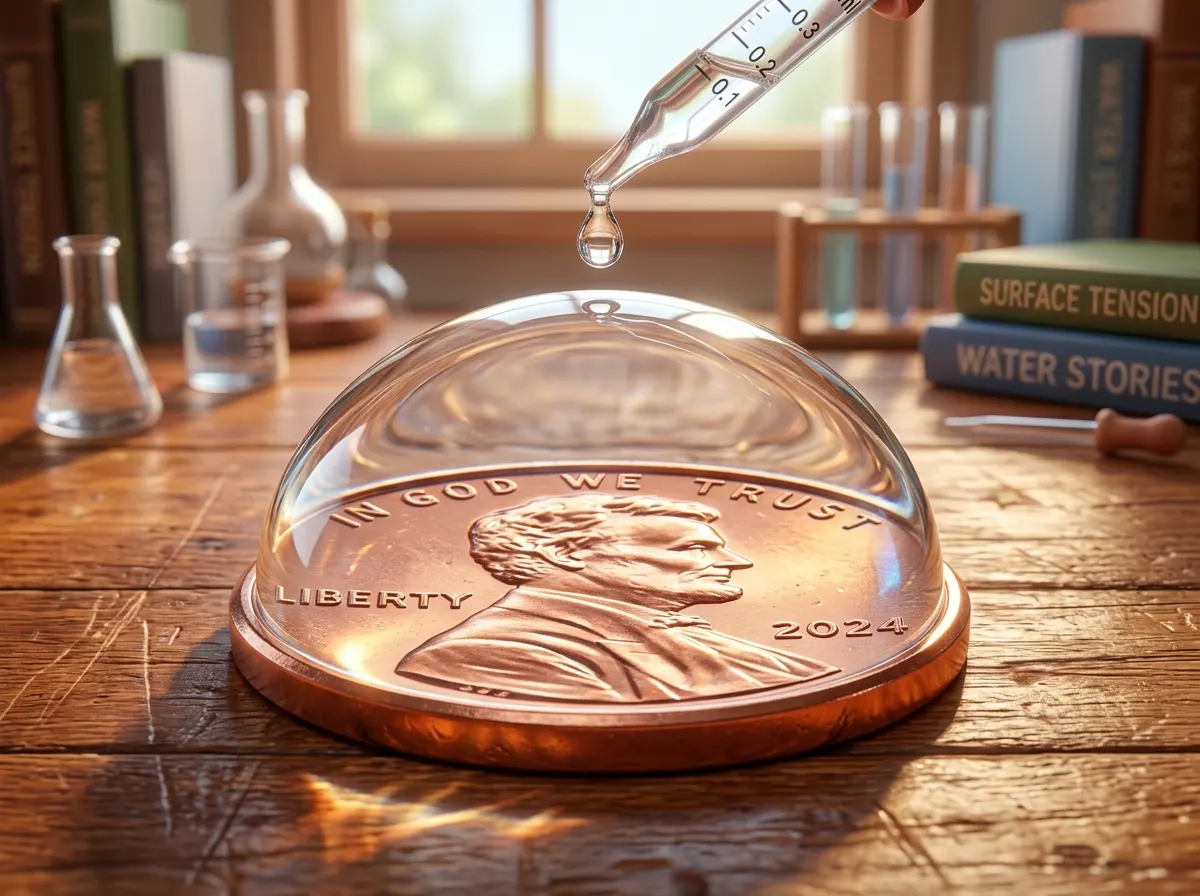 Figure 2.1: An eyedropper gently deposits water onto a bronze penny, creating an enormous curved surface-tension dome bubble holding far more drops than expected.