Unit 2
An independent investigation
Pick your own question, test it fairly, and report what you found, including what you are still unsure about.
Read
Your question, your evidence
In 1919 two small expeditions travelled to Brazil and the island of Príncipe off West Africa to watch a solar eclipse. They were not on a holiday. Einstein's theory said that the Sun's gravity should bend starlight slightly, and the eclipse was the only time the stars near the Sun could be photographed. Someone had asked a question, made a prediction that could turn out wrong, and gone to find out. Every discovery, from a new vaccine to a faster sorting program, follows the same loop.
This unit is your chance to run that loop on a question of your own, from the first idea to the final report.
The inquiry cycle
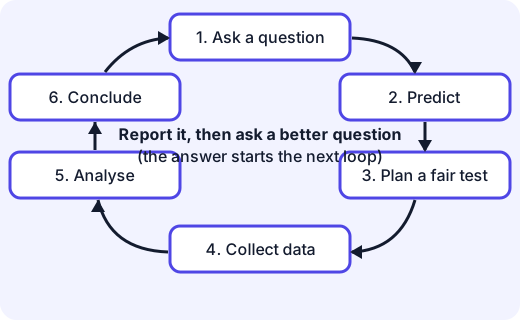
No step is optional, and the cycle really is a cycle. The last step does not end with "the answer". It ends with a better question.
1. Ask a question you can test
A testable question can be answered by measuring something.
Not testable yet Testable Which paper plane is best? Does a plane with a longer nose fly farther than one with a shorter nose? Does music help plants? Do bean seedlings grow taller in 10 days with 2 hours of music a day than without? Are people faster at maths in the morning? Do students in my class solve more of the same ten sums in 2 minutes before lunch than after lunch? Good questions name what you change, what you measure and who or what you will study. Choose a question where you can collect the data, safely, in a week or less.
2. Predict
Write down what you think will happen and why, before you test. A prediction can be wrong, and that is fine. A wrong prediction is the most informative result you can get, because it shows that your picture of the world needs mending.
3. Plan a fair test
A fair test changes one thing and keeps everything else the same.
- The independent variable is the thing you change (nose length).
- The dependent variable is what you measure (distance flown).
- The controlled variables are everything else you keep the same: same paper, same thrower, same throwing angle, same launch spot, same indoor space without a draught.
Also plan how many repeats you will do. Any single trial is partly luck. Your arm does not throw the same way twice. You need several trials of each condition to see a pattern beneath the noise. For a classroom investigation, 5 trials per condition is a sensible minimum.
4. Collect data
Record every trial in a table as you go, including the odd-looking ones. Never throw away a result because it spoils your prediction. If something went wrong (the plane hit a chair), note it and say why you are excluding it.
5. Analyse
Summarise, then compare. Two useful numbers are the mean (total ÷ count) and the range (largest − smallest). Then draw the data. A dot plot shows what a table hides.
Example. A group tests two paper-plane designs, five throws each (distance in metres).
Throw A (short nose) B (long nose) 1 4.2 5.6 2 4.8 5.0 3 4.5 6.1 4 5.1 5.4 5 4.4 5.9 Mean of A: m. Mean of B: m. Ranges: A is m; B is m.
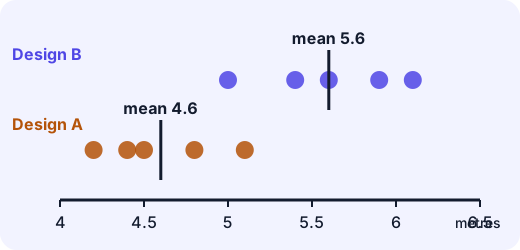
B's mean is 1.0 m greater. The plot also shows something the means hide: the groups overlap a little. B's worst throw (5.0) was slightly shorter than A's best throw (5.1).
6. Conclude honestly
A conclusion answers the question and says how sure you are.
- Weak: "B is better."
- Overclaiming: "B always flies farther." (Not true: one A throw beat one B throw.)
- Honest: "In our 5 throws each, the long-nose plane flew about 1 m farther on average. The two sets of throws overlapped a little, so we are fairly but not completely sure. We only tested one thrower and one pair of designs."
Misconception. "My result is only good if it matches my prediction." No. If your data disagree with your prediction, you have found something. Report it, check your procedure for mistakes, and ask why.
Misconception. "More precise-looking numbers mean a better investigation." A mean of 5.6213 m from three sloppy throws is worse than 5.6 m from ten careful ones. Decimals do not buy trust. A fair test and repeats do.
7. Report, then ask a better question
A report others could follow includes your question, prediction, method (with controlled variables), data table and graph, conclusion with limits, and a next question. The paper-plane group's next question might be: "Is it the nose length or the weight of a longer nose that matters?" That is a sharper question than the one they started with. That is how investigations improve.
Planning your own: a checklist
- Can I state my question as "Does changing ___ change ___?"
- Have I written a prediction and a reason?
- What am I changing? What am I measuring? What will I keep the same?
- How will I measure (what tool, what unit, when)? How many repeats?
- Is it safe, and do I need a grown-up's permission?
- How will I record the data so nothing gets lost?
- How will I show the results (table, dot plot, bar chart of means)?
Try it: Pick two of the questions from the first table and rewrite each so it names the thing you change and the thing you measure. Check them against the checklist.
Summary
- An investigation is a loop: question, prediction, fair test, data, analysis, conclusion, report, and a better question.
- Fair test: change one variable, measure one outcome, control the rest, and repeat.
- Use means and ranges, and draw the data. Look at overlap, not only the averages.
- State conclusions with limits. A surprising result is a result.
Activity
Run your own investigation
Plan, run and report an investigation of your own question, start to finish. Plan about 30 minutes to design it and one or two sessions of 20-40 minutes to collect data, then 30 minutes to analyse and write up. Work alone or in a pair.
You'll need
- Paper or a notebook for your plan and data table
- A ruler, measuring tape, timer or phone stopwatch (whatever your question needs)
- Things to test (for example paper, beans, a ball, a ramp, a class of willing friends)
- Optional - a spreadsheet or coding environment for the means and a chart
Steps
- Choose a question you can test in a week or less with things at home or school. Write it as 'Does changing ___ change ___?' Good starting ideas - paper plane designs, how far a ball rolls down a ramp of different slopes, whether a plant grows differently in two light conditions, whether people remember more words with or without a pattern.
- Write a prediction and one sentence of reasoning. Do this before collecting any data.
- List your variables - what you change (independent), what you measure (dependent, with unit and tool), and at least three things you keep the same (controlled).
- Decide how many repeats. Use at least 5 trials per condition. Draw an empty data table with a column for each condition and a row for each trial.
- Have a grown-up check the plan if anything involves people, living things, heights, heat, electricity or food.
- Run the investigation. Fill in the table as you go. Write down anything odd (a draught, a mistake in measuring) next to the trial it affected. Do not delete results.
- Analyse - work out the mean and range for each condition. Draw a dot plot or bar chart. Look at whether the groups overlap.
- Write your conclusion in 3-5 sentences - answer the question, quote your numbers, say how sure you are, and name one limit of your test.
- Write down a better next question that came from your result, and say how you would test it.
- Show your plan and results to someone else and ask them one thing that was unclear. Note what you would change.
Safety
- Keep experiments to everyday, low-risk materials. No fire, mains electricity, chemicals or sharp tools without an adult.
- Experiments involving other people must be voluntary, harmless and not involve anyone's private information; ask a grown-up first.
- Do not test anything involving eating or drinking something unusual.
- If a living thing is involved (like seedlings), treat it kindly and finish the test within a week.
Keeping a log of the activity is for registered learners. Register to do this.
Quick check
Investigation check
Eight questions on planning, running and reporting an investigation.
1.Put the steps of an investigation in order.
- Ask a testable question
- Plan a fair test
- Analyse and conclude
- Collect data
- Write a prediction
Put these in order
2.Which question is the most testable?
- Are cats better than dogs?
- Does a heavier ball roll farther down the same ramp than a lighter ball of the same size?
- What is the best colour?
Choose one
3.You are testing whether the length of a paper plane's nose changes how far it flies. Which of these must you keep the SAME? Choose all that apply.
- The type of paper
- The nose length
- The person throwing and how hard
- The launch spot and angle
Choose all that apply
4.Four throws of a ball went 3.1 m, 3.5 m, 2.9 m and 3.5 m. What is the mean distance, in metres?
Answer with a number
5.Design A's five throws were 4.2, 4.8, 4.5, 5.1 and 4.4 m. What is the range (largest minus smallest), in metres?
Answer with a number
6.Design A averaged 4.6 m and design B averaged 5.6 m, but A's best throw (5.1 m) was longer than B's worst throw (5.0 m). Which statement is best supported?
- B always flies farther than A.
- B flew farther on average, but the throws overlapped, so we can't say it always does.
- There is no difference between A and B.
Choose one
7.Why do we repeat each condition several times?
- To make the investigation take longer.
- Because any single trial is partly down to chance, and repeats show the pattern underneath.
- So we can throw away the results we don't like.
Choose one
8.A group finds that a long-nose plane flies about 1 m farther. Which is the best next question?
- How can we prove we were right?
- Is it the longer nose or the extra weight at the front that makes the difference?
- Can we stop now that we know the answer?
Choose one
Answering and checking are for registered learners. Register to do this.
Quick check
New puzzles about investigations
Apply the inquiry cycle to investigations you have not seen before.
1.Kavya tests whether music helps bean seedlings grow. She puts one tray in the sunny window and plays it music; she puts the other tray in a dark cupboard with no music. After 10 days the music tray is taller. What is wrong with the test?
- Light and music were both different, so she can't tell which one caused the difference.
- Seedlings never respond to music, so the result must be a mistake.
- She should have measured after 5 days.
Choose one
2.In a ruler-drop test the number shows how far the ruler fell, in cm, before it was caught (a longer fall means slower reaction). Dominant hand - 14, 15, 13, 16. Other hand - 18, 17, 19, 18. How many centimetres greater is the mean fall for the other hand?
Answer with a number
3.Same ruler-drop data, one person, four drops per hand. Which conclusion is the most honest?
- Everyone reacts faster with their dominant hand.
- In my four drops, my other hand's mean fall was about 3.5 cm longer; I should test more people and more drops before claiming this holds for everyone.
- My other hand is useless.
Choose one
4.A team predicted that a bigger parachute would fall faster. Their data showed it fell slower. What should they do?
- Change the data so it matches the prediction.
- Report the result as found, check the method for errors, and ask why it happened.
- Delete the trials that disagree and keep the rest.
Choose one
Answering and checking are for registered learners. Register to do this.
Your turn
Write up a parachute investigation
A group asked: Does a bigger parachute make a toy fall more slowly? They dropped the same small toy, from the same height (2 m), with a 20 cm square parachute and a 40 cm square parachute. Fall times in seconds, five drops each:
Drop 20 cm 40 cm 1 1.8 2.9 2 2.0 3.1 3 1.9 3.0 4 1.7 2.7 5 2.1 3.3 Write a short report (about 150-250 words) that covers:
- The question and what was changed, measured and kept the same.
- The means and ranges for each parachute, with your working.
- A conclusion that answers the question, says how sure you are (look at whether the times overlap), and names one limit of this test.
- A better next question that grows out of this result.
How it's judged
- Variables and fair test
- Analysis
- Honest conclusion
- Next question
Writing and submitting your answer is for registered learners. Register to do this.
Like what you see?
Register for free to answer the quick checks, do the activities and save your work. Your work is saved on your device and syncs to your account.