Unit 1
The anatomy of an argument
Take an argument apart into its five Nyaya steps, test every step, and decide whether the smoke on the hill really proves a fire.
Read
Smoke on the hill
Asha and Dev are walking along a valley road when Asha points at a grey column rising from the far ridge. "There's a fire up there," she says.
"Can you see flames?" asks Dev.
"No. But there's smoke."
"Smoke could be anything," says Dev. "Why should I believe you?"
Asha now has a job to do. She has to take Dev from something they can both see (smoke) to something neither can see (fire), and she has to do it in steps that Dev can check. Thinkers in India have been studying exactly this job for about two thousand years. The school called Nyāya (the school of logic) used this very picture, a hill, smoke and a fire, as its favourite example. Their word for reasoning from what we see to what we don't is anumāna, "measuring after".
An argument is not a quarrel
In everyday talk, "an argument" means a row. In logic it means something calmer: reasons given in support of a claim. A good argument is a way of showing someone why they might agree, not a way of beating them.
Two words will help us all through this unit.
- A premise is a statement offered as a reason. An argument can have one premise or many.
- The conclusion is the statement the premises are meant to support.
The five Nyāya steps
The Nyāya thinkers set out a full argument in five steps. Dev's challenge shows why each one is there.
Step Name Its job Smoke on the hill 1 pratijñā (claim) Say what you want to show The hill has fire. 2 hetu (reason) Give the sign you rely on Because it has smoke. 3 udāharaṇa (rule and example) State the general rule, with a case you know Wherever there is smoke there is fire, as in a kitchen hearth. 4 upanaya (application) Show that this case fits the rule This hill has smoke of that kind. 5 nigamana (conclusion) Say what now follows So the hill has fire. 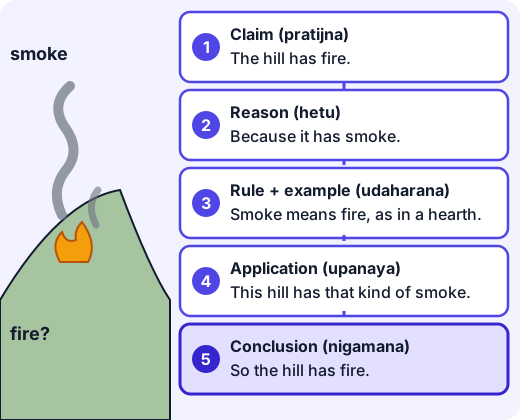
Notice that the claim comes first and comes back at the end. Stating it at the start tells the listener where you are heading. Stating it again at the end shows you have earned it.
The same argument as premises and conclusion
Strip the five steps down and a shorter shape is left:
- Premise 1 (the rule): Wherever there is smoke, there is fire.
- Premise 2 (the case): This hill has smoke.
- Conclusion: So this hill has fire.
The two shapes fit together. The claim and the conclusion are the same sentence, said at the start and at the end. The reason (step 2) and the application (step 4) together give the case premise. The rule and example (step 3) give the rule premise. The example is not a third premise: it is there to remind the listener that the rule has held in places they know.
Worked example. Dev comes home from school and the house smells of fresh bread. He thinks, "Mum has baked today." Laying that out:
- Claim: Mum has baked today.
- Reason: Because the house smells of fresh bread.
- Rule and example: Wherever a house smells strongly of fresh bread, bread was baked there recently, as at the bakery in our lane.
- Application: Our house smells strongly of fresh bread.
- Conclusion: So Mum has baked today.
As premises: (P1) Wherever a house smells strongly of fresh bread, bread was recently baked there. (P2) Our house smells strongly of fresh bread. (C) So bread was recently baked in our house.
A conclusion is only as strong as the steps to it
Now we can answer Dev. He should test three places where the argument can break.
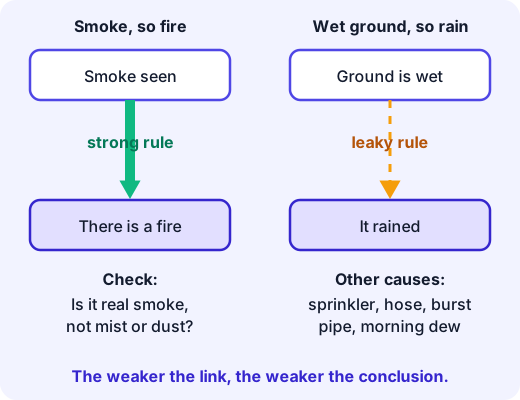
- Is the reason really there? Is it smoke, or mist, or dust from a landslide? A cloud of steam from a tea stall looks a bit like smoke from far away. If the sign isn't what we think it is, the argument fails before it starts.
- Is the rule true? Can you find a case where the reason is present but the claim is false? One honest counterexample is enough to damage the rule. For the bread smell: the neighbour's bakery might be next door.
- Does this case fit the rule? The rule may be about woodsmoke from burning things, while the thing on the hill is a steam engine's vapour.
If all three hold, the conclusion must be true. If any one is weak, the conclusion is weaker, even though it may still be true. That is what "only as strong as the steps" means.
Logicians use two words for this. An argument is valid when the steps are arranged so that, if the premises were true, the conclusion would have to be true. It is sound when it is valid and the premises really are true. Here is a valid argument that is not sound:
- All birds can fly. Penguins are birds. So penguins can fly.
The steps fit together perfectly, but the first premise is false, so the argument shows nothing about penguins.
So, is the smoke proof of fire?
It depends how strict "proof" is. If what we see is truly smoke from a burning thing, then "wherever there is smoke there is fire" has no counterexample in anything Dev has seen, and the chain is very strong. In daily life we would call that proof. But in a strict sense there are still places for doubt: the reason (is it really smoke?) and the application (is it the kind that comes from burning?). A careful thinker can say: "Very probably yes, and here is what would make me less sure." That answer is better than a flat "yes" or "no", because it shows which steps carry the weight.
Three classic mistakes
Mistake 1: reversing the rule. "Wherever there is smoke there is fire" is a good rule. "Wherever there is fire there is smoke" is not. A red-hot iron ball in a blacksmith's forge has fire but no smoke. If you argue "that iron ball is hot, so it must be smoking", you have turned the rule round.
Mistake 2: "the conclusion is true, so the argument is good." Mina says, "It is Tuesday, because I saw a cat today. Cats appear on Tuesdays." Suppose it really is Tuesday. Her argument is still bad: her rule is invented, so it would have worked just as well on a Friday. A good argument gives us a reason to believe the conclusion, not just a lucky match.
Mistake 3: "one weak step means the conclusion is false." Not so. A weak argument means this argument does not show it. The hill may well be on fire, but Dev has been given no good reason yet.
Try it: Choose a claim you believe, like "our bus will be late today" or "that mango is ripe". Write the five steps. For each, ask: is it true? Which step were you least sure about?
When you lay out an argument in this way, you can point at the exact step you disagree with. Instead of "I don't buy it", you can say "I accept the smoke, but I doubt the rule." That is how Shastrartha begins.
Quick check
Quick check - taking an argument apart
Practise laying out arguments and testing their steps. This is practice; your Shastrartha is what counts.
1.Put the five Nyaya steps in the order a full argument uses them.
- Rule and example (udaharana): state the general rule
- Application (upanaya): show this case fits the rule
- Conclusion (nigamana): say what now follows
- Reason (hetu): give the sign you rely on
- Claim (pratijna): say what you want to show
Put these in order
2.Here is an argument about a mango. Match each sentence to the step it plays.
- That mango is ripe.
- Because it smells sweet.
- Wherever a mango smells strongly sweet it is ripe, as with the ones Nani picked.
- This mango smells strongly sweet.
- So this mango is ripe.
Match each to: Reason · Conclusion · Claim · Rule and example · Application
3.Look at this argument: 'All metals conduct electricity. Copper is a metal. So copper conducts electricity.' Which sentence is the conclusion?
- All metals conduct electricity.
- Copper is a metal.
- Copper conducts electricity.
Choose one
4.A student argues: 'Wherever there is fire there is smoke. This red-hot iron ball in the forge has fire. So it has smoke.' What is wrong?
- The rule is false: a red-hot iron ball is fire without smoke, so the rule has a counterexample.
- Nothing: any argument about fire is sound.
- The claim must come after the conclusion.
- The argument needs a third premise before it can have a conclusion.
Choose one
5.Dev doubts that the smoke on the hill shows a fire. Which of these would really weaken the argument? Pick all that apply.
- What looks like smoke is really mist or dust
- Asha has walked past that hill many times
- The rule 'wherever there is smoke there is fire' fails for the kind of smoke seen
- The hill is called Rampur Hill
Choose all that apply
6.'All birds can fly. Penguins are birds. So penguins can fly.' The steps fit together. Why is the argument still no good?
- The first premise is false, so the argument shows nothing about penguins.
- It has too many premises.
- A conclusion about animals cannot come from premises about birds.
- It is a good argument; penguins can fly.
Choose one
7.Mina says: 'It is Tuesday, because I saw a cat today. Cats show up on Tuesdays.' Suppose it really is Tuesday. Is her argument good?
- Yes, because the conclusion is true.
- No: a true conclusion does not make the steps good, and her rule is made up.
- Yes, because she gave a reason.
- No, because arguments cannot be about days of the week.
Choose one
8.Ravi says: 'The ground is wet, so it rained in the night.' Which question would test his rule best?
- How old is Ravi?
- Could the ground be wet in other ways, such as a sprinkler, a burst pipe or dew?
- What colour is the ground?
- Does Ravi like rain?
Choose one
Answering and checking are for registered learners. Register to do this.
Quick check
New puzzles - arguments in the wild
Use the five steps on arguments you have not seen before.
1.Priya says: 'The canteen has a long queue, so its food must be good.' Which unstated rule is she relying on?
- Wherever there is a long queue, the food is good.
- Queues form at every canteen.
- Good food is always expensive.
Choose one
2.Which case is a counterexample to 'wherever there is a long queue, the food is good'?
- A short queue outside a good stall
- A long queue outside a stall handing out free but stale snacks
- A long queue outside a famous sweet shop whose sweets are delicious
Choose one
3.'Every Jataka tale has a moral. The Banyan Deer is a Jataka tale. So the Banyan Deer has a moral.' Which sentences are premises?
- Every Jataka tale has a moral.
- The Banyan Deer is a Jataka tale.
- The Banyan Deer has a moral.
Choose all that apply
4.Which argument has the stronger rule? (1) 'Wherever there is smoke there is fire.' (2) 'Wherever a dog barks there is a thief.'
- (1), because smoke has few causes other than burning
- (2), because dogs bark only at thieves
- They are equally strong
Choose one
Answering and checking are for registered learners. Register to do this.
Your turn
Shastrartha - proof from the smoke
The question: Is the smoke on the hill proof of fire?
Write a Shastrartha response of about 250-400 words.
- State your position clearly (pratijna): is it proof, not proof, or proof only under conditions you name?
- Lay out your argument in the five Nyaya steps, then give it again as premises and conclusion.
- Give a real example of your own where the same kind of reasoning works or fails (udaharana).
- State the best argument for the opposite view fairly (purvapaksha), and say which step of your own argument it attacks.
- Check your own argument for a false reason or a reversed rule (hetvabhasa).
- Answer the objection that you think is strongest (tarka).
- Say what new fact would make you change your mind (vada), and finish with a conclusion that follows from what you wrote (nigamana).
How it's judged
- Clear position (pratijna)
- Reasons (hetu)
- Examples (udaharana)
- Fairness to the other side (purvapaksha)
- Sound reasoning (hetvabhasa)
- Responding to objections (tarka)
- Openness to changing your mind (vada)
- Conclusion follows (nigamana)
Writing and submitting your answer is for registered learners. Register to do this.
Your turn
Explain - lay out an argument
Choose one everyday claim you have heard someone make (for example "the match will be cancelled, because the sky is dark").
- Write it out in the five Nyaya steps.
- Write it again as premises and a conclusion.
- Say which step is weakest, and explain why in two or three sentences.
- Explain in your own words what "a conclusion is only as strong as the steps to it" means.
How it's judged
- Laying out the argument
- Finding the weakest step
- Explaining the big idea
Writing and submitting your answer is for registered learners. Register to do this.
Like what you see?
Register for free to answer the quick checks, do the activities and save your work. Your work is saved on your device and syncs to your account.