Unit 2
Trusting what we're told
Most of what you know came from other people, so learn how to tell a source worth trusting from one that only sounds sure.
Read
Who told you that?
Try this quick test. Have you ever personally checked that the Earth goes round the Sun? That Mumbai is on the west coast of India? That your own birthday is the date you think? Almost certainly not. You know these things because someone told you, and you had good reason to believe them.
Now think about all the things you believe like this. Add up the facts from school, books, news, maps, doctors, labels on food. Very little of what any of us knows was found out by ourselves. Most of what we know comes from others.
That sounds worrying until you notice that it is also how human knowledge grows. No one person could rediscover medicine, bridge-building and geography from scratch in a lifetime. The question is not whether to trust other people. It is whom to trust, about what, and how much.
Testimony and the āpta
When someone tells you something you have not seen for yourself, philosophers call that testimony. Indian thinkers gave it a place of its own among the ways of knowing: śabda, knowledge from words.
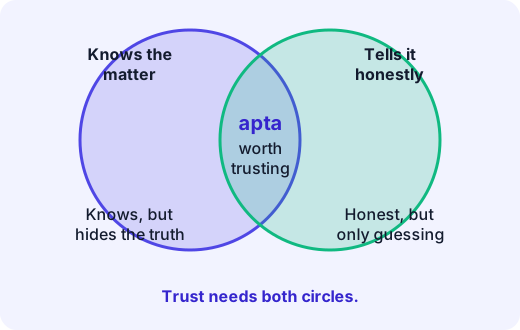
But not every word counts. The Nyāya thinkers said that words give knowledge when they come from an āpta: a trustworthy speaker. An āpta, they said, has two qualities:
- They know. They have seen the matter directly or learned it properly.
- They tell it as they know it. They are not trying to fool you, and they have no reason to bend the truth.
A speaker who knows but lies is not an āpta. A speaker who is honest but guessing is not one either. You need both.
Experts
An expert is someone with deep training or long experience in one field: a structural engineer, an orchard farmer, a bird-watcher who has logged thirty years of migration. Experts are usually the people most likely to meet the first quality (they know). But being an expert does not settle the second quality, and it does not stretch beyond the field.
Five questions for any source
Next time a claim reaches you, ask these.
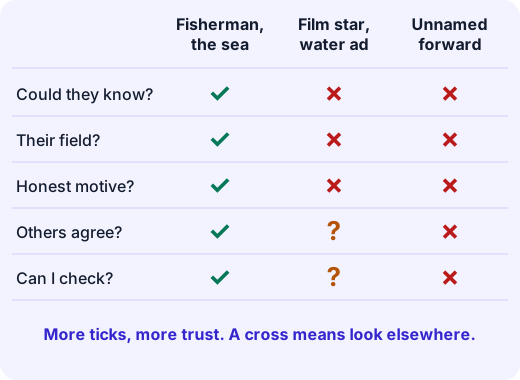
- Could they know? Did they see it, or are they trained to understand it? A fisherman who has worked a stretch of coast for thirty years knows when the sea will turn.
- Is it their field? Expertise is narrow. A heart surgeon is a strong source on heart operations. On which phone to buy, she is just another shopper.
- Would they tell me the truth? Look for what the speaker gains. A company that sells a drink has a reason to say it is healthy. That does not make it wrong, but it means the claim needs a second source.
- Do other experts agree? One expert can be mistaken. When many experts who worked independently reach the same answer, the claim stands on much firmer ground. This is called consensus.
- Can I check? A good source shows its evidence: the report, the data, the method. A source that only says "trust me" is asking you to skip the thinking.
Worked examples
Example 1: the bridge. A town is told that the old river bridge is safe. Source A is a structural engineer who inspected it last month and published her report. Source B is a neighbour who "heard from someone" that it is fine. Both say "safe". Applying the five questions: A could know (trained, inspected), it is her field, she has no reason to lie (the report carries her name), other engineers could re-check, and anyone can read the report. B passes none of them. The right conclusion is not "A is certainly right", but "A gives me far more reason to believe the bridge is safe than B does."
Example 2: the forward. Your cousin forwards a message: "Scientists say eating this seed makes you smarter." No scientist is named, no study is linked, and the sender wants you to share it. Questions 1, 4 and 5 all fail, because there is nobody to ask. The sensible move is not to believe it or to dismiss it. It is to look for the actual study, who ran it and who paid for it, and whether anyone else found the same thing.
Example 3: a famous face. A cricketer says on an advertisement that a certain cooking oil is the best. He is a fine cricketer. But cooking oil is not his field, and he is paid to say it. Questions 2 and 3 both fail.
Mistakes to avoid
"Experts have been wrong before, so I will trust my own guess." Experts are sometimes wrong, and science corrects itself by checking claims over and over. But if experts are right most of the time on their own subject, then an untrained guess, which is wrong far more often, is a worse bet. The right response is not to ignore experts but to ask how sure they are, whether others agree, and to be ready to update.
"If I cannot check it myself, I should believe nothing." That is impossible, since we can personally check almost nothing. What we can check is the source: its record, its reasons, and whether others back it.
"Lots of people believe it, so it must be true." Popularity is not evidence. A rumour may be repeated by a million people who all heard it from the same place. What matters is whether the people who know agree.
"Experts are always right in their own field." Even good experts disagree at the edge of what is known. When they do, a careful thinker says, "The evidence is mixed, so I hold my view loosely," instead of picking the answer they like.
So, when should you believe an expert?
A good answer sounds like this: "When they know the topic from training or experience, when it is their own field, when they have no strong reason to mislead me, when other independent experts agree, and when they show their evidence. The more of those hold, the more I should believe. If one fails, I look for another source before I decide." Notice that it is not a yes or a no, but a dial.
Try it: Pick one thing you were told this week by someone online or at school. Run the five questions. Which one could you not answer?
Quick check
Quick check - whom to trust
Practise judging sources. This is practice; your Shastrartha is what counts.
1.What is the Sanskrit word for a trustworthy speaker, one who both knows the matter and tells it honestly?
Answer with a word or phrase
2.Match each word to what it means.
- Testimony
- Apta
- Expert
- Consensus
Match each to: Something you accept because someone told you, not because you saw it · Someone with deep training or experience in one field · A speaker who knows and tells it honestly · What most independent experts in a field agree on
3.Dr Mehra is a famous heart surgeon. On which of her claims should you give the most weight?
- How well people usually recover after a heart operation
- Which cricket bat is best
- Which film will win the prizes
- Which political party should win
Choose one
4.Which of these make a source MORE reliable? Pick all that apply.
- They are trained in, or have seen, the matter first-hand
- They have no big reason to mislead you
- They show their evidence so others can check it
- They say it very confidently
- Millions of people have shared it
Choose all that apply
5.A juice company publishes its own report saying its juice is the healthiest. What is the main reason to be careful?
- The company gains if you believe it, so you should look for an independent source too.
- Companies are never right about their products.
- Reports cannot be about juice.
- A report is always weaker than a rumour.
Choose one
6.Someone says: 'Experts have been wrong before, so I will trust my own guess instead.' What is the best reply?
- You are right: experts should always be ignored.
- Experts being wrong sometimes does not make an untrained guess better; they are usually more reliable, and others check their mistakes.
- Experts are never wrong.
- A guess is better if more people share it.
Choose one
7.You ask ten independent geologists whether a region has big earthquakes. Nine say yes, giving the same evidence. One says no. What is the most reasonable view?
- Lean strongly toward yes, while noting what the one geologist says.
- Decide it is 50-50.
- Believe the one, because disagreement means the majority is biased.
- Believe nothing at all.
Choose one
Answering and checking are for registered learners. Register to do this.
Quick check
New puzzles - who to ask
Use the five questions in situations you have not seen.
1.A friend forwards: 'Scientists say eating X makes you smarter.' No names, no study. What is the best next step?
- Share it quickly in case it is true.
- Find out which scientists, which study, and whether other sources agree.
- Delete it, because everything forwarded is false.
- Believe it, because your friend sent it.
Choose one
2.Which of these is a POOR use of someone's expertise? Pick all that apply.
- A chess champion on the best opening move in chess
- A chess champion on whether a medicine works
- A mountaineer on avalanche conditions on a slope she has climbed
- A film star on which bank pays the best interest
Choose all that apply
3.You want to know if a river is safe to swim in. Which source should you weigh most?
- A viral video with no place named
- A boatman who has worked that river for twenty years and has no reason to lie, backed by the local rescue service
- A stranger who says it is fine in a confident voice
- A tourist brochure from a hotel on the bank
Choose one
4.Put these steps in a sensible order when you meet a surprising claim.
- Ask whether they could know, and whether it is their field
- Look for their evidence and whether independent sources agree
- Decide how strongly to believe it, not just yes or no
- Notice who is saying it
Put these in order
Answering and checking are for registered learners. Register to do this.
Your turn
Shastrartha - when to believe an expert
The question: When should you believe an expert?
Write a Shastrartha response of about 250-400 words.
- Take a clear position (pratijna): when exactly should you believe an expert, and when should you hold back?
- Give reasons (hetu) that use ideas from the unit (apta, the five questions, consensus).
- Give an example of your own where trusting an expert was wise and one where it was not (udaharana).
- State fairly the view that we should rely on our own thinking instead of experts (purvapaksha).
- Check your reasoning for a trap such as "popular means true" or "all experts are always right" (hetvabhasa).
- Answer the strongest objection, for example "experts have been wrong before" (tarka).
- Say what would change your mind (vada) and end with a conclusion that follows (nigamana).
How it's judged
- Clear position (pratijna)
- Reasons (hetu)
- Examples (udaharana)
- Fairness to the other side (purvapaksha)
- Sound reasoning (hetvabhasa)
- Responding to objections (tarka)
- Openness to changing your mind (vada)
- Conclusion follows (nigamana)
Writing and submitting your answer is for registered learners. Register to do this.
Your turn
Explain - check a source
Choose one claim you were told recently by a person, a video or a message. Do not choose anything about your own health.
- Say what the claim is and who told you.
- Run the five questions on the source and write one sentence for each.
- Say how much you now believe the claim, and what you would do next.
- In your own words, explain why "most of what we know comes from others" makes whom we trust important.
How it's judged
- Applying the five questions
- Judging how much to believe
- Explaining the big idea
Writing and submitting your answer is for registered learners. Register to do this.
Like what you see?
Register for free to answer the quick checks, do the activities and save your work. Your work is saved on your device and syncs to your account.