Unit 6
Changing your mind
Learn why changing your mind for good reasons is a strength, and how to do it well in a debate meant to find the truth.
Read
Is changing your mind weakness?
Kabir was sure. In the school debate, he spoke for banning phones from school grounds. "They distract us, they cause fights and they spoil playtime. Ban them." His team clapped.
Then Leela, on the other side, spoke. She did not shout. She said that her bus stops 40 minutes from school and that her mother needs to reach her if it breaks down. She said the school itself uses a phone-based attendance app. She asked Kabir whether a ban on use during lessons would solve his problems, without cutting off students like her.
Kabir felt his face go warm. Everyone was watching. He could keep arguing, or he could say, "Hmm, I hadn't thought of the bus." What should he do?
Our prashna is: is changing your mind a sign of weakness? Most of us feel the pull of "yes", because people who change are often laughed at. Let's look more carefully.
Three kinds of argument
The old Indian school of logic, Nyaya, separates three kinds of debate. They have very different aims.
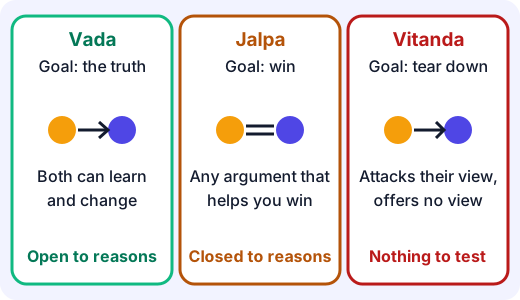
- Vāda is debate to find the truth. Both sides give honest reasons and want to know who is right. If a good argument turns up, either side may be persuaded. This is the debate in which changing your mind is the point.
- Jalpa is debate to win. Each person uses any argument that helps, even if they do not believe it. The aim is victory, not truth.
- Vitanda is a debate in which one person only attacks the other's view and puts forward no view of their own. It tears down but builds nothing.
The Nyaya Sutras treat vada as the proper kind of debate for people who really want to know. Notice that many online arguments and many family arguments are jalpa or vitanda, and they feel bad for a reason: nobody can change their mind, because nobody is looking for the truth.
So the first thing to understand is: in vada, you do not lose when you are persuaded. You gain. If Kabir was wrong about phones, then being persuaded means he now holds a better view than he did a minute ago. The only loser is a mistaken belief.
Good reasons and bad reasons to change
Changing your mind is not always good. A person who changes with every wind is not wise either. What matters is why you change.
Good reasons to change your view:
- New evidence. Facts you did not have, such as the bus that is 40 minutes away.
- A mistake found. You notice an error in your reasoning or your numbers.
- A better argument. Someone points to a consideration you missed, or shows that your conclusion does not follow from your reasons.
Bad reasons to change your view:
- Everyone laughed or looked at you.
- You were tired and wanted to stop.
- You wanted to be liked, or feared an argument.
- The other person was louder or more confident.
And the same test works in reverse. There are bad reasons to refuse to change: pride ("I said it, so I must stick to it"), fear of looking foolish, or the feeling that you have already spent so much effort defending the view. Staying firm is only a strength when it is because the reasons still stand.
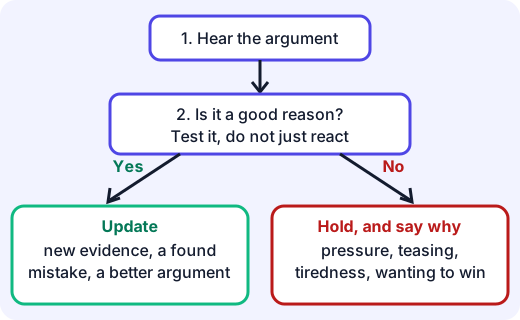
Worked example. Back to Kabir. Leela gives a fact (the bus) and a question (would a lessons-only ban work?). He asks himself the test question: is this a good reason?
- Is the fact true? He checks with the teacher: yes, the bus stop is that far.
- Does it affect my conclusion? His reasons were distraction, fights and playtime. A ban in lessons would cover distraction. The bus problem is a real cost of a full ban.
- How much should I change? Not to the opposite view. He still thinks phones disrupt lessons and spoil play. He changes from "ban phones" to "no phones in lessons or at play, but they may be kept in bags for emergencies."
- Say it. He tells the class what changed and why.
Notice what Kabir did not do. He did not say "you're right, I was totally wrong about everything", and he did not keep arguing against the bus. He moved by the amount the reasons justified.
Changing your mind is not always a sudden flip
Real changes are often partial. Kabir changed part of his view. A scientist might lower her confidence from 90% to 60%, not switch from "yes" to "no". Good thinkers keep the parts that still stand.
History has many examples. The emperor Ashoka's rock edicts, written more than two thousand years ago, speak of his deep regret after the war in Kalinga, when so many people died, and he turned toward ideas of non-violence and care for his subjects. Whatever else we think about his rule, he publicly said what changed his mind. In medicine, two Australian doctors, Barry Marshall and Robin Warren, proposed in the 1980s that a bacterium caused most stomach ulcers, when most doctors believed that stress and food were the cause. Many were unconvinced at first. As evidence built up, including trials of treatment with antibiotics, the medical world changed its mind, and the two shared a Nobel Prize in 2005. Here, the community changed its mind for good reasons.
Misconceptions
- "If I change my mind, I lose." Only in jalpa. In vada, learning is winning.
- "Strong people never back down." A person who never changes cannot learn. Being firm for good reasons is strength. Being firm only for pride is stubbornness.
- "Changing means I was stupid before." You did the best with what you knew then. The mistake is not in having a view but in refusing to test it.
- "Changing often shows you are wise." Not unless the changes follow reasons. Switching to whoever spoke last is not wisdom either.
How to change your mind well
- Say what convinced you ("The bus problem convinced me").
- Say what you still think. Don't throw away what still stands.
- Thank the person who showed you. It makes the next vada easier.
- Do not pretend you always held the new view. Honesty makes it believable.
Try it: Remember a time you changed your mind about something, perhaps a food, a person, or a belief. What changed it: a fact, an argument, a feeling or someone's pressure? Was it a good reason?
Remember
- Vada seeks truth; jalpa seeks victory; vitanda only attacks.
- Good reasons to change are new evidence, a found mistake and a better argument. Pressure and embarrassment are not.
- Change by the amount the reasons justify, and say what changed.
- Holding firm is a strength when the reasons still stand, a weakness when it is only pride.
Quick check
New puzzles
Decide which reasons are good enough to change a mind, and how to do it well.
1.Match each kind of debate with its aim.
- vada
- jalpa
- vitanda
Match each to: to attack the other's view without offering your own · to win by whatever argument works · to find the truth together
2.Which of these is the best reason to change your mind about whether a new road should be built through a forest?
- A survey shows the forest shelters an animal found nowhere else, which you did not know.
- Your friends laughed when you said the road was a good idea.
- You are bored of the argument.
- The person arguing against you spoke very loudly.
Choose one
3.Which of these are signs that someone is changing their mind well? Pick all that apply.
- They say what convinced them.
- They pretend they always believed the new view.
- They keep the parts of their view that still stand.
- They switch to whatever the last speaker said.
Choose all that apply
4.Put the steps of revising a view in a sensible order.
- Hear the other person's argument
- Decide how much of your view to change
- Test whether it is a good reason
- Say what changed and why
Put these in order
5.Mira argued that a school should have a longer lunch break. Sam argued back loudly and everyone cheered, but Sam gave no new reason. Mira says, 'Fine, you're right,' to end the argument. Is that a good reason to change her view?
- No. She changed because of the pressure, not because of an argument, and she should ask what reason supports Sam's view.
- Yes. The louder side is always right.
- Yes. Changing your mind is always good.
- No. She should never change her mind, whatever the reasons.
Choose one
Answering and checking are for registered learners. Register to do this.
Your turn
Shastrartha - is changing your mind a weakness?
The question: Is changing your mind a sign of weakness?
Write 14 to 20 sentences, or prepare a three-minute talk. Use all of these parts.
- Your position (pratijna). Yes, no, or "it depends on why", in one sentence.
- Reasons (hetu). Give at least two reasons. Use the difference between good and bad reasons to change, and between vada and jalpa.
- An example (udaharana). Use Kabir and Leela, Ashoka, the stomach-ulcer doctors, or a time you or someone you know changed a view, and show how your reason fits it.
- The other side (purvapaksha). State the strongest case that changing your mind is weak, in words its supporters would accept.
- Sound reasoning (hetvabhasa). Look for false steps in your reasoning. For example: "she was persuaded, so she was right to be" or "he stuck to his view, so he was strong". Name a weak spot in your own argument.
- An objection (tarka). Answer this: "If anyone can change your mind with a good argument, then you will believe whatever the cleverest speaker says, even when they are wrong." Say what is true in it and give your reply.
- Open to change (vada). Say what would change your mind about this question, or show how thinking it through changed something in your view.
- Conclusion (nigamana). End with a conclusion that follows from your reasons.
How it's judged
- Clear position and a conclusion that follows (pratijna and nigamana)
- Reasons and examples (hetu and udaharana)
- Fair to the other side (purvapaksha)
- Sound reasoning (hetvabhasa)
- Answers the objection (tarka)
- Open to changing the view for good reasons (vada)
Writing and submitting your answer is for registered learners. Register to do this.
Your turn
Explain it - vada and winning
Your cousin says: "Debates are about winning. If you give in, you lose."
Write what you would say back, in 8 to 12 sentences. Include:
- What vada is and how it differs from jalpa.
- Two good reasons to change your mind and two bad reasons.
- An example of someone changing their mind well, from the reading or your own life.
How it's judged
- Explains vada and jalpa
- Good and bad reasons to change
- Example of changing well
Writing and submitting your answer is for registered learners. Register to do this.
Like what you see?
Register for free to answer the quick checks, do the activities and save your work. Your work is saved on your device and syncs to your account.