Unit 5
Who counts as "you"?
Explore what makes you the same person from age five to fifty, and why identity has layers rather than one answer.
Read
The ship, the river and you
Find a photograph of yourself from when you were four or five. Look at it for a minute.
That child was much smaller than you. They may have had different teeth, a different haircut, a different favourite food and different fears. They could not read the way you do. They have probably forgotten most of what you remember now, and you have forgotten most of what they knew.
And yet you say, without any doubt, "That is me."
Why? What exactly is the same between that child and you? This is the question of identity, and our prashna this week is a sharp version of it: if you changed everything about yourself, would you still be you?
A ship that was rebuilt
Philosophers have used a puzzle for more than two thousand years. It is usually told about a ship, called the ship of Theseus, kept in a harbour as a memorial. As the wood rotted, the harbour keepers replaced the planks one at a time with new ones. After many years, not one original plank remained.
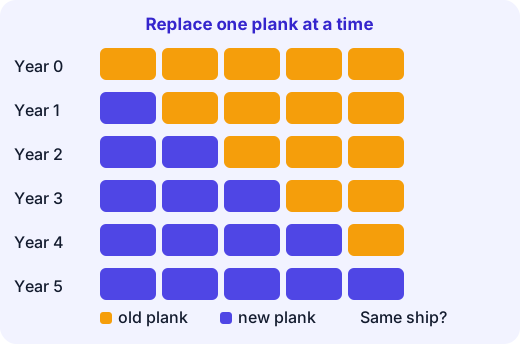
Worked example. Suppose the ship has 20 planks and the keepers replace 4 each year. How long until no original plank is left? years. At the end of year 3, 12 planks have been replaced and 8 are original. Is it the same ship then? Most people say yes. At year 5? Then everything is new, and many people hesitate.
This shows the puzzle's shape. At every single step, nothing important changes, so we say "same ship". But the steps add up. Where, if anywhere, did it stop being the same ship? To make it harder, imagine someone gathers the old planks and rebuilds them as a second ship. Which one is the real one?
Think about a river too. The Ganga at Varanasi today holds none of the water it held last year. We still call it the same river. What makes it the same is not the water, but something else: its path, its banks, its history and its name, which continue through the change.
Four answers people have given
If identity is not just "the same stuff", then what is it? Here are the main answers, and what each gets right and wrong.
Answer It says you are the same person if... A problem The body view it is the same living body Your body changes constantly, and we could imagine a person in a new body The memory view you can remember being that earlier person We forget most of our past, and a person who has lost memory is still the same person to those who love them The character view your values, habits and way of being persist Characters change. A shy child may become a bold adult The chain view each stage overlaps and connects to the next, like links in a chain Where do we draw the line if the chain changes very quickly? A widely known fact check: you may hear that "every cell in your body is replaced every seven years". That is a myth. Many cells are replaced often (skin and the lining of the gut, for example), but many neurons in the brain last most of a lifetime, and the number is not the same for every tissue. So the real body is more like the repaired ship than the entirely new one.
A famous Buddhist text, the Milindapanha ("The Questions of King Milinda"), puts a related puzzle through the monk Nagasena. He asks the king how he came: on foot or in a chariot? In a chariot. Then he asks, what is the chariot: the wheel? the axle? the frame? the flag-pole? The king says no part is the chariot, yet it is not something apart from the parts either. "Chariot" is a name for the parts arranged and working together. Nagasena says the same about a person. The Buddhist view is that there is no unchanging inner core; the person is a stream of connected processes. Other Indian traditions, such as Vedanta and Nyaya, argue the opposite, that there is a self (atman) that continues. This is a real debate, not a settled one, and you can take part in it.
Identity has layers
So far the question was "what stays the same?". But identity also asks "who am I?" and "where do I belong?" People answer that using several layers at once.
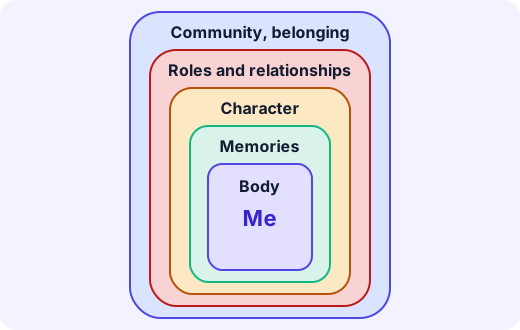
- Body. Your face, your height, your health.
- Memories. What you remember, including stories your family tells you about when you were small.
- Character. What you value and how you tend to act: curious, kind, stubborn, funny.
- Roles and relationships. Daughter, brother, friend, student, teammate. Others know you by these.
- Community, language and belonging. The languages you speak, the places and traditions you are part of, the groups that count you as one of them.
Layers explain why the answer to "are you the same?" is rarely a plain yes or no. After moving to a new city, a new school and a new set of friends, a boy named Dev might have changed in his roles, his friends and even his accent. But he is still kind, still funny, still remembers his old street, and still has his grandmother's recipes and his name. If an old friend says, "You've completely changed, you're not the Dev I knew", the layers help you reply. Some layers changed. Others carried on. "Completely" is too strong.
The misconceptions
- "If anything changes, you're a different person." If that were true, you would be a new person every morning. A person who learns a new language, grows taller or changes a view is still the one who did it. Change is part of being a person.
- "If you are the same person, you can't really change." Also false. Being the same person over time does not mean being frozen. The point of growing up is to change.
- "Identity is one thing, and I get to pick it." Some layers you choose (friends, hobbies, beliefs). Others you are given (family, birthplace, body) or others give you (a nickname, a label). Identity is partly chosen, partly given, and partly made by how others treat you.
Back to the prashna
If you changed everything about yourself, would you still be you? Here are the two sides.
- Yes, still you. Because the changes happened one after another, like the ship, there was always someone who made each change. The thread of connection is what makes you you, not any one feature.
- No, not you. If everything changed at once, body, memories, character and relationships, there would be nothing left to connect the two. We would say the old person is gone, and a new one is here.
A good answer takes a side and explains what it counts as "you". Is it the chain, the character, the memories, or something deeper? And a good answer notices which layers it is talking about.
Try it: Draw your own layers. For each layer, write one thing that has changed since you were six and one thing that has stayed. Which layer feels most like "the real you"? Does your friend choose the same one?
Remember
- Identity over time is the puzzle of what stays the same while things change.
- There are several answers (body, memory, character, chain), and each has problems.
- Identity has layers, partly chosen and partly given.
- "Everything changes" and "nothing changes" are both too simple. Ask what changed and what continued.
Quick check
New puzzles
Use the ideas of identity over time and layers of identity in situations that are new.
1.A wooden boat has 24 planks. Each year the owner replaces 6 of the original planks. After how many years has every original plank been replaced?
Answer with a number
2.Match each view of what makes you the same person over time with its idea.
- Body view
- Memory view
- Character view
- Chain view
Match each to: each stage overlaps with the next, like links · the same living body continues · you remember being the earlier person · your values and ways of acting continue
3.A grandfather has lost many of his memories. Someone argues, 'Since he cannot remember his life, he is no longer the same person.' What does this case most show?
- A view that makes memory the only test of identity seems too narrow, since his body, character and relationships continue.
- That identity does not matter.
- That he has become a completely new person with no link to the earlier one.
- That only bodies matter, never memories.
Choose one
4.Someone says, 'The water in the river is completely replaced in a few days, so it is a different river every week.' What is the best reply?
- A river is identified by more than its water, such as its path, banks and history, so it can stay the same river while the water changes.
- Rivers never change at all.
- Water is not real.
- A river can only be the same if the water stays the same.
Choose one
5.Meena moves to a new country and learns a new language. Her cousin says, 'You are not the Meena I knew.' Which reply best uses the idea of layers?
- Some layers, like my language and surroundings, have changed, but others, like my values, memories and family bonds, continue.
- Nothing about me has changed.
- Everything about me changed, so I am a stranger.
- Identity is only about my name.
Choose one
Answering and checking are for registered learners. Register to do this.
Your turn
Shastrartha - if you change everything, are you still you?
The question: If you change everything about yourself, are you still you?
Write 14 to 20 sentences, or prepare a three-minute talk. Use all of these parts.
- Your position (pratijna). Say yes, no, or "it depends on what changes", in one sentence.
- Reasons (hetu). Give at least two reasons. Say what you think makes a person the same over time: the body, memories, character, a chain of connected changes, or something else.
- An example (udaharana). Use the ship of Theseus, the river, the chariot, Dev's move, or a real change in someone you know, and apply your reason to it.
- The other side (purvapaksha). State the strongest view that disagrees with you, in words its supporters would accept.
- Sound reasoning (hetvabhasa). Check for false steps. For example: "the ship's planks changed, so it is obviously a different ship" ignores how gradually it changed, and "I feel like the same person, so I am" needs support. Name one weak spot in your argument.
- An objection (tarka). Answer this: "If you say a person can change a lot and still be the same, then 'same person' means nothing. Anyone could be anyone." Say what is true in it and reply.
- Open to change (vada). Say what argument or example would change your mind, or what changed in your thinking while you wrote.
- Conclusion (nigamana). End with a conclusion that follows from your reasons.
How it's judged
- Clear position and a conclusion that follows (pratijna and nigamana)
- Reasons and examples (hetu and udaharana)
- Fair to the other side (purvapaksha)
- Sound reasoning (hetvabhasa)
- Answers the objection (tarka)
- Open to changing the view for good reasons (vada)
Writing and submitting your answer is for registered learners. Register to do this.
Your turn
Explain it - the layers of who you are
A friend says: "People either change or they don't. You're either the same person as you were at six, or you're not."
Write what you would say back, in 8 to 12 sentences. Include:
- The ship of Theseus (or the river) and what it shows about change and sameness.
- At least three layers of identity, with one thing about you that has changed and one that has stayed in two of those layers.
- Why "yes or no" is too simple an answer.
How it's judged
- Uses the ship or river puzzle correctly
- Layers with real examples
- Explains why "yes or no" is too simple
Writing and submitting your answer is for registered learners. Register to do this.
Like what you see?
Register for free to answer the quick checks, do the activities and save your work. Your work is saved on your device and syncs to your account.