Unit 1
Fold, cut and join
Make careful folds and cuts, join paper with glue or tape, and fold a paper dog face.
Read
Careful hands, careful steps
Anaya wants to fold a paper hat for the school play. She folds fast. The corners do not meet. The edges stick out. The hat flops over.
Her cousin Dev folds the same kind of paper. He goes slowly. He lines up the corners first. Only then does he press the fold flat. His hat stands up straight.
The paper was the same. The difference was careful hands.
Four words to know
Word What it means fold bend paper over on itself crease the sharp line a fold leaves behind cut divide paper with scissors glue and tape two ways to join pieces together How to make a good fold
- Look at the paper. Which corner goes to which corner?
- Line up the edges or corners. Do not press yet.
- Hold them still with one hand.
- Press the fold flat with the other hand, from the middle out to the edge.
- Crease it. Run your thumbnail along the fold so it is sharp.
If the corners did not meet, open the paper and try again. A paper with one crooked fold is hard to fix later, so fix it now.
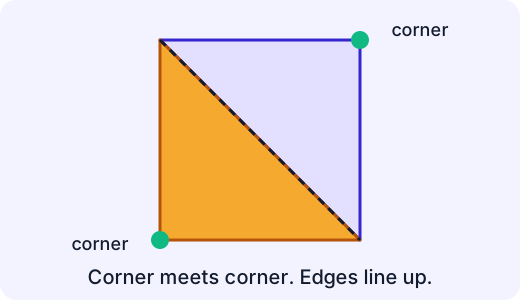
Try it: Take a square of paper. Fold one corner onto the opposite corner. Do the edges line up? Press the crease. You just made a triangle from a square.
How to cut along a line
- Draw the line first, with a pencil.
- Hold the paper with your helper hand. Keep your fingers away from the blades.
- Open the scissors wide and cut with the part near the screw. Cut a little at a time.
- Turn the paper, not the scissors, when the line bends.
Paper scissors for children have round tips. Always carry them closed, with the points down.
How to join
- Glue: use a small dot or a thin line. A lot of glue makes paper wet and wrinkly. Press the pieces together and wait for it to dry.
- Tape: sticks straight away. Tear or cut a short piece. Press it down flat.
Folding a dog face
You can fold paper into an animal. This is called origami, a Japanese word, and children around the world make it now. Here is an easy one. It has three steps.
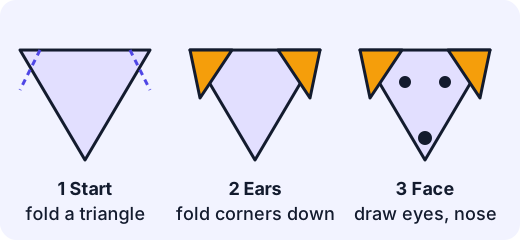
A fold only works if the one before it was neat. That is what we mean by careful hands follow careful steps.
A mistake that is normal
Many children think a fold is done when the paper is bent. It is done when the edges line up and the crease is flat. Bent is not folded.
For the grown-up helping
Let your child do the folding, even when it is slow. Say what you see, not "good job": "The corners meet. Your crease is sharp." If a fold is crooked, ask "What could you do?" and let them unfold it. Children aged six and seven often need several tries; that is practice, not failure. Stay close while they use scissors.
Activity
Fold, cut and join
Your child folds a paper dog face, then cuts a wavy line and joins the pieces back with tape. About 25 minutes.
You'll need
- 2 square sheets of paper (cut a square from a sheet of plain paper or use origami paper)
- 1 more sheet of plain paper
- Child-safe scissors with round tips
- Glue stick or tape
- A pencil and a marker or crayon
Steps
- Part 1, the dog face. Place the square flat with a corner pointing toward your child, like a diamond. Fold the top corner down to the bottom corner. Line up the edges first. Press from the middle out. Run a thumbnail along the crease.
- You now have a triangle with the long edge at the top. Fold the left top corner down and a little outward to make an ear. Do the same on the right.
- Draw two eyes and a nose on the lower part with the marker. Your dog is done.
- Check it together: do the two ears match? Did the first fold's edges line up? If not, unfold and try again with the second square.
- Part 2, cut and join. Draw a wavy line across the plain sheet with a pencil. Your child cuts along it, turning the paper (not the scissors) at the bends.
- Now join the two pieces back with a strip of tape on the back, or a thin line of glue on the edge. Press the edges together so they touch with no gap.
- Ask "Which fold, cut or join was hardest? What would you do differently?"
Safety
- An adult stays close while scissors are used. Scissors travel closed, points down.
- Keep the glue stick and tape away from mouths and hair.
- Put paper scraps in the bin so nobody slips on them.
Keeping a log of the activity is for registered learners. Register to do this.
Quick check
Fold, cut and join check
Seven questions about careful folding, cutting and joining.
1.Which fold is neat?
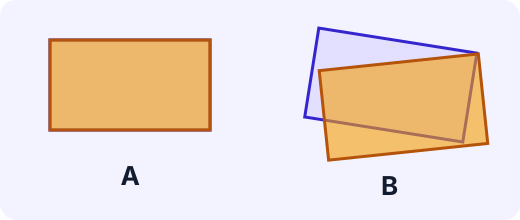
- A, the edges line up
- B, the edges are crooked
Choose one
2.You fold a square corner to the opposite corner. What shape do you get?
- A triangle
- A smaller square
- A circle
Choose one
3.Your fold came out crooked. What is the best thing to do?
- Unfold it and fold again, lining up the edges first
- Keep going and hope it gets better
- Press it harder
Choose one
4.Put the steps for a good fold in order.
- Hold them still
- Press the fold flat from the middle out
- Run a thumbnail along the crease
- Line up the edges or corners
Put these in order
5.Match each word to what it means.
- crease
- cut
- tape
Match each to: divide paper with scissors · a sticky strip that joins paper right away · the sharp line a fold leaves
6.Your cutting line bends to the left. How do you follow it?
- Turn the paper a little as you cut
- Cut faster to get there
- Pull the paper hard toward you
Choose one
7.How much glue should you use to join two pieces of paper?
- A thin line or small dots
- As much as you can squeeze out
- None at all, because paper sticks by itself
Choose one
Answering and checking are for registered learners. Register to do this.
Quick check
New puzzles
Use what you know about careful folding in new situations.
1.You fold a sheet of paper in half, then in half again. You open it flat. How many equal parts do the crease lines make?
Answer with a number
2.You fold a sheet in half and cut along the crease with scissors. How many pieces do you have?
Answer with a number
3.Ravi's paper boat has a flap that sticks out on one side. What should he check first?
- Whether the edges lined up before he pressed the crease
- Whether the paper is the right colour
- Whether he used enough glue
Choose one
4.Which will hold a sharp crease better?
- A thin sheet of writing paper
- A thick piece of cardboard
Choose one
Answering and checking are for registered learners. Register to do this.
Activity
Tell it back
Your child explains why careful hands matter when folding. Two minutes.
Steps
- Show the paper dog face (or fold a quick triangle together). Ask "What did you do to make the fold neat?"
- Ask "What happens if the first fold is crooked?" Let your child show you with a sheet of paper if they like.
- Write down what your child says, in their own words.
Keeping a log of the activity is for registered learners. Register to do this.
Like what you see?
Register for free to answer the quick checks, do the activities and save your work. Your work is saved on your device and syncs to your account.