Unit 2
Shaping clay
Roll, pinch and coil clay into a pot, and find out why clay keeps the shape you give it.
Read
Press it and it stays
In many Indian villages, a potter sits at a wheel with a lump of wet clay. He presses his thumbs into it. The lump grows tall and hollow. In a few minutes it is a pot for carrying water. In other places, children make little oil lamps, called diyas, from clay too.
Try pressing your thumb into a rubber ball. When you let go, the dent springs back. Now press your thumb into clay. The dent stays. Clay is a material that changes shape when you press it, and it keeps the new shape.
Three moves
You can make almost anything from clay with three moves.
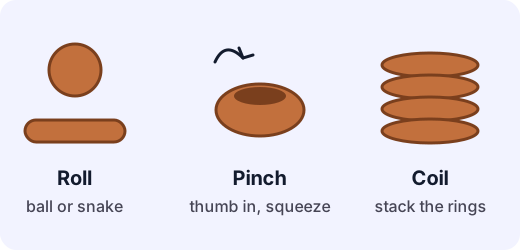
- Roll. Rub the clay between your palms to make a ball. Roll it on the table with your fingers flat to make a long snake.
- Pinch. Push your thumb into the middle of a ball. Pinch the clay between your thumb and fingers and turn it slowly. The walls get thinner and the bowl gets wider.
- Coil. Roll a long snake. Lay it round in a ring on a flat base. Roll another snake and put it on top. Keep going and press the rings together.
A coil pot
A coil pot grows ring by ring.
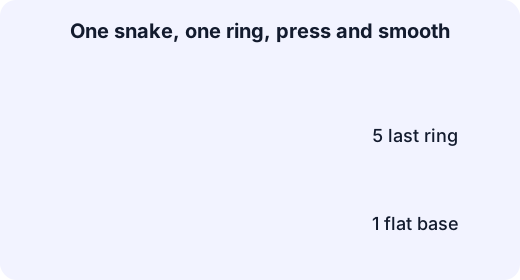
Press each ring onto the one below and smooth the clay across the join with a wet finger. If you skip the smoothing, the rings can come apart when the clay dries.
Looking after clay
- Clay that is too dry cracks. Wet your fingers a little and smooth it.
- Clay that is too wet is sticky and slumps. Let it sit a few minutes.
- Pots with a round bottom roll over. Tap the base on the table to flatten it.
- Wrap leftover clay in a damp cloth or plastic so it stays soft.
Clay that stays
Soft clay can be squashed and shaped again and again. But when a pot dries it becomes hard, and when it is baked very hot in a kiln it becomes hard for good and cannot be reshaped. That is how a baked clay pot can hold water for many years. A pot that is only air-dried would turn soft again in water. Some modelling doughs and clays never harden. They are fun, but they are not for pots.
A mistake that is normal
Many children think a lumpy first pot means they are bad at clay. Potters throw away lumpy pots all the time. The skill is in the trying again.
For the grown-up helping
Let your child squish and explore for a few minutes before asking for a pot; that is how they learn what the clay does. Real clay is best, but air-dry clay or salt dough works. Ask open questions: "What happens if you press harder?" Do not fix their pot for them. Help with the safety rules: wash hands after, never eat it, and keep it out of sink drains.
Activity
Make a pot
Your child makes a pinch pot, then a coil pot or a small clay figure. About 40 minutes, including clean-up.
You'll need
- A fist-sized lump of clay, air-dry clay or salt dough (see below)
- A plastic tray, board or old tablecloth to work on
- A small bowl of water
- A damp cloth or plastic bag to wrap leftover clay
- Optional - a toothpick or spoon handle for patterns
Steps
- Explore first. Let your child squeeze, flatten and roll the clay for a few minutes. Ask 'What happens when you press? Does it spring back?'
- Roll. Make a ball the size of a plum by rubbing it between the palms. Then roll one part into a snake on the table with flat fingers.
- Pinch pot. Push a thumb into the ball, stopping before the bottom. Pinch the wall between thumb and fingers while slowly turning the clay. Keep the walls even.
- Tap the bottom on the table so the pot sits flat.
- Coil or figure. Roll a flat circle for a base. Roll 3 or 4 snakes. Lay one in a ring on the edge of the base, press it down, smooth the join with a wet finger, and add the next ring. Or shape a small animal from balls and snakes.
- Press patterns into the wet clay with a toothpick if you like.
- Ask 'How did the clay change when you pressed it? What stayed the same?'
- Leave the pots to air-dry for a few days. Wrap leftover clay in a damp cloth. An adult can bake oven-bake clay if the packet says so.
Safety
- Clay is not food. Do not put clay or salt dough in the mouth.
- Wash hands with soap after. Do not wash clay down the sink; wipe it into a bin.
- An adult does any baking or kiln firing, following the packet.
- Use a toothpick only under supervision; keep the point away from faces.
Keeping a log of the activity is for registered learners. Register to do this.
Quick check
Shaping clay check
Six questions about clay. Look at the pictures.
1.Match each clay move to what you do.
- roll
- pinch
- coil
Match each to: push a thumb in and squeeze the wall thinner · stack rings of clay snake · rub clay into a ball or a long snake
2.You press your thumb into each one. Which keeps the dent?
- A lump of clay
- A rubber ball
- A sponge
Choose one
3.Which pot was made from coils?
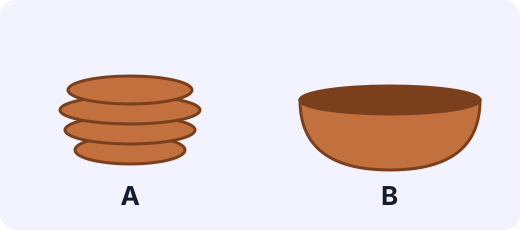
- Pot A, with stacked rings
- Pot B, one smooth bowl
Choose one
4.Put the steps for making a pinch pot in order, first to last.
- Roll the clay into a ball
- Tap the finished pot on the table so the bottom is flat
- Pinch the wall and turn the clay
- Push a thumb into the middle
Put these in order
5.Your clay is dry and cracks when you bend it. What helps?
- Wet your fingers a little and smooth it
- Press it as hard as you can
- Put it in the sun to get drier
Choose one
6.Choose all the good clay habits.
- Wash your hands when you finish
- Taste the clay to check it
- Wrap leftover clay so it stays soft
- Rinse clay down the sink
Choose all that apply
Answering and checking are for registered learners. Register to do this.
Quick check
New puzzles
Use what you know about clay in new situations.
1.Soft clay is pressed flat like a pancake. Can it be rolled back into a ball?
- Yes, soft clay keeps a new shape and can be reshaped
- No, it can only ever be a pancake
Choose one
2.Mira's pot has a round bottom and it keeps rolling over. What should she do?
- Tap the bottom on the table to make it flat
- Make the walls thinner
- Add a lid
Choose one
3.Each ring of a coil pot uses one clay snake. Nina wants a pot with 6 rings. How many snakes does she need?
Answer with a number
4.A tennis ball, a sponge and a lump of clay each get a thumb dent. An hour later, which still has the dent?
- The clay
- The tennis ball and the sponge
- All three
Choose one
Answering and checking are for registered learners. Register to do this.
Activity
Tell it back
Your child explains what clay does when you press it, and how they made their pot. Three minutes.
Steps
- Hold the clay pot (or a fresh lump of clay). Ask "What happens when you press clay? What is different from pressing a ball?"
- Ask "How did you make your pot? Tell me the moves in order."
- Write down what your child says, in their own words.
Keeping a log of the activity is for registered learners. Register to do this.
Like what you see?
Register for free to answer the quick checks, do the activities and save your work. Your work is saved on your device and syncs to your account.