Unit 4
Needs, wants and saving
Tell needs from wants, then save coins toward a goal and watch the total grow.
Read
Choosing later over now
Kabir has ₹20 from his grandmother. At the fair there is ice cream for ₹20. He wants it right now.
But Kabir also wants a kite that costs ₹40. If he buys the ice cream, the money is gone. If he keeps the ₹20 and saves more, he can buy the kite later.
What should Kabir do? There is no one right answer for every child. But thinking about it is the start of knowing about money.
Needs and wants
Some things we must have to stay alive, well and safe. These are needs.
Other things are nice to have. These are wants.
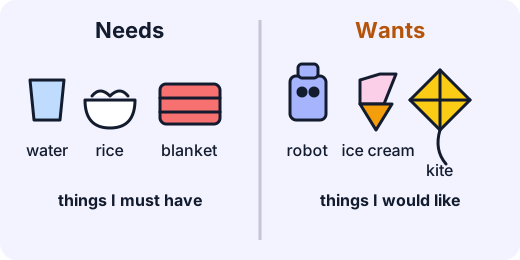
Need Want Clean water to drink A fizzy drink Rice, dal and fruit Sweets and chips A warm coat in winter A coat with sparkles Medicine when you are sick A toy robot Wants are not bad. A kite is lovely. But wants wait, and needs do not. Sometimes a thing is both: you need shoes, but you want a very fancy pair. When you are unsure, ask "Can I stay well and safe without it?"
Saving
Saving means keeping some money to use later. When you save, you choose later over now. You give up ice cream today so that you can have something you want more.
A goal is the thing you are saving for. Having a goal makes saving easier, because you can see where the coins are going.
Save toward a goal
Suppose Kabir wants a kite that costs ₹40. He has ₹20 and he saves ₹5 each week.
- After 1 week: ₹25
- After 2 weeks: ₹30
- After 3 weeks: ₹35
- After 4 weeks: ₹40. He has enough!
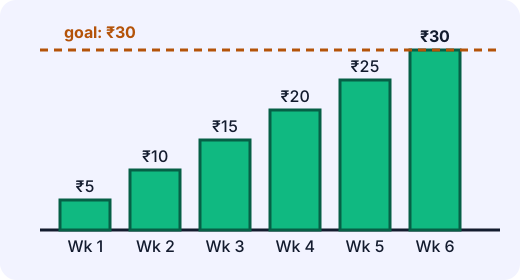
To track the total, write the amount in a chart each time you add money. Count the coins in your jar to check. The total goes up every time you save. If you spend some, it goes down.
Try it: You want a toy that costs ₹30. You save ₹5 each week. How many weeks? Count in fives: 5, 10, 15, 20, 25, 30. That is 6 weeks.
A mistake that is normal
Many children think saving means you can never have fun. It does not. Saving means you decide when. You can still spend money. You just choose on purpose, not on a rush.
For the grown-up helping
Use real coins and a clear jar or tin so your child can see the total grow. Let them handle money and count it aloud. Talk about needs and wants using the family's own choices, without shaming ("We need to buy rice this week; the kite can wait"). Keep coins away from children under three: they are a choking hazard. Allow your child to decide where their own savings go within the limits you set.
Lab
Needs, wants and my savings jar
Sort eight things into needs and wants. Then pick a goal and put coins in the jar until you can buy it.
Your goals
- Sort all eight cards into needs and wants.
- Pick a goal and save coins in the jar until the total reaches the price.
The interactive lab opens once you register. Register to do this.
Activity
Save for a goal
Your child sorts real things into needs and wants, then picks a small goal and saves coins toward it for a few weeks. About 20 minutes to set up, then a minute each week.
You'll need
- A jar, tin or box with a lid
- Coins (from the family's usual pocket money or a few coins set aside)
- Paper and a pencil
- Pictures of things from a shop flyer, or real things from home
Steps
- Sort. Put a few things on the table, such as a water bottle, a toy, a coat, a packet of sweets, a school book, a game. Your child puts needs in one pile and wants in another. Ask 'Why?' for each.
- Choose a goal your child really wants and that costs a small amount, such as a small toy, a book or a kite. Find out the price together and write it on a sheet.
- Draw a chart with the weeks in a row and a row for the total. Each week, your child puts coins in the jar.
- Each time, count the coins aloud and write the new total on the chart. Colour a bar or a row of boxes to show the total growing toward the goal.
- Ask "How many more rupees to go? How many more weeks if you save the same each week?"
- When the jar reaches the price, go and buy the goal together. Ask 'How did it feel to wait?'
Safety
- Keep coins away from children under three, and away from mouths. Coins are a choking hazard.
- Keep the jar somewhere safe at home. Do not take a jar full of money outside.
- Never ask a child to hand money to a stranger; the buying is done with a grown-up.
Keeping a log of the activity is for registered learners. Register to do this.
Quick check
Needs, wants and saving check
Seven questions about needs, wants and saving.
1.Choose all the needs.
- Clean drinking water
- A new toy
- Medicine when you are sick
- A bag of sweets
- A warm coat in winter
Choose all that apply
2.How many rupees are in the jar?
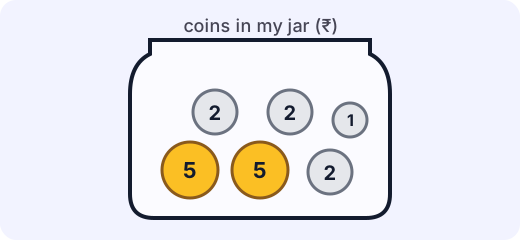
Answer with a number
3.A kite costs ₹40. You have ₹25. How many more rupees do you need?
Answer with a number
4.You save ₹5 every week. How many weeks until you have ₹30?
Answer with a number
5.What does saving mean?
- Keeping some money to use later, choosing later over now
- Spending everything today
- Never spending any money at all
Choose one
6.What is a savings goal?
- The thing you are saving for
- The jar the coins are in
- The shop where you buy it
Choose one
7.Put the steps for saving toward a goal in order.
- Find out its price
- Put coins aside each week
- Write down the new total each time
- Pick a goal
Put these in order
Answering and checking are for registered learners. Register to do this.
Quick check
New puzzles
Use what you know about needs, wants and saving in new situations.
1.Mira has ₹20 and wants a book that costs ₹50. She saves ₹5 each week. How many weeks until she has enough?
Answer with a number
2.Your jar has ₹12. You spend ₹4 on ice cream. How much is left in the jar?
Answer with a number
3.It is very cold and Leo has no coat. Is a coat a need or a want for Leo?
- A need
- A want
Choose one
4.Ananya has two pairs of shoes that fit. She wants a third pair just because it is pink. Is the third pair a need or a want?
- A need
- A want
Choose one
Answering and checking are for registered learners. Register to do this.
Activity
Tell it back
Your child explains the difference between a need and a want, and what saving means. Three minutes.
Steps
- Ask "What is a need? What is a want? Can you give me one of each?"
- Ask "What does it mean to save? Why might someone choose to save instead of spend right now?"
- Write down what your child says, in their own words.
Keeping a log of the activity is for registered learners. Register to do this.
Like what you see?
Register for free to answer the quick checks, do the activities and save your work. Your work is saved on your device and syncs to your account.