Unit 3
Caring for my space
Take on a regular job at home or school for two weeks, keep a log, and see how everyone's part keeps a shared place nice.
Read
Everyone does their part
Imagine a classroom where nobody ever tidies up. Pencils on the floor. Chairs in the way. Dry leaves in the plant pot.
Now imagine the same room where each child has a small job. One pushes in the chairs. One waters the plant. One collects the pencils. In five minutes the room is nice again.
A room like that is a shared space. It belongs to everyone who uses it. A shared space stays nice when everyone does their part.
Shared spaces
You are in shared spaces every day.
- The kitchen and living room at home.
- Your classroom and the school corridor.
- A park or a playground.
If one person tidies up alone, it takes a long time. If everyone does a little, it is quick, and nobody gets tired.
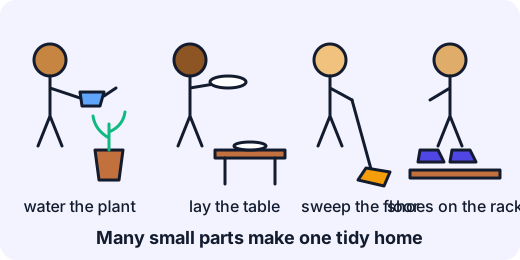
A regular job
A regular job is a job you do again and again, at the same time. Some examples:
- Watering the plants every morning.
- Laying the table before dinner.
- Putting your shoes and bag in their place after school.
A regular job is different from a one-time job, like wiping up one spill. A regular job gets easier because it turns into a habit.
In many schools in Japan, children clean their own classroom and corridor together every day, and take turns serving lunch. Everyone has a part, so the school stays clean without anyone feeling it is only their job.
Keep a log
How will you know if you really did your job? Keep a log. A log is a chart that shows each day. When you do the job, you give the day a tick.
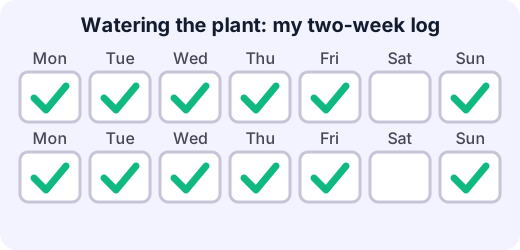
Here is how to make your log work:
- Pick a job small enough to do every day. Five minutes is plenty.
- Pick a time, such as right after breakfast.
- Tick the box straight after you finish, so you do not forget.
- If you miss a day, leave it empty. Do not tick a day you did not do. Then do it again tomorrow.
After two weeks, count your ticks. A log shows you the truth, even when it has gaps. That is useful.
A mistake that is normal
Many children think a job is only worth doing if it is big. But a small job done every day is worth more than a big job done once. Tiny parts add up to a clean, happy space.
For the grown-up helping
Let your child choose from two or three jobs, then keep the same one for two weeks so it becomes a habit. Choose something real, not pretend: it should matter to the household. Remind gently at the same time each day, and then step back. Praise the effort and the log, not perfection. Gaps are normal; talk about them kindly ("What could help you remember?"). The lab on the next screen lets your child set up a log; the real log lives on paper on the wall or fridge.
Lab
Set up my jobs log
Pick a job and a time, then tap the days to see how a two-week log fills up. Your real log goes on paper.
Your goals
- Pick a regular job and a time to do it.
- Tap at least three days to give them a tick and watch the log fill.
The interactive lab opens once you register. Register to do this.
Activity
My two-week job
Your child takes on one regular job at home or school for two weeks and ticks a paper log each day. About 5 minutes a day for 14 days, plus 10 minutes to set up.
You'll need
- A sheet of paper and a pencil or crayons
- A ruler (optional)
- Tape or a magnet to put the log where it is seen every day
Steps
- Choose the job together from two or three real ones: watering the plants, laying the table, putting shoes and bag away, pushing in the chairs, feeding a pet with an adult.
- Choose a time of day that never changes, such as right after breakfast.
- Make the log. Draw 14 boxes in two rows of seven. Write Mon to Sun above each row. Title it with the job.
- Stick it where your child will see it every day, near where the job is done.
- Each day after the job, your child ticks the box. If the job was missed, leave the box empty. Do not tick it later.
- After one week, look at the log together. Ask 'What helped you remember? What got in the way?'
- After two weeks, count the ticks together. Ask 'How did our home look when you did your part? What would happen if everyone skipped their job?'
Safety
- Choose jobs that suit a six- or seven-year-old. Adults handle hot, sharp and heavy things and cleaning chemicals.
- Pets are fed with an adult watching. Wash hands after handling food, soil and pets.
- Watch for wet floors when watering plants indoors.
Keeping a log of the activity is for registered learners. Register to do this.
Quick check
Caring for my space check
Seven questions about shared spaces and regular jobs.
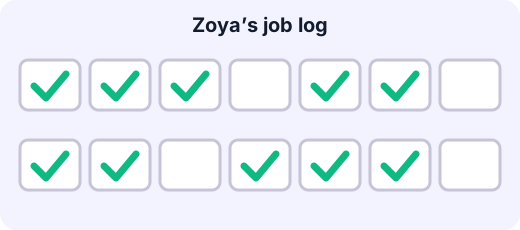
1.Zoya has a log with 14 boxes. On how many days did she do her job?
Answer with a number
2.Look at Zoya's log again. On how many days did she miss her job?
Answer with a number
3.A shared space stays nice when...
- everyone does their part
- one person does all the work
- nobody touches anything
Choose one
4.Which is a regular job?
- Watering the plants every morning
- Wiping up one spill
- Picking up a toy that fell once
Choose one
5.Choose all the things that help a job log work.
- Tick the box right after the job
- Do the job at the same time each day
- Tick days you did not do the job so the log looks full
- Pick a job small enough to do every day
Choose all that apply
6.You forgot your job for two days. What should you do?
- Leave those days empty, do the job today, and think of a reminder
- Tick the missed days anyway
- Stop doing the job
Choose one
7.Dev lays the table for 4 people. Each person gets 1 plate and 1 spoon. How many things does Dev put out in all?
Answer with a number
Answering and checking are for registered learners. Register to do this.
Quick check
New puzzles
Use what you know about shared spaces and jobs in new situations.
1.Ria wants to do her job on all 14 days. She has ticked 9 days. How many days are left to tick?
Answer with a number
2.There are 20 pencils on the classroom floor. 4 friends pick up the same number each. How many pencils does each friend pick up?
Answer with a number
3.Nobody in a family wants to take out the bin. What is a fair way to share the job?
- Take turns, with a chart that shows whose turn it is
- The youngest child always does it
- Leave it until someone gives up
Choose one
4.Sana's job is feeding the fish. When is the best time for a regular job?
- At the same time every day, such as right after breakfast
- Whenever she remembers
- Only on days she feels like it
Choose one
Answering and checking are for registered learners. Register to do this.
Activity
Tell it back
Your child explains why everyone's part matters in a shared space. Two minutes.
Steps
- Ask "What would our home (or classroom) be like if nobody did their job? What is different when everyone does a part?"
- Ask "What was your job? How did the log help?"
- Write down what your child says, in their own words.
Keeping a log of the activity is for registered learners. Register to do this.
Like what you see?
Register for free to answer the quick checks, do the activities and save your work. Your work is saved on your device and syncs to your account.