Unit 4
Running a small stall
Make something simple, set a price, sell it to customers, count the money and find your profit.
Read
Selling something people want
Lakshmi loves making bookmarks. She cuts card, decorates it and ties on a ribbon. Her friends say, "I wish I had one!" So Lakshmi has an idea. What if she sold them at the school fair?
Lakshmi is about to run a stall: a small table where you sell things. Selling is a skill. Let's learn it.
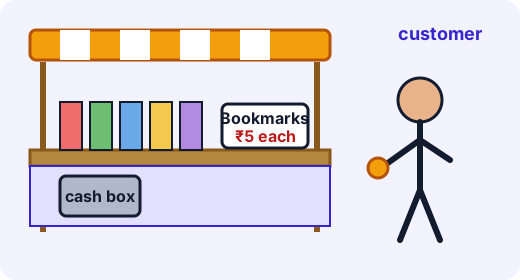
Three words
- A price is how much money you ask for something. Lakshmi's price is ₹5.
- A customer is a person who buys from you. Customers come because they want what you have.
- A profit is the money you gain, after you take away what you spent to make the things.
Make something people want
Before you make anything, ask people. "Would you like a bookmark? What colour?" A good thing to sell is simple, useful or lovely, and you can make it well. Lakshmi will sell bookmarks. A friend sells lemonade. Another sells painted stones.
Set a price
Lakshmi buys card and ribbon for ₹20. It is enough for 10 bookmarks. So her cost is ₹20.
- If her price is too low, she gains nothing. If she sold all 10 for ₹2 each she would only get her ₹20 back.
- If her price is too high, customers walk away.
- A good price is one that customers think is fair, and that is more than it costs you.
Lakshmi decides on ₹5.
Count the money
On fair day, Lakshmi sells 8 bookmarks. 8 × ₹5 = ₹40 taken in. She sorts the coins into piles and counts them in fives and twos.
Now she works out her profit:
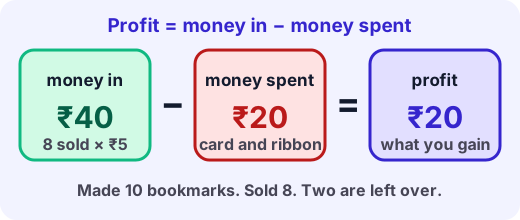
Example. Money in: 8 × 5 = ₹40. Money spent: ₹20. Profit: 40 − 20 = ₹20. She still has 2 bookmarks left to sell another day.
Be careful: the money in the box is not all profit. Some of it pays back what you spent. If you started with some coins of your own in the box (a float, kept for giving change), take those out too.
Giving change
A customer gives ₹10 for a ₹7 bookmark. How much change?
Count up from the price: 7... 8, 9, 10. That is 3 steps, so the change is ₹3 (7 + 3 = 10). You could give three ₹1 coins, or a ₹2 coin and a ₹1 coin.
Try it: Pretend your toys are customers. Make price tags. Use real coins or paper coins and practise change from ₹10.
Selling kindly
Smile. Say hello. Tell people what you are selling and the price. Be honest about your things. Say "thank you" even when someone does not buy.
For the grown-up helping
Help your child choose something they can make well and cheaply, and let them set the price themselves; talk about why. Practise counting coins and giving change at home before the event. Stay close at the stall, keep the cash box in sight, and keep it simple: a few items, small prices. Treat the sale as learning, not earning, whatever the profit. If food is sold, check allergies and hygiene, and keep sharp or hot jobs for a grown-up.
Lab
Open the stall
You make 10 bookmarks every day for a cost of ₹20. Choose a price, open the stall, and see how many customers buy. Then practise giving change.
Your goals
- Try at least four different prices and find the price that earns the most profit.
- Give the right change to three customers.
The interactive lab opens once you register. Register to do this.
Activity
Hold a small stall
Your child makes something simple, sets a price and sells it at a family or school event, then counts the money and works out the profit. Allow one session to make things, one hour for the stall and 15 minutes to count.
You'll need
- Things to sell. Bookmarks, painted stones, paper flowers or lemonade are good, 10 or more of the same kind
- Materials for making them (keep the receipt or a list of what you spent)
- A table and a cloth
- A price sign, card and a marker
- A cash box or tin with a small float of coins for change (a grown-up lends this)
- Paper and a pencil for the sales record
Steps
- Decide what to make. Ask three people "Would you buy this? How much would you pay?"
- Work out your cost. Add up what you spent on materials and divide by how many you will make to find the cost of each one.
- Make the things. Make at least 10, and make them well.
- Choose a price. It must be more than the cost of one. Write it on the sign with the name of the thing.
- Before the event, practise giving change from ₹10 with a friend.
- At the stall, greet each customer, say what you are selling and the price, take the money and give any change. Mark a tally for each one sold.
- Afterwards, sort the coins and count them in piles. Take out the float. That is your money in.
- Work out the profit. Money in minus money spent equals profit.
- Talk about it. Did your price feel right? What would you change next time?
Safety
- A grown-up stays at or near the stall at all times, and looks after the cash box.
- Hold the stall only at a family or school event, or in a place a grown-up has chosen. Never go out alone to sell, and never sell to strangers on your own.
- If you sell food or drink, a grown-up prepares it, keeps it clean, labels what is in it and checks for allergies (nuts, milk, gluten). Use hot water and knives only with a grown-up.
- Wash your hands before preparing food. Keep coins away from babies and toddlers (choking).
Keeping a log of the activity is for registered learners. Register to do this.
Quick check
Small stall check
Six questions about prices, money and profit.
1.How much money is there in all?
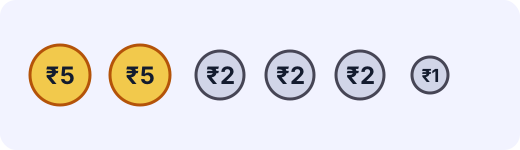
Answer with a number
2.A customer buys 3 pencil toppers at the price on the sign. How much do they pay?
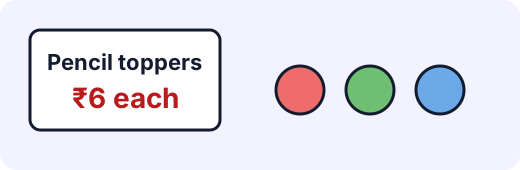
Answer with a number
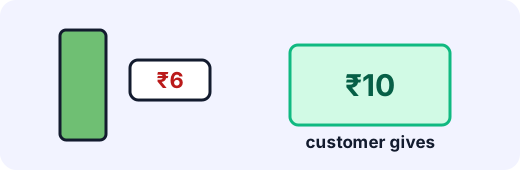
3.The customer gives a ₹10 note for the ₹6 bookmark. How many rupees of change do you give back?
Answer with a number
4.A stall takes in ₹40 and spent ₹25 on materials. What is the profit in rupees?
Answer with a number
5.Match each word to what it means.
- Price
- Customer
- Profit
Match each to: A person who buys from you · The money you gain after taking away what you spent · How much money you ask for something
6.Your price is much higher than most people think the thing is worth. What will probably happen?
- Fewer people will buy
- More people will buy
- Nothing, because price never matters
Choose one
Answering and checking are for registered learners. Register to do this.
Quick check
New puzzles
Use price, customers and profit in new situations.
1.Noor made exactly 6 cups of lemonade. Each cup cost ₹4 to make. She sold all 6 cups at ₹10 each. What was her profit in rupees?
Answer with a number
2.Each bookmark costs Pavan ₹4 to make, and he sells them for ₹3 each. What happens?
- He loses money on every bookmark
- He makes a profit on every bookmark
- He gets exactly his money back
Choose one
3.Three friends say the most they would pay for a painted stone is ₹4, ₹6 and ₹8. If the price is ₹6, how many of them will buy?
Answer with a number
4.At which price would all three friends (₹4, ₹6 and ₹8) buy a painted stone?
- ₹4
- ₹6
- ₹8
Choose one
5.Chen started with a float of ₹20 in the cash box. At the end of the fair the box holds ₹68. Chen spent ₹18 on materials. What was the profit in rupees?
Answer with a number
Answering and checking are for registered learners. Register to do this.
Activity
Tell it back
Your child explains how they chose their price and what profit means. About five minutes, after the stall.
Steps
- Ask "How did you choose your price? What would have happened if it were much higher, or much lower?"
- Ask "What is profit? How did you work out yours?"
- Ask "Why did people buy from you? What did they want?"
- Write down what your child says in their own words.
Keeping a log of the activity is for registered learners. Register to do this.
Like what you see?
Register for free to answer the quick checks, do the activities and save your work. Your work is saved on your device and syncs to your account.