Unit 1
Sewing a running stitch
Thread a blunt needle and sew a neat running stitch to join two pieces of felt.
Read
Up and down with a needle
Asha made a felt fish. It has two halves, a front and a back. She put them together, and they fell apart again. Glue was too messy. What can hold cloth together using only a long thin string?
A thread, a needle, and a stitch.
What is a stitch?
A stitch is one trip of the thread into the cloth and out again. Make many stitches in a row and the thread locks the pieces together. People have joined cloth this way for thousands of years, in every country: saris, school bags, quilts and kites all hold together because of stitches.
Your tools
- Felt is thick, soft cloth. It is the best cloth to start with because its edges do not fray. That means they do not come undone into loose threads.
- A blunt needle has a round tip and a big hole, called the eye. It will not poke your finger easily. A grown-up still stays near.
- Thread or wool. Cut a piece about as long as your arm from fingertips to elbow. Longer thread tangles.
- A knot at one end.
The running stitch
The running stitch is the first stitch to learn. The needle goes up, down, up, down, all along a line. On top you see short stitches with small gaps between them.
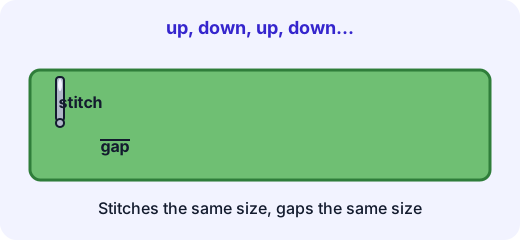
Here are the steps.
- Thread the needle. Push the thread through the eye and pull out a short tail.
- Knot the long end of the thread. Tie a small knot, then another on top of it.
- Put the two pieces of felt together. Start at the back, near the edge. Push the needle up through both pieces. Pull the thread until the knot stops against the felt.
- Push the needle down a little way along, about as far as the width of your small fingernail. This is one stitch.
- Come up again after a gap. Keep going. Pull the thread gently each time.
- To finish, make two tiny stitches on top of each other, then cut the thread, with a grown-up's help if the scissors are sharp.
Try it: Draw a line on paper with dots every 1 cm. Say "up, down, up, down" as you point to each dot. Do this before you try with a real needle.
Why do stitches hold?
Look at the side of the cloth.
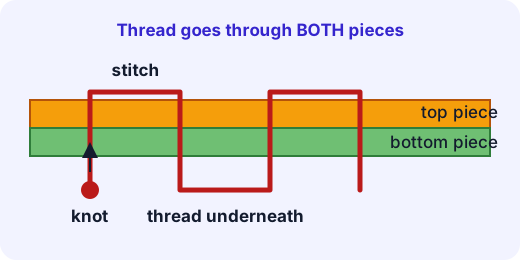
Each stitch goes through both pieces. The knot stops the thread from slipping out. Each stitch is a small bridge. Together, many small bridges are strong.
Tidy stitches
Neat stitches are about the same size, with gaps about the same size. If you pull too hard, the felt puckers. That means it bunches up like a little wave. Pull until the thread is snug, not tight.
A mistake is easy to fix. Gently pull the thread out and sew it again. Makers do this all the time.
For the grown-up helping
Stay close and use a blunt, large-eyed needle (a plastic or wool needle is ideal). Count the needles out and back in. Let your child do their own threading, even if it takes five tries. Uneven stitches are normal at first; praise the careful steps, not only the neat result. If the thread keeps slipping out, the knot is usually too small: a second knot on top fixes it. Left-handed children may find it easier to sew from the other direction, so let them choose.
Activity
Sew a felt bookmark
Your child sews two felt pieces together with a running stitch to make a bookmark or a small pouch. About 30 minutes. Work with a grown-up beside you.
You'll need
- Two pieces of felt, each about 6 cm by 12 cm, in different colours
- A blunt needle with a big eye (a plastic or wool needle)
- Thick thread or wool, in a colour that shows up on the felt
- Child-safe scissors (the grown-up cuts the thread if the scissors are sharp)
- A pencil or chalk and a ruler
Steps
- Lay one piece of felt on top of the other. Draw a faint line 1 cm in from one long edge with the pencil. Mark a dot every 1 cm along the line.
- The grown-up cuts a piece of thread about as long as your child's arm from fingertips to elbow. Your child threads the needle and pulls the tail through.
- Your child ties a knot at the long end of the thread, then a second knot on top of the first.
- Starting at the back, push the needle up through both pieces on the first dot. Pull until the knot stops.
- Go down at the next dot, up at the next one, and so on. Say "up, down, up, down". Keep the thread snug, not tight.
- At the end, make two tiny stitches on top of each other. The grown-up cuts the thread.
- Look at the front. Are the stitches about the same size? Are the gaps about the same? Did the felt stay flat? Pull out any stitch your child wants to redo.
- Optional. Sew along the other sides to make a small flat pouch for a coin or an eraser.
Safety
- Use a blunt needle only, and count needles out and back in. Keep the needle away from the face and mouth.
- Keep thread and small scraps away from babies and toddlers (choking and wrapping).
- A grown-up cuts thread with sharp scissors. Child scissors only otherwise.
- Stop and rest if the hands get tired.
Keeping a log of the activity is for registered learners. Register to do this.
Quick check
Running stitch check
Six questions about threading, stitching and tidy sewing.
1.What is the knot at the end of the thread for?
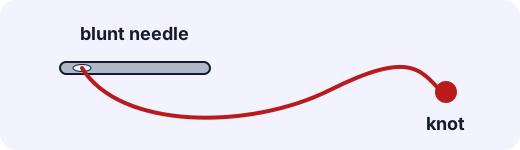
- It stops the thread from pulling through the felt
- It makes the stitch look pretty
- It keeps the needle from falling off
Choose one
2.How many stitches can you see on top of the felt?
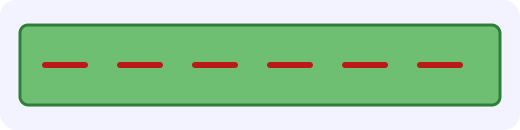
Answer with a number
3.Which seam is neater?
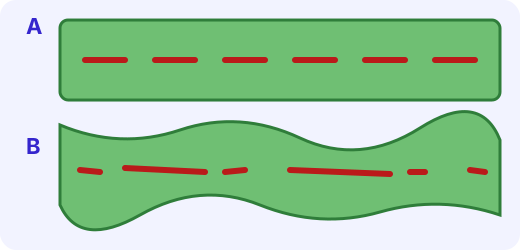
- Seam A
- Seam B
Choose one
4.Put the first steps of a running stitch in order.
- Push the needle up through the felt
- Push the needle down a little way along
- Thread the needle and tie a knot
- Come up again after a small gap
- Pull the thread until the knot stops
Put these in order
5.Why is felt a good cloth for a first sewing project?
- Its edges do not fray into loose threads
- It is the only cloth a needle can go through
- It is very thin, so a needle goes through it easily
Choose one
6.Each stitch and the gap after it together take up 2 cm along the line. The line is 10 cm long. How many stitches fit?
Answer with a number
Answering and checking are for registered learners. Register to do this.
Quick check
New puzzles
Use what you know about stitches in new situations.
1.Dev's felt bunches up in little waves along his seam. What is the most likely reason?
- He pulled the thread too tight
- His thread is the wrong colour
- His needle is blunt
Choose one
2.Mina's first stitch keeps slipping out and the whole thread pulls loose. What should she do?
- Tie a bigger knot, then start again
- Use a shorter needle
- Make the stitches much longer
Choose one
3.Rani is sewing the front and back of a felt pouch. Where do her stitches go?
- Through both pieces, a little way in from the edge
- Only through the top piece, in the middle
- Right on the cut edge, cutting into it
Choose one
4.Why can a row of small stitches hold two pieces of felt together, even though thread is thin?
- Each stitch goes through both pieces, so many stitches share the pull
- Thread sticks to felt by itself, so the stitches only need to touch it
- Thread is very strong, so one stitch would be enough
Choose one
5.A doll's felt belt needs a seam 12 cm long. Each stitch is 1 cm and each gap is half a centimetre, so a stitch and its gap take 1.5 cm. How many of them fit along 12 cm?
Answer with a number
Answering and checking are for registered learners. Register to do this.
Activity
Tell it back
Your child shows the bookmark and explains how a running stitch holds cloth together. About five minutes.
Steps
- Ask "Show me how your stitch works. Where does the needle go?" Let your child point along the stitches.
- Ask "Why does the knot matter?" and "Why does the thread go through both pieces?"
- Ask "If your stitches were bunched up, what would you change?"
- Write down what your child says in their own words.
Keeping a log of the activity is for registered learners. Register to do this.
Like what you see?
Register for free to answer the quick checks, do the activities and save your work. Your work is saved on your device and syncs to your account.