Unit 2
Building a model
Plan, build, test and improve a cardboard vehicle whose wheels really roll.
Read
Plan, build, test, improve
Kabir built a cardboard truck. He was so proud. Then he pushed it, and it went three steps, turned sideways and stopped. One wheel was rubbing on the body.
Did Kabir fail? No! Kabir is a maker, and makers know a secret: the first try is almost never the last try.
Four steps that go round and round
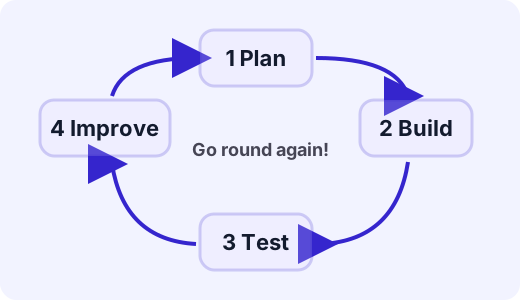
- Plan. Decide what you want to make. Draw it. List what you need.
- Build. Make it, one careful step at a time.
- Test. Try it. Does it do the job? Watch closely.
- Improve. Find what is wrong and change it. Then test again.
Testing is not a bad thing. It is how a model gets better.
Wheel and axle
A wheel is a round part that rolls. It spins around its middle on a rod called an axle.
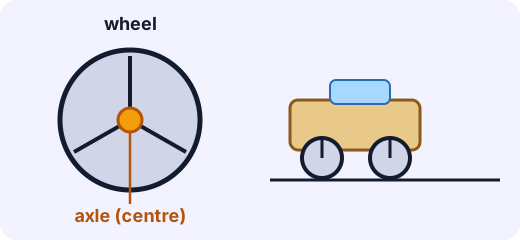
A wheel makes moving easy. Rolling is much easier than dragging a box along the ground.
To make a model car with wheels:
- The body is a cardboard box or a folded piece of card.
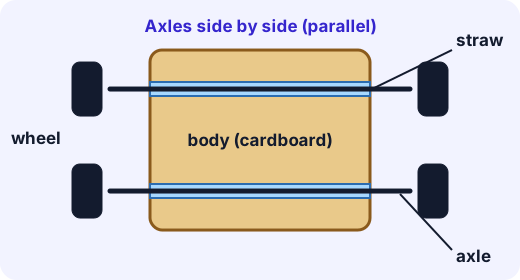
- Tape two straws across the bottom of the body. They are tubes for the axles.
- Slide a stick or pencil through each straw. That is an axle. It must turn freely inside the straw.
- Fix a wheel on each end of each axle. Bottle caps or cardboard circles work well. A grown-up makes the middle hole.
Three things that go wrong
- The hole is not in the middle. A wheel with an off-centre hole wobbles, like a bumpy ride. Measure and mark the exact middle before you make the hole.
- The axles are not side by side. If the axles are crooked, the car turns in a curve and falls off the road. Lay a ruler along the straws to check.
- The wheels rub the body. Leave a small gap, about the width of a finger, so the wheel can spin freely.
Test and improve
Roll your car down a ramp made from a book and a board. Mark where it stops with a piece of tape.
Try it: Change one thing and test again. If you change three things at once, you will not know which change helped.
Example. Kabir's truck rolled 40 cm. He moved the wheels out a little, to leave a gap. Now it rolled 65 cm. The gap helped: it rolls 25 cm farther (65 − 40 = 25).
Models are not only cars
A cardboard house can have a door that opens. A crane can have a handle that turns. The four steps are the same: plan it, build it, test it, improve it.
For the grown-up helping
Let your child do the planning and the drawing, and resist fixing it for them. Make the middle holes and cut any skewers for them (point snipped off, or use pencils). Ask "What do you notice?" and "What will you change?" rather than telling. A first model that doesn't work is a good outcome: the learning is in the improving. Praise the changes ("you moved the wheel and it went further") more than the looks.
Lab
The test ramp
This pretend car has some problems. Roll it down the ramp, look at what happens, then change one thing and test again until it reaches the finish flag and stays on the road.
Your goals
- Test the car, fix what is wrong, and test again.
- Get the car to the finish flag while it stays on the road.
The interactive lab opens once you register. Register to do this.
Activity
Build a rolling cardboard model
Your child plans, builds, tests and improves a cardboard car, truck or cart with four wheels that really turn. About 60 minutes, or two shorter sessions.
You'll need
- A small cardboard box or thick card for the body
- Two drinking straws (wider ones are best)
- Two round pencils or smooth sticks, about 6 cm longer than the body is wide, so there is room for the wheels and gaps
- Four bottle caps or cardboard circles (about 4 cm across) for wheels
- Tape, glue or modelling clay
- A ruler and a pencil
- A board or large book, propped on a few books, for a ramp
- Paper for the plan
Steps
- Plan. Your child draws the model from the side and from below, and writes what it is. They mark where the two straws will go.
- Build the body. Tape the two straws across the bottom of the body, side by side, with the ruler laid along them to check that they are parallel.
- The grown-up makes a small hole in the exact middle of each wheel (find the middle by measuring). Your child pushes a pencil through each straw.
- Fix a wheel on each end of each pencil with glue or a little clay. Leave a gap about the width of a finger between each wheel and the body.
- Test. Roll the model down the ramp three times. Mark where it stops with tape and measure the distance.
- Improve. Ask "What went wrong? What will you change?" Change one thing only. Test three times again and measure.
- Repeat the improve step at least once more. Your child records each test and what changed.
- Optional. Add a feature with a moving part, such as a door that opens or a trailer that hooks on.
Safety
- A grown-up makes holes and cuts card or sticks. Use pencils or sticks with blunt ends only, never sharp skewers.
- Keep bottle caps and small parts away from babies and toddlers (choking).
- Work on a clear table. Ask a grown-up to use any hot glue.
- Keep the ramp away from stairs and walkways, so nobody trips.
Keeping a log of the activity is for registered learners. Register to do this.
Quick check
Building a model check
Seven questions about planning, wheels and axles, and testing.
1.Put the four maker steps in order.
- Build
- Plan
- Improve
- Test
Put these in order
2.Which wheel will roll most smoothly?
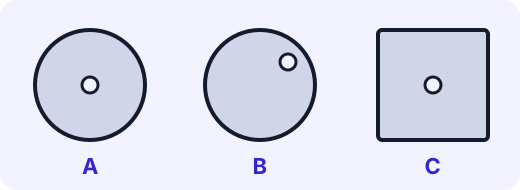
- Wheel A
- Wheel B
- Wheel C
Choose one
3.Which car will drive straighter?
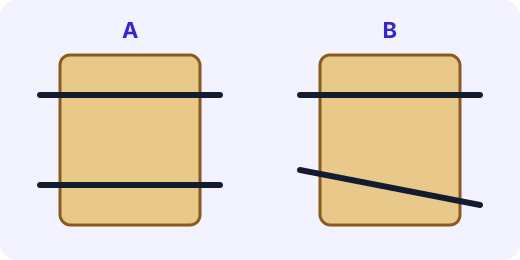
- Car A
- Car B
Choose one
4.Match each part of the car to its job.
- Axle
- Straw
- Body
Match each to: A tube that lets the axle spin freely · The rod a wheel turns around · The frame that holds the parts together
5.The wheel is pressed tight against the body and the car stops quickly. What is the best change?
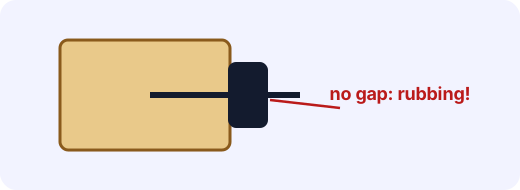
- Move the wheel out a little to leave a small gap
- Wrap more tape around the wheel
- Make the body heavier
Choose one
6.Why should you change only one thing between tests?
- So you can tell which change made the difference
- To save glue
- Because the car can only be changed once
Choose one
7.Before the change the car rolled 40 cm. After the change it rolled 65 cm. How many centimetres farther is that?
Answer with a number
Answering and checking are for registered learners. Register to do this.
Quick check
New puzzles
Use plan, build, test and improve in new situations.
1.Zoya's model lorry wobbles and bumps along. She finds the hole in one wheel is near the edge, not in the middle. What should she do?
- Make a new wheel with the hole in the exact middle
- Paint the wheel a brighter colour
- Add a heavier body
Choose one
2.Lucas built a cardboard house with a door that opens. When he tries it, the door sticks on the wall. Which step is he doing, and what comes next?
- He is testing, and next he improves the door, for example by trimming it
- He is planning, and next he builds the house
- He is finished, because a model never needs changing
Choose one
3.Sam changed the wheels, the tape and the body weight all at once, and the car went faster. What do we know?
- At least one of the changes helped, but we cannot tell which
- The wheels made it faster
- The tape made it faster
Choose one
4.Nadia glued her wheels to the car body, not to the axles, and the car will not roll. Why?
- The wheels cannot turn around the axle if they are stuck to the body
- The glue makes the car too heavy to move on any floor
- Wheels only roll when they are the same colour
Choose one
5.The body is 20 cm long. Mia places each axle 3 cm in from an end. How many centimetres apart are the two axles?
Answer with a number
Answering and checking are for registered learners. Register to do this.
Activity
Tell it back
Your child shows the model and explains what they planned, what went wrong in testing and what they changed. About five minutes.
Steps
- Ask your child to roll the model and tell you the story of making it, from the plan to now.
- Ask "What went wrong the first time? What did you change? Did it help?"
- Ask "How do the wheel and the axle work together?" Let your child show you with their hands.
- Ask "What would you improve next time?" Write down what your child says in their own words.
Keeping a log of the activity is for registered learners. Register to do this.
Like what you see?
Register for free to answer the quick checks, do the activities and save your work. Your work is saved on your device and syncs to your account.