Unit 1
Analysing literature with evidence
Answer "why do you say that?" about a story: make a claim, quote the exact words, and explain how they prove it.
Read
Claim, quote, explain
Suppose you tell a friend, "Rukmini is the kindest person in this story." Your friend shrugs and asks, "Why do you say that?" If your answer is "I just feel it," nobody has a reason to agree with you. If your answer points to particular words on the page and shows what they mean, your friend can check your thinking and maybe be convinced. That second kind of answer is literary analysis: making a statement about a text and backing it up with the text itself.
Read this short story first. We will use it through the whole reading.
Rukmini had sold lanterns at the bridge market for nine winters, and for nine winters the stall next to hers had belonged to Mr. Pillai, who sold lanterns too, only cheaper. On the first evening of the festival, rain came down so hard that Pillai's paper lanterns slumped and bled red onto the ground. Rukmini watched from under her tin awning. Then she folded back the cloth that covered her spare stock, lifted six of her best lanterns, and hung them along his empty poles.
"Don't thank me," she said, when he stared at her. "Customers walk past a dark stall and a lit one. I'd rather they all stop at the bridge."
She went back to her place. Her hands, he noticed, were shaking from the cold, not from reluctance.
Three moves: claim, quote, explain
Every strong analysis paragraph is built from the same three parts.
Move The question it answers In our example Claim What do I think is true about the character, theme or text? Rukmini is generous, though she hides it behind practical excuses. Quote (evidence) Where exactly does the text show this? She hangs "six of her best lanterns" on her rival's empty poles. Explain (reasoning) How do these words prove the claim? "Best" means she gives up her strongest stock, not leftovers, to a rival who undercuts her. 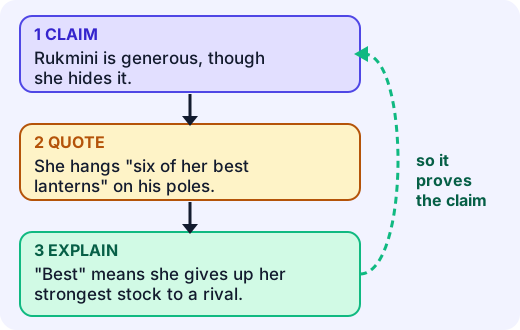
Put together, they make a paragraph:
Rukmini is generous, even though she hides it. When rain ruins her rival's lanterns, she hangs "six of her best lanterns" along his empty poles. The word "best" matters: she is not clearing out unsold stock but giving away her finest work to a man who sells the same goods more cheaply. Her explanation, "I'd rather they all stop at the bridge," is practical on the surface, but the shaking hands the narrator notices suggest she is uncomfortable being thanked for a kindness.
Notice that the explanation does most of the work. The quote is the proof; the explanation is the argument that shows why it is proof.
Quoting well
- Keep it short. Choose the few words that carry the evidence. "six of her best lanterns" is better than copying three sentences.
- Keep it exact. Use the author's words and put them in quotation marks. Do not tidy them up.
- Weave it in. The quote should be part of your sentence, not a stranger dropped between two of them. Write she hangs "six of her best lanterns" along his poles, not she helps him. "Lifted six of her best lanterns."
- Look for the loaded word. Often one word does the work: "best," "slumped," "only cheaper." Name it.
Misconception: "A quote speaks for itself." It does not. A quote with no explanation is like a photograph with no caption: the reader has to guess what you saw. After every quote, ask yourself, So what? How does this show my claim?
Explaining: the "how"
Weak explanations repeat the claim: "This shows Rukmini is generous." You already said that. Strong explanations show the path from the words to the claim. Useful ways to build that path:
- Zoom in on a word. "Best" tells us the lanterns were not leftovers.
- Compare. Pillai sells cheaper; she helps him anyway.
- Look at what is said against what is done. She says it is about customers, but she does it in the rain with shaking hands.
- Ask what it costs the character. Giving away her best stock costs her money.
Sentence starters help: This suggests… / The word "…" shows… / Rather than…, she… / This matters because…
Character traits, not just feelings
A character trait is a lasting quality: generous, stubborn, careful, shy. A feeling is temporary: nervous this morning, angry just now. When you write about a character, aim for traits, and remember that one detail rarely proves one. Look for a pattern: things the character does, says, thinks, and what other characters say or notice about them. Writers usually show a trait through actions rather than saying "she was generous."
Example. Claim: "Imran is careful." Weak evidence: "Imran put on his shoes." (Everybody does.) Strong evidence: "He read the instructions twice, then a third time before touching the switch." The repeated reading is a pattern that points to carefulness.
From topic to theme
A topic is what a text is about, in a word or two: rivalry, kindness, rain. A theme is what the text says about that topic, a message about life that you can state in one full sentence and that someone could argue about.
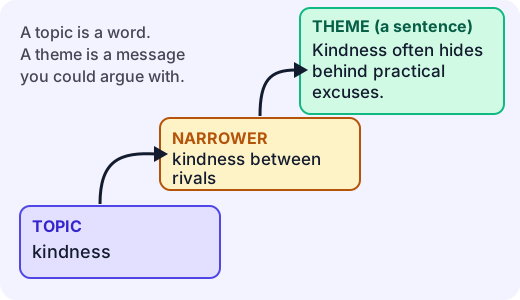
Our story's topic could be "kindness between rivals." A possible theme: Kindness often hides behind practical excuses. Another reader might say: Rivals can still look after each other. Both can be defended with the same quotes, which tells you something important.
Misconception: "There is one right answer." There is not one single correct reading, but not every reading is equal. A good claim is supported: the text gives clear evidence for it and little against it. "Rukmini is cruel" fails; you would struggle to find a single quote for it. Your job is to choose a claim the words can carry, and to show how.
Worked example: a theme paragraph
Claim. Start with a theme sentence: The story suggests that real kindness does not need credit.
Quote. Choose evidence: "Don't thank me," and the detail that her hands were "shaking from the cold, not from reluctance."
Explain. Link them: By cutting off the thanks before it starts, Rukmini refuses to be seen as a hero. The narrator then makes sure the reader knows her reluctance is not the issue, which tells us the generosity is real even though she dresses it up as business.
Paragraph. The story suggests that real kindness does not need credit. Rukmini tells Pillai, "Don't thank me," and immediately gives a business reason for what she did. Yet the narrator adds that her hands shake "from the cold, not from reluctance," which confirms that the kindness is sincere. By refusing the thanks, she shows the theme: the act matters more than who is praised for it.
Try it: Choose one more detail from the story (for instance "for nine winters"). Write a claim it could support, then write the explain sentence only. Does your sentence say how, or does it only repeat the claim?
Four mistakes to avoid
- Summary instead of analysis. "Rukmini hangs lanterns on Pillai's poles and tells him not to thank her" is what happened. Analysis says what it means.
- Restating the claim. "She is generous because she is a generous person."
- Quote dropping. A quotation with no lead-in and no explanation.
- One detail, big claim. "Pillai sells cheaper, so he is dishonest." One fact cannot carry that trait.
Checklist
Before you finish a paragraph, check it against this list:
- Does the first sentence make a claim about the text, not just retell it?
- Is there at least one short, exact quote, woven into a sentence?
- Does an explanation say how the words prove the claim, using a particular word, comparison or contrast?
- Could a reader who has not read the story follow your reasoning?
Analysis is claim, quote, explain. Master that, and you can answer "Why do you say that?" about any text you meet.
Lab
The paragraph builder
Three short passages, three claims. For each one, pick the quotes that really support the claim, then pick the explanation sentence that shows how. Watch your paragraph assemble.
Your goals
- Choose the quotes that support each claim and leave out the ones that do not.
- Choose the explanation that shows how the quotes prove the claim, not one that only repeats it.
- Finish all three passages.
The interactive lab opens once you register. Register to do this.
Quick check
Analysis quick check
Eight questions about claims, quotes and explanations.
1.Which of these is a claim about a character, something that needs evidence to be believed?
- Tenzin carries the radio up the hill.
- Tenzin is determined.
- The story is set in Ladakh.
- Tenzin wears a red scarf.
Choose one
2.Put the sentences of this analysis paragraph in the best order.
- Tenzin is stubborn, and the story shows it when the path turns hard.
- The word "until" shows that he will not accept anyone else's word; he sets his own limit and tests it.
- So his stubbornness is not just refusing advice: it is a need to check the world for himself.
- When the guide says the pass is closed, Tenzin answers, "I will walk until I see the snow myself."
Put these in order
3.The claim is "Meera is anxious." The quote is "Meera checked her bag three times before leaving." Which explanation is strongest?
- This quote shows that Meera is anxious.
- Checking three times shows she cannot trust that she packed everything, which suggests a worry she cannot switch off.
- Many people check their bags before leaving.
- Meera has a bag and she is leaving.
Choose one
4.Read this paragraph: "Rahul is brave. He is brave in the story. Rahul is very brave and does brave things." Select every weakness.
- It has no quote from the text.
- It never explains how anything shows bravery.
- It only repeats the claim in different words.
- It uses far too many quotations.
- It retells too much of the plot.
Choose all that apply
5.Which of these is a theme (a message) rather than just a topic?
- Friendship
- Kindness can hide behind practical excuses.
- A lantern market
- Rukmini
Choose one
6.Match each piece of evidence to the character trait it best supports.
- He gave his only umbrella to a stranger and walked home soaked.
- She read the rules twice, then a third time before touching the board.
- He kept trying the lock long after everyone else had gone to lunch.
- He mumbled his name to the floor and edged behind his sister.
Match each to: persistent · shy · careful · generous
7.Claim: "Dev is determined to improve." The passage says: "Dev finished the race second and shook the winner's hand. That night he ran the same course alone, twice, timing himself with his father's old watch." Which quote is the best evidence?
- shook the winner's hand
- ran the same course alone, twice, timing himself
- his father's old watch
- finished the race second
Choose one
8.A student writes a claim, pastes a quotation straight after it, and starts a new paragraph. What is missing?
- A longer quotation.
- An explanation of how the quotation proves the claim.
- A summary of the whole story.
- A second, different claim.
Choose one
Answering and checking are for registered learners. Register to do this.
Quick check
New puzzles
Use claim, quote and explain on passages you have not seen.
1.Passage: "Kavya gave up her window seat to a woman with a baby, then pretended to be absorbed in her phone so that no one would thank her. When the woman got off, Kavya looked up and watched until the door closed." Which claim is best supported by the whole passage?
- Kavya is selfish.
- Kavya is kind but uncomfortable being noticed.
- Kavya loves her phone more than anything.
- Kavya dislikes babies.
Choose one
2.In the same passage, which detail best supports the claim "Kavya avoids being thanked"?
- gave up her window seat
- a woman with a baby
- pretended to be absorbed in her phone
- watched until the door closed
Choose one
3.A student claims "Dev is greedy," and offers one piece of evidence: "Dev ordered a large tea." What is the main problem?
- The quotation is too short.
- One ordinary detail cannot show a lasting trait; the claim needs a pattern of actions.
- Traits should never be used in analysis.
- The student should have written about the setting.
Choose one
4.Claim: Dev is determined. Which version weaves the quote into a sentence AND explains it?
- Dev is determined. "Next week," he muttered at the finish line.
- Dev's determination shows when he mutters "Next week" at the finish line, as if setting himself a deadline.
- "Next week," he muttered at the finish line.
- Dev is determined because he is determined.
Choose one
Answering and checking are for registered learners. Register to do this.
Your turn
Write an analysis paragraph
Read this passage, then write about it.
Ajji had never let anyone touch her sewing machine. On the morning of Arjun's sister's wedding, the zip of the lehenga tore, and the whole house began to shout at once. Ajji said nothing. She lifted the black cover, oiled the wheel, and began to stitch, her lips moving as though she were counting. When a cousin murmured, "Ajji, your eyes...", she waved a hand. "Eyes are for looking. Hands remember." The zip was finished before the band began. She wiped the machine, covered it again, and never mentioned the stitch to anyone.
- Write one paragraph (6 to 9 sentences) that analyses Ajji. Start with a claim about her character (a trait, not a feeling). Use at least two short, exact quotes from the passage, woven into your sentences. After each quote, explain how it supports your claim.
- State a theme of the passage as one full sentence (not a single word). Say in one or two sentences which part of the passage supports it.
How it's judged
- Claim
- Evidence
- Explanation
- Theme statement
Writing and submitting your answer is for registered learners. Register to do this.
Your turn
Fix a weak paragraph
A classmate wrote this paragraph about the lantern story you read:
Rukmini is a good person. In the story Rukmini helps Pillai by hanging lanterns on his poles. She says, "Don't thank me." So Rukmini is a good person because she helps.
Write a short reply (about 150 words) to your classmate.
- Name two things that make this paragraph weak. Use the words claim, quote and explain.
- Rewrite the paragraph so it is stronger. Keep it to four or five sentences.
- Explain in one or two sentences why the classmate's idea "a quote speaks for itself" is a mistake.
How it's judged
- Diagnosing problems
- The rewrite
- Why a quote needs explaining
Writing and submitting your answer is for registered learners. Register to do this.
Like what you see?
Register for free to answer the quick checks, do the activities and save your work. Your work is saved on your device and syncs to your account.