Unit 2
Poetry forms and devices
Meet the haiku, sonnet, ballad and doha, hear how rhyme, alliteration and rhythm work, and see why a poem's shape is part of its meaning.
Read
The shape and sound of a poem
More than four hundred years ago, the poet Rahim (Abdul Rahim Khan-i-Khana, 1556 to 1627) wrote two lines that people still repeat without being asked:
रहिमन धागा प्रेम का, मत तोरो चटकाय।
टूटे पे फिर ना जुरै, जुरै गाँठ परि जाय॥
Rahiman dhaaga prem ka, mat toro chatkaay. / Toote pe phir na jurai, jurai gaanth pari jaay.
In plain English: Don't snap the thread of love with a jerk. Once it breaks it does not join again, and if it does, a knot is left. Say the same thing in a paragraph and it is a decent piece of advice. Say it in this form and people carry it in their heads for centuries. Why? The rhyme (chatkaay and jaay), the steady beat, and the compact shape make it easy to remember, and the picture of a thread with a knot in it does the rest. The form is not packaging around the meaning. It is part of the meaning.
Four forms
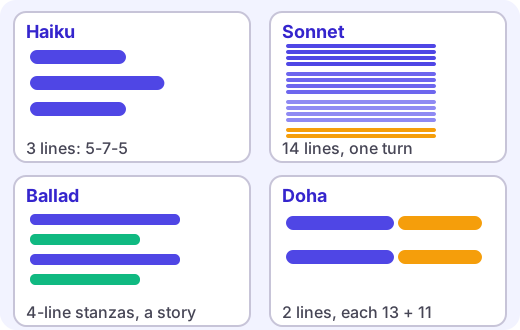
A form is a poem's pattern: how many lines, what rhythm, what rhyme, what it is for. Here are four, from four traditions.
Haiku
A Japanese form of three short lines. In English the lines are often written with 5, 7 and 5 syllables, though in Japanese what is counted is smaller sound units, so 5-7-5 in English is an approximation. Syllables are only part of it. A traditional haiku captures one moment, usually from nature, often with a season word and a small pause or "cut" between two images.
Morning mist rises;
the crow shakes dew from its wings
and the day begins.
The tiny space forces the poet to leave things out, so the reader's mind fills the gap. A haiku can't argue; it can only point.
Sonnet
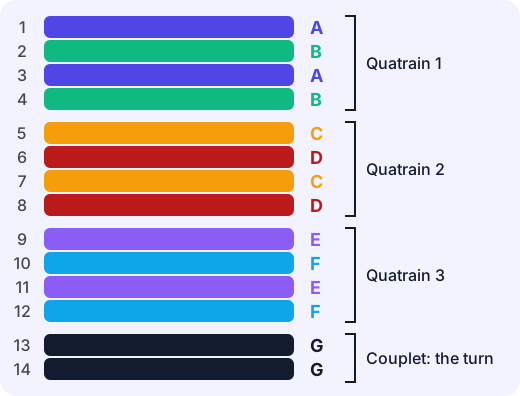
Fourteen lines, usually with a fixed rhyme scheme and ten syllables to a line. In the Shakespearean sonnet the scheme is ABAB CDCD EFEF GG: three four-line quatrains and a closing couplet. Many sonnets have a turn (the volta) where the thought changes, often in the final couplet. Here is an original one.
First Rain
The first fat drops fall slowly on the street,    A
and dust-brown puddles open into rings;           B
the whole town stops, and listens to the beat     A
of water drumming on a thousand things.           B
The tea-stall man pulls plastic overhead,         C
a child kicks off her shoes and starts to run,    D
the cracked earth drinks, and wakes, and is not dead,  C
and every roof rings out: the wait is done.       D
We carried months of heat on aching backs,        E
we watched the empty sky for any sign;            F
now ribbons of cool wind run down the tracks      E
and rivers hum one long, delighted line.          F
So hold your face up, let the water fall:         G
the rain does not ask who deserves it all.        G
Look at what the form does. The first twelve lines build the scene and the long wait. The couplet turns outward, from description to a lesson, and the two rhyming lines click shut like a lid.
Ballad
A ballad tells a story in short stanzas, usually four lines, and comes from songs passed on by voice. Many rhyme only the second and fourth lines (ABCB), and many repeat a line or two as a refrain. Here is an original ballad opening:
The tide came in at midnight hour,
The fisher's boat was gone;
Her mother lit a lamp of oil
And kept it burning on.
The short lines and the plain words make it easy to sing and to remember, and they carry the story along quickly.
Doha
The doha is a couplet from the Hindi and Braj tradition, used by Kabir, Rahim, Tulsidas and many others. Each line is made of two parts, and the traditional line length is 24 matras (beats counted by the weight of syllables), split 13 + 11. In Rahim's first line, रहिमन धागा प्रेम का gives 13 and मत तोरो चटकाय gives 11. The two lines end on a rhyme (चटकाय and जाय). Because it is short, rhymed and balanced, the doha is perfect for a single sharp insight, often a moral.
Sound devices
Poets also work at the level of sound.
- Rhyme is matching sound at the ends of lines (street and beat), or inside a line (internal rhyme). It is about sound, not spelling: through and blue rhyme; cough and rough do not. We label a rhyme scheme with letters: lines that rhyme share a letter, so street / rings / beat / things is ABAB.
- Alliteration is repeating the same starting sound in nearby words: "the silent snake slid slowly." Again, sound beats spelling: phone and fish alliterate; knight and key do not.
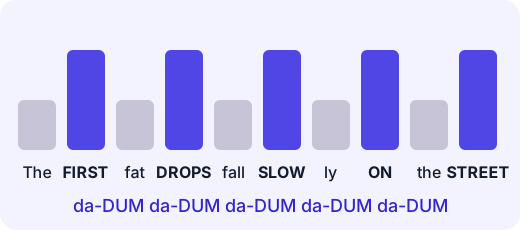
- Rhythm is the pattern of stressed and unstressed syllables. Say "The FIRST fat DROPS fall SLOW-ly ON the STREET": five da-DUM beats make iambic pentameter, the most common rhythm in English sonnets. Rhythm can feel like walking, a heartbeat, or the wheels of a train.
Explaining an effect
Naming a device is only half the job. Always follow it with the effect: what it makes the reader hear, see, or feel, and how that supports the meaning.
Weak: "The poet uses alliteration." Better: "The repeated s sounds in 'the silent snake slid slowly south' hiss like the snake itself, so the reader hears it creeping."
A reliable pattern is device, quote, effect, link to meaning.
Worked example. Take the last lines of the sonnet: "So hold your face up, let the water fall: / the rain does not ask who deserves it all." Device: a rhyming couplet, a change from describing to advising. Quote: "the rain does not ask who deserves it all." Effect: the matched end sounds (fall and all) give the lines a feeling of finality, as if a door has quietly shut. Link: the poem ends on a general truth, that rain (and kindness) comes without conditions, so the form lets the poet say the big idea last, in a sentence the reader can remember.
Common mistakes
- "Every poem has to rhyme." No. Many fine poems are in free verse. Rhyme is one tool among many.
- "A haiku is just 5-7-5." Syllable count is one feature; the single moment, the image and the cut matter as much.
- "Alliteration means the same first letter." It means the same first sound.
- "The device is the answer." Saying "this is a simile" or "this rhymes" earns little. The effect is the answer.
Try it: Pick any four lines of a song you know. Does it have a rhyme scheme? Write its letters. Then say one effect the rhyme or beat has on the mood.
Remember
Before you decide what a poem means, ask what it is: how many lines, what pattern, what sound. The form is part of the message.
Lab
The sound workshop
Four short jobs with short poems: label the rhyme scheme, count syllables, hunt for alliteration by sound, and name the form from its clues.
Your goals
- Label the rhyme scheme of three short poems.
- Count the syllables in four lines.
- Find alliteration by starting sound, not spelling.
- Name the form (haiku, sonnet, ballad or doha) from its clues.
The interactive lab opens once you register. Register to do this.
Quick check
Poetry quick check
Eight questions about forms, sound devices and their effects.
1.Match each form to its description.
- Haiku
- Sonnet
- Ballad
- Doha
Match each to: Fourteen lines with a fixed rhyme scheme and usually a turn in the thought · A story told in short stanzas, often with a refrain, suited to singing · A two-line rhymed couplet from the Hindi tradition, each line split into two parts · Three short lines that capture one moment, often from nature
2.Give the rhyme scheme (as letters) of this poem: "I walked beside the quiet sea / The sand was cool and wide / The waves came whispering to me / And carried out the tide"
Answer with a word or phrase
3.How many syllables are in the line "The monsoon clouds come rolling in"?
Answer with a number
4.Select every pair of words that alliterate (begin with the same SOUND).
- photo, fine
- knife, nose
- city, cat
- chef, chair
- gem, goat
Choose all that apply
5.Which statement explains the EFFECT of a sound device, not just names it?
- The poet uses alliteration.
- The repeated s sounds in "soft sighs of the sea" hush the line, so the reader hears the waves.
- There are four words beginning with s.
- The poet likes the letter s.
Choose one
6.Why is the doha well suited to a single piece of advice?
- It is long enough to tell a whole story.
- Two short, rhymed lines are easy to remember and to quote.
- It must always describe a season.
- It must have fourteen lines.
Choose one
7.A student says, "Any poem with 5-7-5 syllables is a haiku, and nothing else matters." Which is the best reply?
- Correct; the syllable count is the only rule.
- Not quite; a traditional haiku also captures one moment, usually from nature, and 5-7-5 is only an approximation of the Japanese sound units.
- No; a haiku cannot be counted in syllables at all.
- No; haiku must rhyme.
Choose one
8.In a Shakespearean sonnet, what does the closing couplet (the last two lines) often do?
- Repeats the opening line.
- Gives a twist, a conclusion or a comment on the first twelve lines.
- Introduces the rhyme scheme for the first time.
- Must be in a different language.
Choose one
Answering and checking are for registered learners. Register to do this.
Quick check
New puzzles
Use what you know about form and sound on poems and lines you have not seen.
1.A poet wants to tell the story of a flood that swept away a village, in a form that can be sung and handed down by mouth. Which form fits best?
- Haiku
- Sonnet
- Ballad
- Doha
Choose one
2.Which line's sounds best suit a slow, sleepy afternoon?
- The long low hum of the lazy lane
- Crack! Snap! Pop! Clatter!
- Quick, quick, kick, click, tick
- Tap, tap, tap, tap, tap
Choose one
3.How many syllables are in "The kettle whistles in the dark"?
Answer with a number
4.A poet writes about a long, sad winter for twelve lines, then finds a hopeful thought in the last two. Why does a sonnet suit this?
- Sonnets must be sad.
- Its closing couplet gives a natural place for the thought to turn.
- Sonnets cannot be about seasons.
- Because a sonnet has only two lines.
Choose one
5.Give the rhyme scheme of: "The lamp burns low; the hour is late, / the rain sings softly on the pane, / the clock repeats its slow refrain, / and I have only time to wait."
Answer with a word or phrase
Answering and checking are for registered learners. Register to do this.
Your turn
Analyse a poem and write your own
Read this original poem.
Night Train The night train taps along the track, tick-tack, tick-tack, tick-tack, tick-tack, and carries every sleeping town to where the dawn is coming down. A tea-man calls, a baby sighs, the moon goes with us, slow and wise, and I, with forehead on the glass, watch all the quiet countries pass.
- Give the rhyme scheme of the poem (use letters) and say whether it is a haiku, sonnet, ballad or doha, or none of them, and why.
- Name two sound devices (for example rhyme, alliteration, rhythm or repetition). For each, quote the words and explain its effect: what it makes the reader hear or feel, and how that supports the meaning.
- Write four lines of your own about a journey or a place you know. Choose one form or device on purpose (for example a rhyme scheme, a steady beat, or alliteration). Then explain your choice in two sentences.
How it's judged
- Form and rhyme scheme
- Devices and effects
- Your own four lines
Writing and submitting your answer is for registered learners. Register to do this.
Your turn
Is form just decoration?
A friend says: "The shape of a poem is just decoration. You could say the same thing in a plain paragraph and nothing would change."
Write 150 to 200 words to answer your friend.
- Use two examples from this unit (for example Rahim's doha, a haiku, the sonnet "First Rain", or the ballad) and say what the form does that a paragraph could not.
- Mention at least one sound device and its effect.
- End with one sentence saying what you would tell your friend to look for first when reading a new poem.
How it's judged
- Argument
- Use of examples
- Sound device
Writing and submitting your answer is for registered learners. Register to do this.
Like what you see?
Register for free to answer the quick checks, do the activities and save your work. Your work is saved on your device and syncs to your account.