Unit 10
Presentations
Plan a short talk as a spoken argument, with a clear claim, findings in a logical order, one good visual and real eye contact.
Read
An argument you say aloud
Two students give a talk on the same topic.
The first turns to the screen, where forty lines of small text appear, and reads them out in a mumble. The audience reads ahead, finishes the slide before she does, and stops listening. When she says "So, yeah, that's it", nobody is sure what she wanted them to think.
The second begins: "I believe our school should build a covered stand for bicycles. Let me show you why." She looks at a classmate in the front row, then at someone near the back. There is one slide behind her, with a headline and a simple chart. After three minutes the room can tell you exactly what she wanted and the three reasons she gave.
The topic was the same. What differed was that the second student treated the talk as an argument spoken aloud: a clear claim, supported by findings, in an order the listeners can follow, with a visual that helps and a speaker who is actually talking to them.
The parts of a talk
- A claim is the main point you want listeners to accept: "Our school should build a covered stand for bicycles."
- A finding is a piece of evidence you discovered or collected that supports the claim: a measurement, survey result, observation, or fact from a reliable source.
- A visual aid is anything shown to help the listener understand: a slide, chart, diagram, photo or object.
- Eye contact is looking at your listeners, not at your notes or the screen, so they feel you are speaking to them.
If you have already studied argument writing, you will recognise this: a presentation is an argument, but the reader has to catch every word the first time. There is no going back to re-read the previous paragraph. That changes how you build it.
Step 1: Decide the claim and say it early
Write your claim as one clear sentence before you build anything else. Then say it in the first thirty seconds. Listeners who know where you are heading can fit each finding into place. Listeners who do not will spend the talk guessing.
A classic recipe: say what you will say; say it; say what you said.
Step 2: Put the findings in a logical order
A written reader can skip around. A listener cannot, so your order has to be easy to follow. Pick a logic and keep it:
- Need, problem, solution. Many people do X; X has this problem; here is a fix.
- Time order. First, then, finally.
- Strongest first, or strongest last. Choose on purpose.
Use signposts so listeners know where they are: "My first finding...", "The second reason is...", "So, to sum up...". These can feel odd on paper, but they are the audible equivalent of headings.
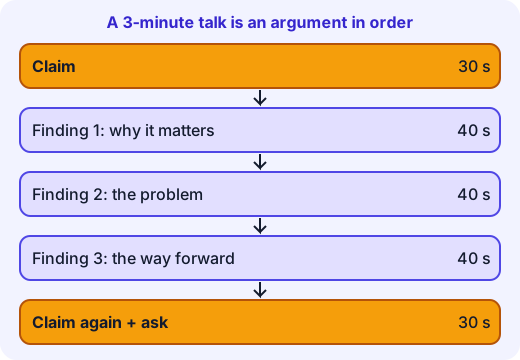
Example. An outline for the bicycle talk (the survey numbers are imagined for this lesson):
- Claim. "Our school should build a covered stand for bicycles."
- Finding 1 (need). In a survey of our class of 30, 14 cycle to school.
- Finding 2 (problem). The yard has no shelter. Bikes stand in sun and monsoon rain, so seats crack and chains rust.
- Finding 3 (solution). A simple roof over the existing rack would keep off sun and rain, using the same kind of sheeting as the canteen shed (imagined detail).
- Conclusion. "A covered stand protects the bicycles our classmates already ride. Please support it."
Notice that every finding answers the question "why should I agree?", and the conclusion repeats the claim and says what the listeners can do.
Step 3: Make a visual that helps
A visual aid is there to carry what the voice cannot: a number, a shape, a picture. It is not there to carry your script.
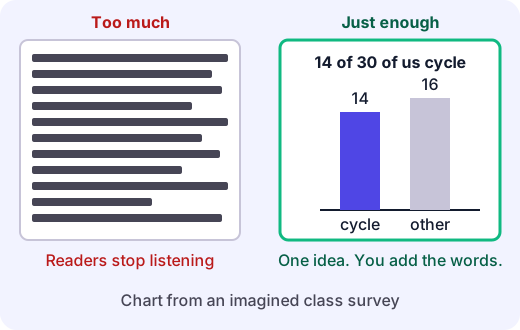
Good slides:
- hold one idea each, with a short headline;
- use large, high-contrast text (a back-row listener should read it);
- show data as a simple chart with labelled axes or bars, rather than a table of numbers;
- use a picture or diagram when the point is spatial or visual;
- give a source for facts, in a small note.
Misconception. "The slide is my notes, so I should read it." If the audience can read your slide, they do not need you. Put the big idea and the picture on the slide; keep your words and details for your voice. Put your reminders on small cards as keywords and numbers, never full sentences. If you write a full script, you will read it, and reading kills eye contact.
When you show a chart, tell the listeners what to look at: "Look at the blue bar: 14 of the 30 cycle."
Step 4: Speak to people
Eye contact is the single biggest signal that you are talking to your listeners.
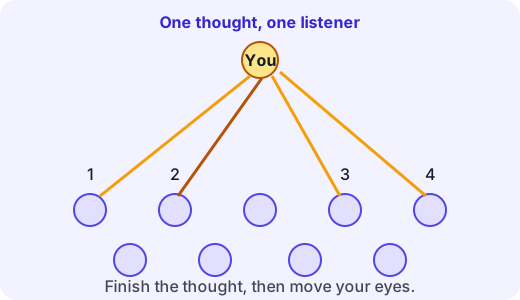
- Look at one person for a whole thought, then move to someone else. Darting eyes look nervous; staring looks fixed.
- Cover the room: front, back, left and right.
- Look down at your cards only between thoughts, then look up before you start speaking again.
- When you point to something on the slide, look at it, then turn your eyes back to the room.
Other habits that help your voice carry an argument:
- Pace. Most people speak too fast when nervous. A comfortable pace for a listener is about 120 to 150 words a minute, so a three-minute talk holds roughly 360 to 450 words. That is a lot less than you think.
- Pauses. Stop for a breath after the claim and before a key number. Silence tells the audience "this matters".
- Volume and posture. Speak to the back wall. Stand steadily with both feet on the floor.
Misconception. "If I'm nervous, everyone can see it." Usually they cannot. Nerves feel much bigger inside you than they look outside. A slow breath before you begin and a planned first sentence help more than anything.
Practising
Practise aloud, standing up, with your slide and cards. Time yourself. If you are over, cut a finding or a detail; do not speed up. Ask a friend: What was my claim? What were my reasons? If they cannot say, that is where to revise.
Try it: Take any opinion you hold, such as "Our class should have a reading corner". Write the claim, three findings (real or imagined, but marked), and a one-line conclusion. Say it aloud in two minutes. Then ask someone to tell it back to you.
Lab
Talk builder
Put the parts of a short talk in a logical order, then trim a crowded slide until it holds just what the audience needs to see.
Your goals
- Arrange five parts of a talk in an order that argues logically.
- Trim a slide so it keeps the headline and chart and has no more than three items and 25 words.
The interactive lab opens once you register. Register to do this.
Quick check
Presentations check
Eight questions on claims, findings, slides and eye contact.
1.What should a speaker do in the first half minute of an argument talk?
- Keep the claim secret so the ending is a surprise.
- State the claim clearly so listeners know where the talk is heading.
- Read every slide aloud from start to finish.
- Apologise for being nervous.
Choose one
2.Which is the best use of eye contact?
- Look at the screen so you do not forget what is on it.
- Look at one listener for a whole thought, then move to another.
- Look at the back wall the whole time.
- Dart your eyes quickly across everyone every second.
Choose one
3.Which are features of a good slide? Pick all that apply.
- One main idea
- Large, high-contrast text
- A full paragraph of the script
- A chart with labelled bars or axes
- As many facts as will fit
Choose all that apply
4.Put the parts of an argument talk in a logical order.
- Give the second finding
- Repeat the claim and say what you want listeners to do
- Give the first finding
- State your claim
Put these in order
5.A comfortable speaking pace is about 130 words a minute. About how many words fit in a three-minute talk?
Answer with a number
6.Match each term to its meaning.
- Claim
- Finding
- Visual aid
- Eye contact
Match each to: A slide, chart or picture that helps the listener understand · Looking at your listeners rather than at notes or screen · A piece of evidence that supports the claim · The main point you want the audience to accept
7.Why should you not simply read your slide aloud?
- The audience can read it themselves faster, so they stop listening to you.
- Slides are never allowed to contain words.
- It makes the talk too short.
- It makes the claim harder to find.
Choose one
8.What is the word for the main point your talk argues for?
Answer with a word or phrase
Answering and checking are for registered learners. Register to do this.
Quick check
New puzzles with presentations
Plan and judge talks in situations the reading did not show.
1.A talk argues "Our town needs a library." Put these parts in the most logical order.
- So please support a town library.
- A small room in the town hall could be opened as a library.
- But the nearest library is far away and the bus is expensive.
- Our town needs a library.
- Many children here have few books at home.
Put these in order
2.You have 4 minutes. You will speak at 120 words a minute, and you want to keep 30 seconds free for pauses and changing slides. About how many words should your script have?
Answer with a number
3.After your talk, a classmate asks a question you cannot answer. What is the best reply?
- Make up an answer so you look prepared.
- Say you do not know, share what you do know that is related, and offer to find out.
- Say it is a silly question.
- Say nothing and sit down.
Choose one
4.You found that 14 of 30 students cycle and 16 do not. Which visual helps listeners see this at a glance?
- A table with the survey sheet's 30 rows
- A paragraph that lists all 30 answers
- A two-bar chart labelled "cycle 14" and "other 16"
- A photo of a random bicycle
Choose one
5.Which is the best set of speaker notes for a three-minute talk?
- The whole talk written out as full sentences
- Cards with a few keywords and the key numbers for each part
- No notes and no plan at all
- A copy of the slide text
Choose one
Answering and checking are for registered learners. Register to do this.
Your turn
Plan a two-minute talk
Plan a two-minute talk on this claim: "Our class should have a reading corner." You may invent small findings (such as a class survey), but say they are imagined.
- Outline. Write the claim, two or three findings in a logical order, and the conclusion with a request. Say what order logic you used.
- Visual aid. Describe one slide: its headline and what it shows (for example a chart with its labels). List two things you will leave off the slide and say them aloud instead.
- Delivery. Write your opening two sentences exactly as you will say them. Then explain, in 3 to 4 sentences, how you will use eye contact and pace, including roughly how many words your script can have for two minutes at 130 words a minute.
How it's judged
- Claim and logical order
- Visual aid
- Delivery plan
Writing and submitting your answer is for registered learners. Register to do this.
Like what you see?
Register for free to answer the quick checks, do the activities and save your work. Your work is saved on your device and syncs to your account.