Unit 9
Sentence variety and pronouns
Mix short and long sentences on purpose so your writing has a rhythm, and get your pronouns right.
Read
The music of sentences
Read these two paragraphs aloud. They describe the same trip to the market.
Paragraph A. I went to the market. It was crowded. There were many stalls. I saw a man. He sold mangoes. They were ripe.
Paragraph B. When I reached the market, it was already crowded, and the stalls stood so close together that the lanes between them were barely wide enough for a cart. Then I saw him. Behind a heap of mangoes sat a man, calling out the price in a voice like a temple bell. They were ripe. I bought six.
Nothing is wrong with the grammar of Paragraph A. Every sentence is correct. But it sounds like a drum with one beat: da, da, da, da. Paragraph B has a rhythm, with a long wave of a sentence, a short pause, another wave, then two short taps at the end. The facts are the same. The difference is sentence variety, and it changes how the writing feels.
Length is rhythm
Count the words in each sentence.
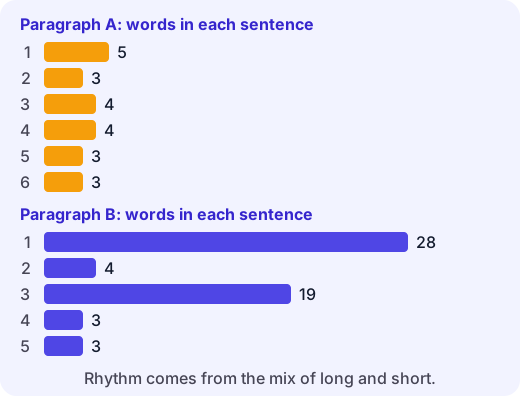
Paragraph A stays between 3 and 5 words. Paragraph B swings between 3 and 28. Sentence length controls the rhythm of what you write:
- Short sentences feel quick, sharp or tense. They are good for emphasis, for a surprise, or for the moment when something happens. "Then I saw him."
- Long sentences feel flowing, detailed or thoughtful. They are good for describing a scene, for linking ideas, and for building up speed before a stop.
- A short sentence after a long one lands like a full stop at the end of a run.
Misconception. "Longer sentences sound more intelligent." Not by themselves. A long sentence that wanders is hard to follow. The aim is variety with purpose: each length chosen for the effect you want.
Misconception. "Short sentences are childish." A well-placed short sentence is one of the strongest tools a writer has. Paragraph B ends on two of them.
Know your building blocks
To change sentences on purpose you need a few terms.
- A clause has a subject and a verb. An independent clause can stand alone: The stalls were crowded. A dependent clause cannot: because the stalls were crowded.
- A simple sentence has one independent clause: I bought mangoes.
- A compound sentence joins independent clauses with a comma and a coordinating conjunction (for, and, nor, but, or, yet, so), or with a semicolon: I bought mangoes, and Dev bought guavas.
- A complex sentence has an independent clause and at least one dependent clause, often starting with a word like because, although, when, while, if, after: When the rain began, I ran for cover.
Four ways to add variety
1. Combine short sentences. Take choppy neighbours and join them with a conjunction or a dependent clause.
- Before: The match started. It began to rain. The crowd stayed.
- After: Although it began to rain as the match started, the crowd stayed.
Be careful with a comma alone, which creates a comma splice ("It began to rain, the crowd stayed" is incorrect). Use a conjunction, a semicolon or a full stop.
2. Change how sentences begin. If every sentence starts with the subject ("I... She... The dog..."), the writing feels like a list. Try starting with:
- a time or place phrase: At dawn, the fishing boats left the harbour.
- an -ing phrase: Clutching the ticket, Neha pushed through the crowd.
- a dependent clause: Because the bridge had washed away, the villagers walked the long way round.
3. Split a long sentence. If a sentence has trailed on through four ideas, cut it at the strongest point. A full stop gives the reader a place to rest.
4. Mix purposes. Most sentences are statements, but an occasional question ("Who left the gate open?") or command ("Listen.") breaks the pattern. Use these sparingly.
Example. Rewrite for variety:
The river was high. It was brown. It carried branches. Children watched from the bridge. They were silent.
Step 1. Join the first three into one flowing sentence: "The river was high and brown, and it carried whole branches past the town." Step 2. Start the next with a participle phrase: "Watching from the bridge, the children were silent." Step 3. Check the lengths: 14 and 8 words. For a sharper ending, make it two: "The children watched from the bridge. Nobody spoke." Now the rhythm runs 14, 6, 2, with the quiet after the long first sentence.
Try it: Take a paragraph you wrote recently and write the number of words in each sentence above it. If all the numbers are within three of each other, choose two sentences to combine and one to cut short.
Pronouns: choosing the right form
Variety is not only about length. When you combine sentences you use more pronouns, and pronouns change form depending on their job. This is case.
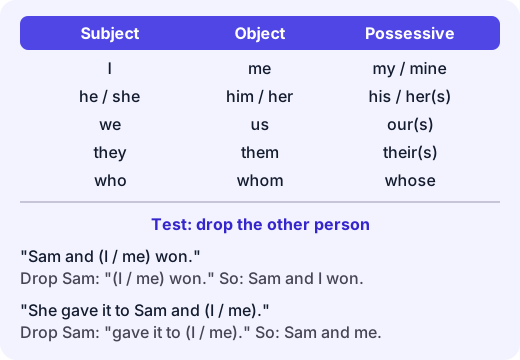
- Subject case (I, he, she, we, they, who) is for the one doing the action: She ran.
- Object case (me, him, her, us, them, whom) is for the one receiving it, or following a preposition: The coach praised her. The ball went to them.
- Possessive forms show ownership: my, his, their, whose. Note that its (belonging to it) has no apostrophe; it's means "it is" or "it has".
The most common slip is with two names. People are told "Sam and I", so they overuse it.
- Wrong: Me and Sam won the quiz.
- Wrong: The teacher gave the prize to Sam and I.
- Right: Sam and I won the quiz. The teacher gave the prize to Sam and me.
The test: drop the other person and read the sentence with just the pronoun. "Me won the quiz" is clearly wrong, so it is Sam and I. "The teacher gave the prize to I" is wrong, so it is Sam and me.
Misconception. "'Sam and I' is always the polite, correct form." It is correct only when the pair is the subject. After "to", "with", "for", or "between", you need me: "between you and me", "come with Priya and me".
A shorter test for who and whom: if you can replace it with he/she/they, use who; if you can replace it with him/her/them, use whom. "(Who/Whom) did you invite?" You invited them, so whom. Many writers use who in speech; in careful writing, aim for whom where the test says so.
Putting it to work
When you revise a paragraph, check these in turn:
- Read it aloud. Where do you run out of breath, or feel a monotone?
- Count lengths. Is there a mix? Is there one short sentence that needs to stand out?
- Check the openings. Are three in a row built the same way?
- Check each pronoun that sits next to another name or a preposition.
Good writers do this almost without noticing, but they learned it the same way: by listening to how the sentences sound and then choosing, again and again, what they want the reader to hear.
Lab
Rhythm builder
Build a paragraph about a kite festival by choosing a short, medium or long version of each sentence, and watch the bar chart of sentence lengths. Then choose the correct pronoun in five sentences.
Your goals
- Choose versions so the paragraph has a short sentence, a long sentence, and no two neighbours of the same length band.
- Pick the correct pronoun in all five sentences in Part 2.
The interactive lab opens once you register. Register to do this.
Quick check
Sentence variety and pronouns check
Eight questions on rhythm, sentence patterns and pronoun case.
1.Read: "The monsoon arrived late that year. Farmers waited by their dry fields, watching the empty sky, and every evening the old men argued about whether the clouds would ever come. Then, one afternoon, it rained." How many more words does the longest sentence have than the shortest?
Answer with a number
2.Which version joins the two ideas correctly?
- The bell rang, the students left.
- The bell rang, and the students left.
- The bell rang the students left.
- The bell rang, the students, left.
Choose one
3.Choose the correct sentence.
- The coach gave the trophy to Leena and I.
- The coach gave the trophy to Leena and me.
- The coach gave the trophy to Leena and myself.
Choose one
4.Which sentences use pronouns correctly? Pick all that apply.
- My brother and I made dinner.
- Between you and I, it is late.
- The dog wagged its tail.
- Her and Zoya won the prize.
- The teacher thanked Omar and me.
Choose all that apply
5.A paragraph has eight sentences, all four words long and all beginning with "The". Which change adds the most useful variety?
- Add one more four-word sentence.
- Combine two of them into one longer sentence and begin another with a time phrase.
- Replace every "The" with "A".
- Make all the sentences longer by the same amount.
Choose one
6.Match each sentence to its type.
- I bought mangoes.
- I bought mangoes, and Dev bought guavas.
- When the rain began, I ran for cover.
Match each to: Compound · Simple · Complex
7.What does a very short sentence do after a long, flowing one?
- It looks like a mistake and should be avoided.
- It makes a pause and gives emphasis, like a full stop at the end of a run.
- It makes the reader skip the long sentence.
- It makes the paragraph more formal.
Choose one
8.Fill in the blank with who or whom: "___ did the committee choose?"
Answer with a word or phrase
Answering and checking are for registered learners. Register to do this.
Quick check
New puzzles with sentence variety
Choose sentence length and form for effect in new situations.
1.A writer wants the reader to feel tense as a character hears someone outside the door at night. Which version fits best?
- Footsteps. Closer. The handle turned.
- She became aware, in a slow and gradual manner, that the sounds she had been hearing for some time from beyond the door were growing steadily nearer to her.
- There were some footsteps outside the door at night.
- Footsteps, as everybody knows, are often heard at night, and they usually come from somewhere.
Choose one
2.Combine into one sentence without a comma splice: "The bus was late. We missed the start. The teacher waited."
- The bus was late, we missed the start, the teacher waited.
- Because the bus was late, we missed the start, but the teacher waited.
- The bus was late we missed the start but the teacher waited.
- The bus was late, and, we missed the start the teacher waited.
Choose one
3.The captain asked Meena and ___ to open the batting. Which word fills the gap?
- I
- me
- myself
- she
Choose one
4.Write who or whom: "To ___ should I give the form?"
Answer with a word or phrase
5.Four sentences in a row begin with "She": She opened the gate. She walked to the well. She lowered the bucket. She waited. Which rewrite of the third sentence changes the pattern best?
- She lowered the bucket slowly.
- Hand over hand, she lowered the bucket.
- She then lowered the bucket.
- She lowered down the bucket.
Choose one
Answering and checking are for registered learners. Register to do this.
Your turn
Rewrite for rhythm
Part 1: rewrite. Rewrite this paragraph so it has a rhythm. Include at least one sentence of 16 words or more, at least one of 5 words or fewer, and at least two different ways of beginning a sentence. Avoid comma splices. You may reorder details and add small details, but keep the facts.
Ravi woke early. It was cold. He put on his jacket. He went to the bus stop. The bus was late. He waited. A dog came. It sat next to him. Ravi shared his biscuit. The bus finally came.
Part 2: pronouns. Correct the pronoun in each sentence, and write the rule you used in a few words.
- Me and Ravi share a seat on the bus.
- The conductor gave tickets to Ravi and I.
- The dog wagged it's tail.
- Whom is waiting at the stop?
Part 3: explain. In 3 to 5 sentences, say how the rhythm of your paragraph is different from the original. Write down the word count of each of your sentences and say which choice of length you are most pleased with and why.
How it's judged
- Variety of length and structure
- Pronoun case
- Explaining the choices
Writing and submitting your answer is for registered learners. Register to do this.
Like what you see?
Register for free to answer the quick checks, do the activities and save your work. Your work is saved on your device and syncs to your account.