Unit 1
Drawing what I see
Look hard at one real thing, draw it, then look again and find more to draw.
Read
Eyes first, then pencil
Tara is asked to draw a leaf. She has seen leaves a thousand times, so she draws one fast, without looking at anything. Out comes a green egg.
Then her teacher puts a real leaf in her hand. "Hold it. Turn it over. Now draw this leaf."
Tara looks. Really looks. And she finds things her green egg never had.
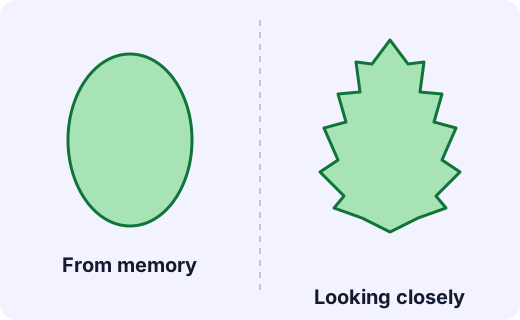
Drawing from memory and drawing by looking
When you draw from memory, your brain gives you a quick idea of a leaf: a simple shape. It is not wrong, but it leaves out almost everything.
When you draw by looking, your eyes keep checking the real thing while your hand draws. You find:
- the stalk at the bottom,
- the veins, the thin lines that carry water through the leaf,
- the edge: is it smooth, or does it have little zigzag teeth?
- the tip: is it round or pointed?
Looking closely changes what you draw. That is the big idea.
How to look
- Pick one thing. A leaf, a shell, a pebble, your shoe, a fruit. Choose something small that you can hold.
- Look before you draw. Count to ten while you only look. Trace the edge with your eyes.
- Draw the big shape first. Keep your eyes on the object most of the time and glance at the paper.
- Look again and find small parts. Ask: What else is there? What is on the top? What is at the bottom?
- Add the details. Lines, spots, bumps, holes, colours.
Try it: Hold a pencil or a spoon. Draw it in 30 seconds from memory. Now look at it for 30 seconds and draw it again. Which drawing has more in it? What did you notice the second time that you missed the first time?
Your second try is not a mistake
Many artists draw the same thing twice or three times. The first drawing is a warm-up. The second one is better because you looked more. You do not rub out the first one. You keep both and compare them.
Example. Imran draws a mango.
- First try: a yellow oval.
- He holds the mango. He sees a small point at the bottom, a dimple at the top where the stalk was, and a green patch on one side.
- Second try: the oval now has a point, a dimple and a green patch. It looks like a real mango.
Nothing about Imran's hand changed. He just looked more.
A common mix-up
Some children say, "I can't draw, because my drawing doesn't look perfect." But drawing what you see is not about being perfect. It is about noticing. A wobbly line that shows a real detail is better than a neat line that shows nothing.
For the grown-up helping
Give your child a real object to hold, and keep their first drawing. Praise what they noticed ("You saw the little hairs on the stalk!"), not how neat it is. Ask questions instead of correcting: "What is at the very top? What colour is the edge?" Do not draw on their paper. If they say "I can't", ask them to draw just the outline, then just one detail.
Activity
Draw it twice
Your child draws one small real object twice, first from memory and then by looking, and compares the drawings. About 20 minutes.
You'll need
- One small object to hold, such as a leaf, a shell, a pebble, a fruit or a toy
- Two sheets of plain paper
- A pencil, and crayons or coloured pencils
Steps
- Choose one object together. Put it out of sight for a moment.
- Drawing 1 (memory): ask your child to draw the object without looking at it. Write the word memory on the back.
- Now hold out the real object. Let your child hold it, turn it, feel it and look at it for a full minute without drawing.
- Ask: What shape is it? What is at the top? What is at the bottom? What small things can you see?
- Drawing 2 (looking): your child draws it again, looking at the object while they draw. Write looking on the back.
- Lay the two drawings side by side. Ask your child to point to three things that are in the second drawing but not in the first.
Safety
- Choose an object with no sharp edges, and nothing small enough for a baby or toddler to swallow nearby.
- Wash hands after handling leaves, soil or shells from outdoors.
Keeping a log of the activity is for registered learners. Register to do this.
Quick check
Drawing check
Five questions about looking and drawing.
1.You want to draw a real shell. What is the best way to start?
- Hold the shell and look at it closely
- Draw what you think shells look like
- Draw the same shell your friend drew
Choose one
2.Which drawing was made by looking closely at a real leaf?
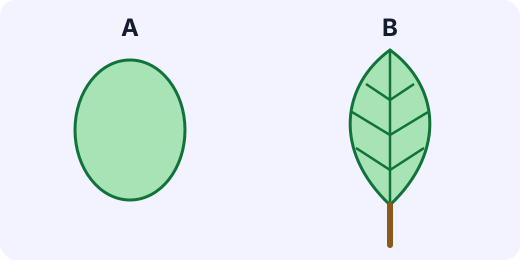
- A
- B
Choose one
3.You drew a leaf once. On your second try you look again. Which details could you add?
- The stalk at the bottom
- The veins inside
- The shape of the edge
- The pattern on your shirt
Choose all that apply
4.Put these in the best order for drawing a pebble.
- Draw its big shape
- Look again for small marks
- Add the small marks
- Look at the pebble closely
Put these in order
5.Why is a second drawing of the same thing often better?
- You looked again and noticed more
- You used a bigger pencil
- It is just luck
Choose one
Answering and checking are for registered learners. Register to do this.
Quick check
New puzzles
Use what you know about looking in new places.
1.Look closely at this flower. How many petals does it have?
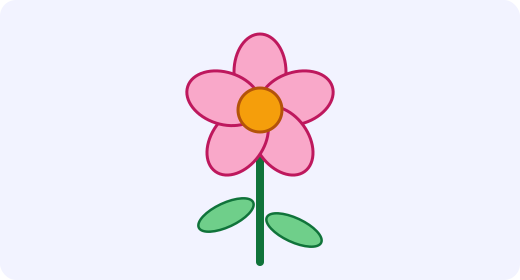
Answer with a number
2.Dev draws a cat from memory. His cat has no whiskers. What should he do to improve it?
- Look at a real cat or a photo, then draw again
- Rub it out and stop drawing
- Colour it in more brightly
Choose one
3.Sara draws a pebble. On her second try she notices a white stripe and adds it. Why is her second drawing better?
- She looked more closely and found a new detail
- She drew it bigger
- She drew it faster
Choose one
4.You are drawing your own shoe. What do you do before you add the laces and the sole?
- Look at the shoe and draw its big shape
- Draw the tiny holes for the laces
- Draw a shoe from memory and skip looking
Choose one
Answering and checking are for registered learners. Register to do this.
Activity
Tell it back
Your child explains, in their own words, what changed when they looked closely. Two minutes.
Steps
- Put the two drawings from "Draw it twice" in front of your child.
- Ask: How are these two different? What did you see when you looked at the real one?
- Ask: If you drew it a third time, what else could you add?
- Write down what your child says in their words. Do not correct them.
Keeping a log of the activity is for registered learners. Register to do this.
Like what you see?
Register for free to answer the quick checks, do the activities and save your work. Your work is saved on your device and syncs to your account.