Unit 2
Colour and shape
Mix new colours from three paints, then cut shapes and build a picture on purpose.
Read
Three paints, so many colours
Nisha's paint box is nearly empty. She only has three pots left: red, yellow and blue. She wants to paint a green frog, an orange sun and a purple plum. "I can't," she says. "I have no green, no orange and no purple."
Her uncle smiles. "You have everything you need."
Three primary colours
Red, yellow and blue are the primary colours of paint. You cannot make them by mixing other paints. But you can mix them to make almost any other colour.
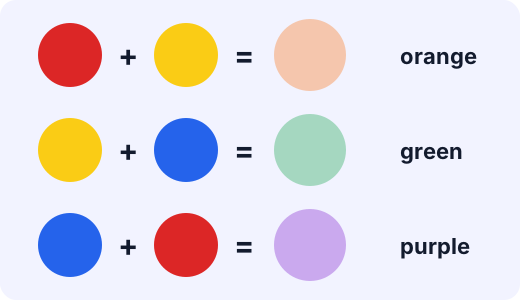
Mix Makes red + yellow orange yellow + blue green blue + red purple Nisha mixes a drop of yellow into blue and gets green for her frog. Red and yellow give her an orange sun. Blue and red give her a purple plum.
How much of each?
The amounts matter. If Nisha uses more yellow than blue, the green looks bright and yellowish, like new leaves. If she uses more blue than yellow, it looks deep and bluish, like a pond.
Example. Start with 3 drops of yellow. Add 1 drop of red. You get a pale orange. Add 3 more drops of red. Now the orange is much redder.
What if you mix all three primary colours together? You get a dull brown. That is why artists add colours slowly, one drop at a time.
Try it: Use the paint mixer on the next page. Which two colours make green? What happens when you add a drop of the third colour?
Shapes, too
Artists also choose shapes. A circle, a square and a triangle are enough to build a house, a tree and a sun.
- a square makes the wall,
- a triangle makes the roof,
- a circle makes the sun,
- a tall rectangle makes the door.
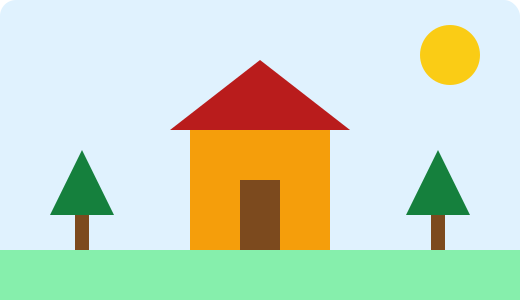
You can make a picture by cutting coloured paper into shapes and sticking them down. The great artist Henri Matisse did this late in his life, using scissors to "draw" with colour.
Artists choose on purpose
When an artist picks a colour or a shape, they pick it for a reason.
- Yellow and orange feel warm and sunny. Blue and grey can feel cool or quiet.
- A big circle can be a sun. A thin triangle can be a mountain peak.
Nobody has to pick the same as you. But you can say why you picked your colours and shapes. That is what makes a picture yours.
A common mix-up
Some people think that you can make yellow by mixing green and red. You can't get yellow back by mixing. Primary colours are the starting colours. Mixing only goes forward to new colours.
For the grown-up helping
Let your child mix a little at a time, with a small amount of water on a plate. Mixing is messy and that is fine; lay down newspaper first. Ask "Why did you choose that colour?" rather than "What is that?" A sun painted blue is a choice, not a mistake. Safe, child-grade paints are best; wash hands after painting.
Lab
The paint mixer
Add drops of red, yellow and blue paint to the bowl and watch the colour change. Make orange, green and purple.
Your goals
- Make orange, green and purple using only red, yellow and blue.
- Notice what happens when you add more of one colour than another, and when you mix all three.
The interactive lab opens once you register. Register to do this.
Activity
Mix and cut
Your child mixes paints from red, yellow and blue, then cuts shapes from the painted paper and builds a picture. About 40 minutes, with drying time.
You'll need
- Red, yellow and blue washable paint
- A plate or an old tray for mixing
- A brush and a cup of water
- Plain or thick paper (4 sheets)
- Child scissors, glue stick, a sheet of paper for the background
- Newspaper to cover the table
Steps
- Cover the table. Put a small blob of each of the three paints on the plate, apart from each other.
- Your child mixes red and yellow, yellow and blue, and blue and red, one at a time. They paint a patch of each new colour on a sheet of paper and say its name.
- Paint three more sheets, one in each of three colours your child likes. Let them dry.
- When dry, an adult helps draw big shapes (circles, squares, triangles, rectangles) on the back, or your child draws them. Your child cuts them out.
- Your child arranges the shapes on the background sheet to make a picture, such as a house, a boat, a bird or an animal. They can move the shapes around before gluing.
- Glue the shapes down. Ask: Why did you pick these colours? Which shapes did you use?
Safety
- Use washable, non-toxic paint. Keep paint and water away from mouths.
- Child-safe scissors only. An adult cuts anything thick.
- Wash hands and brushes afterwards.
Keeping a log of the activity is for registered learners. Register to do this.
Quick check
Colour and shape check
Six questions about mixing colours and using shapes.
1.Which three are the primary colours of paint?
- Red, yellow, blue
- Green, orange, purple
- Red, green, black
Choose one
2.You mix red paint and yellow paint. What colour do you get?
- Orange
- Green
- Purple
Choose one
3.Match each mix to the colour it makes.
- Yellow + blue
- Blue + red
- Red + yellow
Match each to: Purple · Orange · Green
4.Which of these colours can you NOT make by mixing other paints?
- Green
- Orange
- Blue
- Purple
Choose one
5.How many triangles can you count in the picture?
Answer with a number
6.An artist wants her picture to feel hot and sunny. Which colours would she choose on purpose?
- Yellow and orange
- Dark grey and navy
- Pale blue and white
Choose one
Answering and checking are for registered learners. Register to do this.
Quick check
New puzzles
Use colours and shapes in new ways.
1.You want to paint a green frog but you have no green paint. Which two paints do you mix?
- Yellow and blue
- Red and yellow
- Red and blue
Choose one
2.Ravi has only red and yellow paint. Which colour can he NOT make?
- Orange
- Green
- A redder orange
Choose one
3.Leela mixes red, yellow and blue together in one bowl. What does she most likely get?
- A dull brown
- White
- A bright rainbow colour
Choose one
4.Kai cuts a circle, a square and a triangle from paper. Which one has no straight edges and no corners?
- The circle
- The square
- The triangle
Choose one
5.Mina has cut 2 triangles, 3 squares and 1 circle from coloured paper. How many shapes has she cut in all?
Answer with a number
Answering and checking are for registered learners. Register to do this.
Activity
Tell it back
Your child explains why they chose the colours and shapes in their picture. Two minutes.
Steps
- Put the finished shape picture in front of your child.
- Ask: Why did you choose these colours? Why did you pick these shapes?
- Ask: How did you make the green (or orange, or purple)?
- Write down what your child says in their words. Do not correct them.
Keeping a log of the activity is for registered learners. Register to do this.
Like what you see?
Register for free to answer the quick checks, do the activities and save your work. Your work is saved on your device and syncs to your account.