Unit 6
Acting out stories
Make a puppet or take a role, and show how a character feels with your face, voice and body.
Read
Show it, don't just say it
Here is a short story. As you read it, picture how the crow feels in each part.
The Thirsty Crow. One hot summer day, a crow flew a long way looking for water. The ponds were dry. The crow was tired and so thirsty. At last, it saw a pitcher in a garden. It peeped in and saw a little water, far down at the bottom. The crow's beak could not reach it! The crow felt sad and worried. Then it had an idea. It picked up a small stone and dropped it into the pitcher. Plop! Then another, and another. Slowly, the water rose up, and up. At last, the crow could drink. It felt happy and proud.
Characters and roles
A character is a person or an animal in a story. The crow is a character. When you act out a story, you take a role: you become one of the characters for a little while. You can use your own body, or a puppet.
A puppet is a figure that you move and speak for. A stick puppet is a drawing or a paper shape on a stick. A finger puppet fits on a finger. A sock puppet fits over your hand. The puppet acts, and you give it a voice.
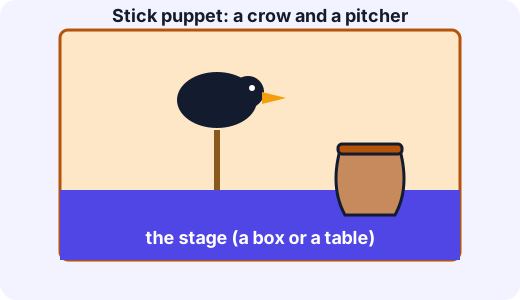
Showing a feeling
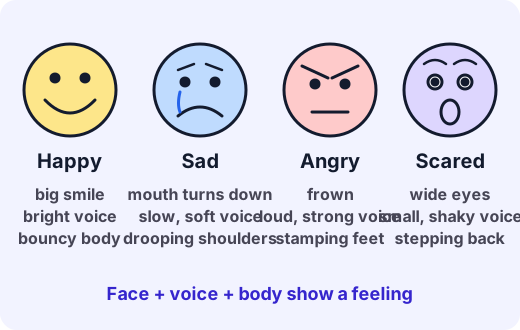
You can show how a character feels with three things.
What you use How it helps Face eyes, eyebrows and mouth Voice loud or soft, fast or slow, high or low Body how you stand, move and hold your arms and feet Look at these four feelings.
Example. The crow at the start of the story is thirsty and tired. How would you show that?
- Face: half-closed eyes, a sad mouth.
- Voice: slow, low and a little croaky: "So thirsty..."
- Body: shoulders low, walking slowly, wings hanging down.
Then the crow has an idea! The face opens up, the voice gets quick and bright ("I know!"), and the body hops up.
A common mix-up: saying "I am happy" is not the same as showing it. If you say "I'm so happy!" in a flat voice with a frown, the audience will not believe you. The face, voice and body have to tell the same story.
Try it: Say "I got a present!" three times. First like a happy person, then like a sad person, then like a scared person. What did you change each time?
Acting with a puppet
With a puppet, the puppet's body does the acting. Move it so the feeling shows: a sad puppet moves slowly with its head down; an excited puppet bounces. Give it a voice that matches. And keep your eyes on your puppet, so the audience looks at it too.
For the grown-up helping
Act out the story with your child several times, taking turns being the crow. Ask "How is the crow feeling now? How can we show that?" Let your child lead. Any story they love will do, including ones from your own family. It is normal for young children to giggle or go very quiet at first; make it fun, not a performance.
Activity
Puppet show
Your child makes a puppet (or uses their own body), acts out a short story, and shows at least two different feelings. About 30 minutes.
You'll need
- Paper or thin card, and crayons or pencils
- A craft stick, a straw or a rolled-up piece of paper for a handle
- Tape or glue
- A table or a box to hide behind, optional
- A short story, such as "The Thirsty Crow", or one your child loves
Steps
- Read or tell the story. Ask your child to name the characters and pick one to be.
- The grown-up cuts out a character shape from paper (about the size of a hand). Your child colours it and gives it a face. Tape or glue the shape to the handle.
- Choose two moments in the story where the character feels different (for example thirsty and sad, then happy and proud). Say each feeling out loud.
- Practise showing the first feeling with the puppet's body and a voice. Move it slowly or quickly, high or low. Then do the second feeling.
- Do the whole story. Your child moves the puppet and speaks for it. The grown-up is the audience and any other characters.
- Try without the puppet. Your child acts as the character, with their own face, voice and body.
- Talk about it. Ask "How did you show the character was sad? How did you show it was happy?"
Safety
- The grown-up does all the cutting with scissors. Choose a blunt handle such as a straw, a craft stick or rolled paper, and keep pointed sticks away from faces and eyes.
- Never put a plastic bag over anyone's head. Paper-bag puppets go on the hand only.
- Keep the acting space clear of furniture, in case of hopping and stamping.
Keeping a log of the activity is for registered learners. Register to do this.
Quick check
Acting out stories check
Six questions about showing feelings. Look at the pictures.
1.How is this character feeling?

- Sad
- Excited
- Angry
Choose one
2.How is this character feeling?

- Scared
- Happy and excited
- Sleepy
Choose one
3.Which of these show that a character is scared?
- Wide eyes
- Stepping back
- A small, shaky voice
- A big grin and a loud, happy laugh
Choose all that apply
4.Match each feeling to the voice that shows it best.
- Angry
- Sad
- Excited
Match each to: Slow and soft · Quick and bright · Loud and strong
5.What is a puppet?
- A figure you move and speak for, to act out a story
- A kind of song
- A game with a ball
Choose one
6.You play a character who has just won a race. What do you do?
- Big smile, bright voice, arms up high
- Frown, whisper, shoulders drooping
- Keep a blank face and stand perfectly still
Choose one
Answering and checking are for registered learners. Register to do this.
Quick check
New puzzles
Use what you know about showing feelings in some new places.
1.A puppet is alone in a dark forest. It hears a noise, stops still, and its legs shake. What is the puppet feeling?
- Scared
- Proud
- Sleepy
Choose one
2.You are acting a very angry king. Which voice and body fit best?
- A loud, strong voice and stamping feet
- A soft sing-song voice and dancing
- A tiny whisper and a shaky body
Choose one
3.One puppet hops fast and talks in a high, bright voice. The other walks very slowly and talks in a low, slow voice. Which puppet seems more excited?
- The hopping puppet
- The slow puppet
- Both the same
Choose one
4.Rina says "I am so happy!" in a flat voice, with a frown and her arms crossed. What will the audience think?
- They will not believe she is happy, because her face and body say something else
- They will believe she is happy, because she said so
- They will think she is cross or unhappy, whatever the words say
Choose one
5.A puppet show has 3 characters. Each character shows 2 different feelings. How many feelings are shown in all?
Answer with a number
Answering and checking are for registered learners. Register to do this.
Activity
Tell it back
Your child explains in their own words how to show a feeling when acting. Three minutes.
Steps
- Ask your child to show you "angry" without using any words. Watch what they do.
- Ask "What did you do with your face? With your body?" Then ask them to try again with a voice.
- Ask "How could you show 'happy' instead? What changes?"
- Write down what your child says, in their own words.
Keeping a log of the activity is for registered learners. Register to do this.
Like what you see?
Register for free to answer the quick checks, do the activities and save your work. Your work is saved on your device and syncs to your account.