Unit 1
The colour wheel
Mix three paints into a whole wheel of colours, and learn how warm and cool colours change how a picture feels.
Read
Three paints, a hundred colours
Think of Holi morning. Someone throws a handful of yellow powder, someone else throws red, and where the two clouds meet in the air the colour is suddenly a glowing orange. Nobody mixed it in a bowl. The colours mixed themselves.
Painters know a secret: you do not need a hundred pots of paint. With just three pots and a little water, you can make almost every colour you have ever seen. This unit shows you how, and how colour can make a picture feel hot, cold, busy or calm.
The three primary colours
In painting, the primary colours are red, yellow and blue. They are special because you cannot make them by mixing other paints. Every other paint colour starts from them.
Secondary colours
When you mix two primary colours in equal amounts, you get a secondary colour.
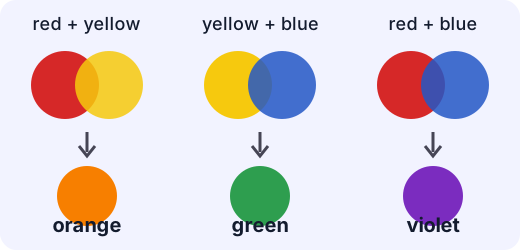
Mix You get red + yellow orange yellow + blue green red + blue violet (purple) Example. A child wants green for a mango leaf but only has yellow and blue. She puts a blob of yellow on her tray and touches it with a little blue. The green is bright and spring-like. She adds a bit more blue and it turns deeper, like a leaf in the shade. How much of each primary you use changes the result. Add the darker colour a little at a time: a tiny drop of blue changes a lot of yellow, but it takes a great deal of yellow to change blue.
Putting them on a wheel
Artists arrange the six colours in a circle, with each secondary sitting between the two primaries that make it. This is the colour wheel.
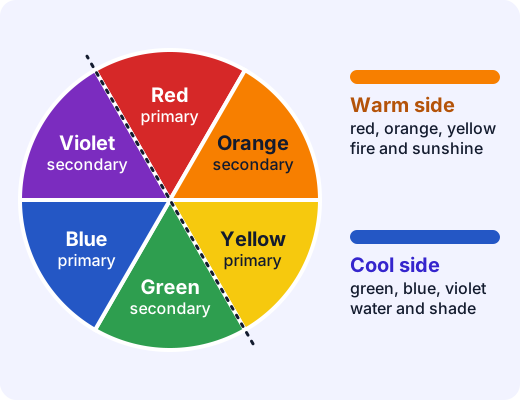
Read it around like a clock: red, orange, yellow, green, blue, violet, and back to red. It is the same order as the colours of a rainbow, bent into a circle.
Try it: Close your eyes and picture a mango tree in the sun. Which two primaries would you mix for the leaves? Which primary pushes the ripe fruit from green towards orange?
Warm and cool colours
Draw a line through the wheel and you get two halves.
- Warm colours are red, orange and yellow. They remind us of fire, the sun, a hot cup of chai, a sunset.
- Cool colours are green, blue and violet. They remind us of water, ice, shade, a rainy sky.
The line is not hard. A yellowish-green feels a little warm, and a reddish-violet feels a little warm too. Colours lean one way or the other, and painters use that.
Colour sets the mood
Here is the big idea of this unit: colour changes how a picture feels, even when the drawing underneath is exactly the same.
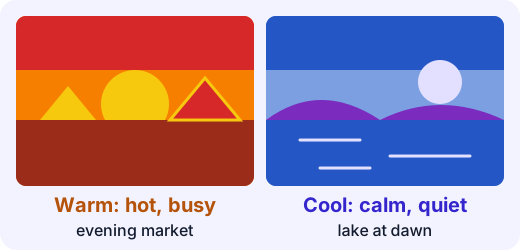
Imagine you draw a lamp-lit village street. Colour it with oranges and reds and it feels warm, busy and welcoming, like Diwali evening. Colour the same street in blues and violets and it feels quiet, lonely, even a little cold, like a night after everyone has gone to sleep.
Here are some pairings that painters use:
Mood or place Colours that help Hot day, festival, excitement reds, oranges, yellows Calm lake, rain, early morning blues, violets, cool greens Fresh and natural greens Example. An artist paints a big, cool, blue-green forest. She wants your eye to land on a tiny lantern hanging in a tree. She paints just the lantern in bright orange. Because everything else is cool, the small warm spot glows like a spark. A warm colour in a cool picture (or a cool one in a warm picture) stands out.
Mistakes to avoid
- "Mixing all my colours will make an even brighter colour." Mix too many paints and you get a dull brown or grey mud. Keep to two primaries at a time for clean secondaries.
- "Warm colours are for happy pictures, cool colours for sad ones." It is not that simple. A bright yellow can feel joyful or glaring; a deep blue can feel peaceful or lonely. Use warm and cool to help the feeling you want, and look at the whole picture.
- "Primary colours are the same for paint, print and screens." For paints on paper they are red, yellow and blue. Printers use a different set (cyan, magenta and yellow) and screens mix light from red, green and blue. This unit uses the painter's wheel.
What you will do next
In the lab you will mix the paints and then colour two scenes to set a mood. Offline, you will make a real colour wheel with real paint.
Lab
The paint mixer
Mix the three primary paints in a bowl to make the secondary colours, then colour two scenes so that one feels warm and the other feels cool.
Your goals
- Mix red and yellow, yellow and blue, and red and blue to make the three secondary colours.
- Colour the evening market so that it feels warm.
- Colour the lake at dawn so that it feels cool.
The interactive lab opens once you register. Register to do this.
Activity
Make your own colour wheel
Mix three paints into a six-colour wheel, then paint the same simple picture twice, once warm and once cool. About 45 minutes.
You'll need
- Red, yellow and blue paint (poster colours, watercolours or powder colours mixed with water)
- A brush and a cup of water
- An old plate or tray for mixing
- A rag or old cloth for wiping the brush
- 2 sheets of thick paper
- A pencil and a round lid or small bowl to trace a circle
- Old newspaper to cover the table
Steps
- Cover the table with newspaper. Trace a circle with the lid on the first sheet. Divide it into six equal wedges like a pizza (draw one line across the middle, then split each half into three). Lightly write R, O, Y, G, B, V in the wedges, in that order around the circle.
- Paint the three primary wedges (red, yellow, blue) with pure paint straight from the pot. Leave one empty wedge between each pair.
- On your plate, mix a small blob of red with a small blob of yellow, adding the darker colour little by little. Paint the orange wedge between them.
- Do the same to make green from yellow and blue, then violet from red and blue. If a mix is dull, try again with a smaller amount of the darker paint.
- Wash the brush between every colour. Write the three mixes under the wheel, for example "red + yellow = orange".
- Draw a dotted line through the wheel to split it into a warm half and a cool half. Write "warm" and "cool" beside the halves.
- On the second sheet, fold the paper in half. Draw the same simple scene on both halves, for example a house, a tree and a hill with a sun or moon.
- Paint the left half using only warm colours (reds, oranges, yellows). Paint the right half using only cool colours (greens, blues, violets). Add one small spot from the opposite family in each half, such as a tiny warm lantern in the cool half.
- Look at both halves. Which one feels like midday and which like night? Which feels more cosy? Write down your answers.
Safety
- Use non-toxic paints. Do not put paints, brushes or water in your mouth.
- Wash your hands after painting.
- Do not drink from or reuse food cups for paint water.
- Wear an old shirt, and keep paint away from your eyes.
Keeping a log of the activity is for registered learners. Register to do this.
Quick check
Colour wheel check
Seven questions about mixing colours and what colours do to a picture.
1.Which three colours are the primary colours in painting?
- Red, green and yellow
- Red, yellow and blue
- Orange, blue and violet
- Green, orange and blue
Choose one
2.You mix yellow paint with blue paint. What colour do you get?
- Green
- Orange
- Violet
- Red
Choose one
3.Match each pair of primary colours to the secondary colour they make.
- Red + yellow
- Yellow + blue
- Red + blue
Match each to: Green · Violet · Orange
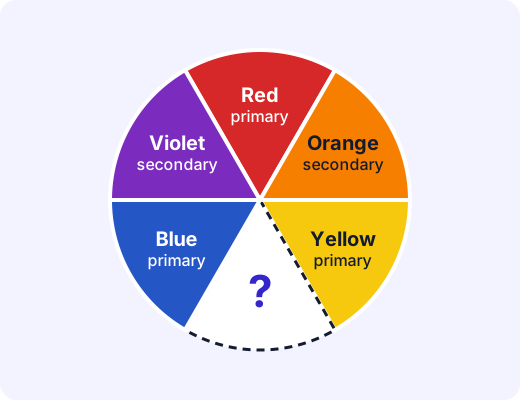
4.One wedge of this wheel is missing. What colour goes in the wedge with the question mark?
Answer with a word or phrase
5.Which of these are warm colours? Pick all that apply.
- Red
- Blue
- Orange
- Green
Choose all that apply
6.Put these colours in order as they go around the wheel, starting at red and moving through orange.
- Orange
- Red
- Green
- Violet
- Blue
- Yellow
Put these in order
7.A painter wants her picture of a snowy, silent morning to feel cold and quiet. Which set of colours should she use mostly?
- Reds, oranges and yellows
- Blues, violets and cool greens
- Every colour mixed together
Choose one
Answering and checking are for registered learners. Register to do this.
Quick check
New puzzles
Use what you know about the wheel in some new situations.
1.Mira has pots of red, yellow and blue paint. She wants violet for a plum. Which two pots should she mix?
- Red and yellow
- Yellow and blue
- Red and blue
Choose one
2.You have the three primary paints. If you mix two different primaries at a time, how many different pairs can you make? (Red with yellow is the same pair as yellow with red.)
Answer with a number
3.An artist paints a desert at midday and wants viewers to feel the heat. Which colours should fill most of the painting?
- Yellows, oranges and reds
- Blues and violets
- Mostly green
Choose one
4.A picture of a night lake is painted in blues and violets. The artist adds a small boat lantern and wants it to stand out the most. What colour should the lantern be?
- Bright orange
- Another blue
- Dark violet
Choose one
5.A picture is painted mostly in green, blue and violet. Are those warm colours or cool colours? Answer with one word.
Answer with a word or phrase
Answering and checking are for registered learners. Register to do this.
Your turn
Explain it to a friend
Imagine a friend has never used paints. Write a short explanation (about 8 to 10 sentences) that does three things:
- Names the three primary colours and tells how to make each secondary colour.
- Explains what warm and cool colours are, with two examples of each.
- Describes how you could paint the same scene, such as a village at night, so that it feels warm one time and cool the other time. Say which colours you would use and what feeling each version gives.
How it's judged
- Mixing and the wheel
- Warm and cool
- Colour and mood
Writing and submitting your answer is for registered learners. Register to do this.
Like what you see?
Register for free to answer the quick checks, do the activities and save your work. Your work is saved on your device and syncs to your account.