Unit 2
Drawing carefully
Look closely at where the light falls, and use shading to turn a flat outline into something that looks solid.
Read
How to make a flat circle look round
Draw a circle on paper. What is it? A coin? A plate? A flat paper sticker? It could be anything, because a plain outline is flat.
Now hold a real ball under a lamp in a dim room. One side glows. The other side sinks into darkness. A soft dark shape lies on the table behind it. You do not need an outline to know that this is round and solid. Your eyes read light and shadow. If you copy what the light does, a flat drawing starts to look solid too.
Why there is a shadow at all
Light travels in straight lines. When a ball is in the way, the light can reach the side that faces the lamp, but it cannot bend around to the far side. That far side gets less light, and we see it as darker. The ball also blocks light from reaching the table behind it, so the table has a dark patch too.
The parts of a lit ball
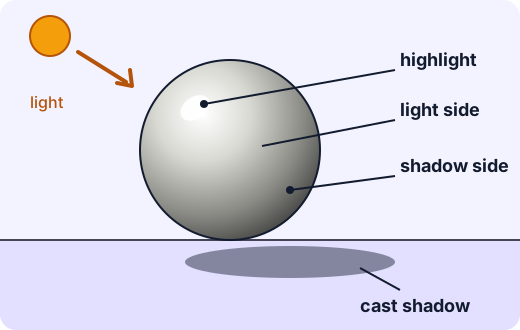
- The highlight is the brightest spot, where the light hits the surface most directly. On a shiny mango or a steel tumbler it is a small bright patch. On a matte clay pot it is only a lighter area.
- The light side is the part facing the lamp.
- The shadow side is the part facing away from the lamp. It is not pitch black. Light bounces off the table and nearby things, so you will often see a faint lighter edge on the shadow side near the bottom of the ball.
- The cast shadow is the dark shape the object throws on the table or ground. It always falls on the side away from the light.
The light decides everything
Before you pick up your pencil, find out where the light comes from. If the lamp is on your left, the left of the ball is bright, the right is dark, and the cast shadow falls to the right. If the lamp moves to the right, everything swaps.
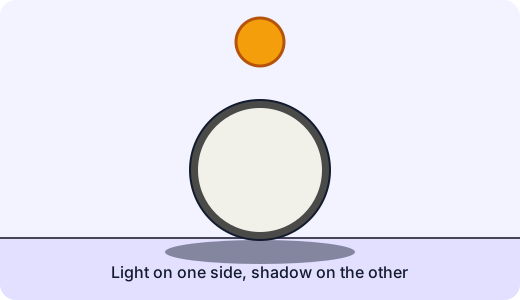
A common mistake is to shade one side but put the cast shadow on the same side as the lamp. Then the picture feels wrong and the viewer cannot say why. Always check: light one side, shadow the other.
Try it: Switch on a torch in a dark room and shine it at an orange from the left. Slowly walk the torch round the orange. Watch the bright patch and the shadow move. The shadow is always opposite the torch.
Making tones with a pencil
Artists call how light or dark a tone is its value. With one pencil you can make a whole scale, just by changing how hard you press.
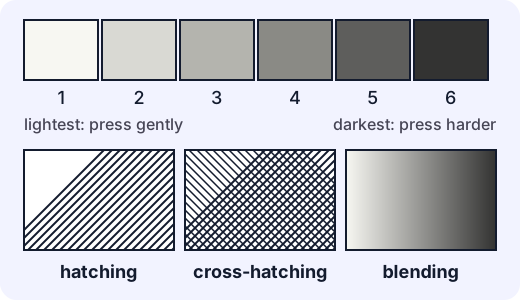
Three ways to shade:
- Hatching: rows of short parallel lines. Closer lines look darker.
- Cross-hatching: a second layer of lines across the first. It gets darker still.
- Blending: smooth tones made with gentle, overlapping strokes (you can soften them with a finger or tissue).
Press lightly for the light side and harder for the shadow side. Keep the highlight as bare paper: do not draw it, leave it. You cannot get white back once it is covered.
How to draw an object, step by step
Example. Let's draw a mango on a table, with a window on your left.
- Look first. Place the mango. Find where the light comes from (the window, so the left). Squint your eyes: the bright and dark areas stand out more.
- Draw a light outline of the mango's shape, an egg-like oval with a small point at the top. Use a soft, thin pencil line. Draw a gently curved line for the table's edge.
- Mark the highlight with a small gap that you will leave unshaded, on the left, a bit above the middle.
- Shade the mid-tones across the mango, getting a bit darker as you go from the left (window side) to the right.
- Deepen the shadow side. Press harder on the right. Leave a thin lighter edge near the bottom right for the bounced light.
- Draw the cast shadow on the table to the right of the mango, darkest right under the mango and fading out as it spreads.
- Step back. Do the edges look soft where light turns to shadow? Real objects change tone gradually, so avoid hard stripes.
Mistakes to watch for
- A thick dark outline all around. Real objects have no line around them, only places where one tone meets another. A heavy outline makes a drawing look like a cartoon sticker. Draw lightly, then let your shading define the edge.
- Shadow in the wrong place. It must agree with the light.
- Making the shadow pure black. Shadows have shades of grey, and your darkest dark should still show a little of the object's shape.
- Going dark too early. Start light, and build up, because it is easy to darken but hard to lighten.
Where this connects
Shadows get longer when the lamp (or the Sun) is low and shorter when it is high. You can explore why in your science course on light and shadows.
Lab
Light and shade
A ball is cut into 7 bands. Choose the tone of each band so the ball looks lit from the lamp, then say where the cast shadow falls. Do it once with the lamp on the left and once with the lamp on the right.
Your goals
- Shade the ball from light to dark, moving away from the lamp, with the lightest band nearest the lamp and a dark band farthest away.
- Put the cast shadow on the side away from the lamp.
- Do it for both lamp positions.
The interactive lab opens once you register. Register to do this.
Activity
Draw it with shading
Draw a real round object with shading that shows light and shadow, first on a practice ball and then on a mango, an orange or a similar object. About 40 minutes.
You'll need
- A pencil (HB, or a soft one marked 2B if you have it) and an eraser
- Plain paper and something to rest it on
- One real object with a smooth round shape, for example an orange, a mango, an onion or a ball
- A small plain tray or sheet of paper for the object to sit on
- A single light source, for example a desk lamp with an LED bulb, a torch, or a window with sunlight coming from one side
Steps
- Set up the object on the paper tray in a dim room with the light coming from one side only. Do not move the light while you draw.
- Squint at the object. Say aloud which side is lightest, which is darkest, and where the cast shadow falls.
- On your page, draw a row of six small boxes. Fill them from the lightest to the darkest by pressing harder each time. This is your tone scale.
- Practice ball. Draw a circle lightly. Leave a small highlight unshaded. Shade the light side with gentle pressure and the far side with firmer pressure, blending in between. Add a cast shadow on the side away from the light.
- Now draw your real object. Start with a soft, thin outline of its shape and the table edge.
- Build up the shading in layers, starting light and getting darker on the shadow side. Leave the highlight as bare paper.
- Draw the cast shadow away from the light, darkest next to the object and fading out.
- Move the lamp to the other side. Look again and, on a new page, make a quick small drawing of the same object with the new lighting. Notice how the shading and the cast shadow switched sides.
- Hold your drawings at arm's length. Does the object look solid? Write what you would change next time.
Safety
- Switch off a lamp and let it cool before you move it. Never touch a hot bulb. Use an LED lamp or a torch where you can.
- Do not eat the fruit until you have washed your hands, and wash the fruit if you plan to eat it after.
- Use a sharpener with care, and have an adult help with a blade. Never put a pencil in your mouth.
- Sit with good light on your paper and take a break if your eyes or neck feel tired.
Keeping a log of the activity is for registered learners. Register to do this.
Quick check
Drawing carefully check
Seven questions about light, shadow and shading. Look at the pictures carefully.
1.The lamp is at the upper left of this ball. Where will the cast shadow fall on the table?
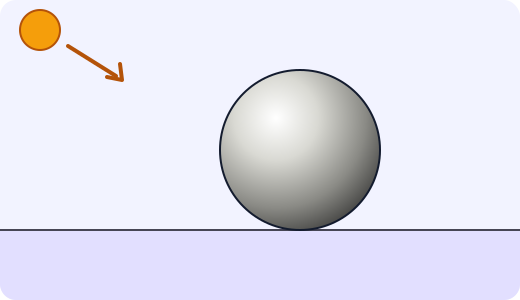
- To the left of the ball, towards the lamp
- To the right of the ball, away from the lamp
- There will be no shadow
Choose one
2.Both balls are shaded the same way, with the light coming from the upper left. Which drawing has a mistake?
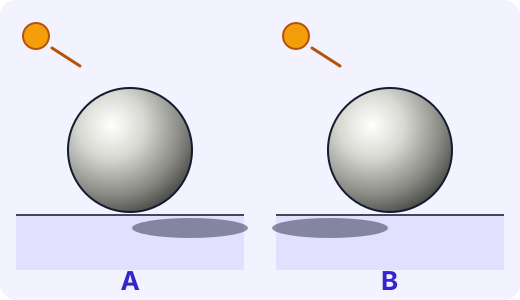
- A
- B
- Both are right
Choose one
3.Why is the side of a ball that faces away from the lamp darker?
- Light travels in straight lines and cannot reach that side directly
- That side is always painted a darker colour
- That side of the ball is hotter
Choose one
4.Match each word to what it means in a drawing of a lit ball.
- Highlight
- Shadow side
- Cast shadow
Match each to: The brightest spot, where light hits most directly · The dark shape the ball throws on the table · The part of the ball that faces away from the light
5.Which of these help a drawing of an apple look solid and round? Pick all that apply.
- Shading that changes gradually from light to dark
- A cast shadow on the side away from the light
- A thick, dark outline all the way around
- Pressing with the same force everywhere
Choose all that apply
6.Put these steps for drawing an object in a sensible order.
- Shade the darker parts lightly
- Press harder to deepen the darkest shadows
- Look at the object and find where the light comes from
- Draw a light outline of its shape
Put these in order
7.What do we call the dark shape that an object throws onto the table or ground?
Answer with a word or phrase
Answering and checking are for registered learners. Register to do this.
Quick check
New puzzles
Light and shadow turn up in new places. Can you use what you know?
1.A lamp stands to the right of an apple. In your drawing, which side of the apple is darkest, and where does the cast shadow go?
- Right side darkest, shadow on the right
- Left side darkest, shadow on the left
- Left side darkest, shadow on the right
- Right side darkest, shadow on the left
Choose one
2.In this drawing the top of the cube is the lightest, the left face is medium and the right face is the darkest. Where is the light coming from?
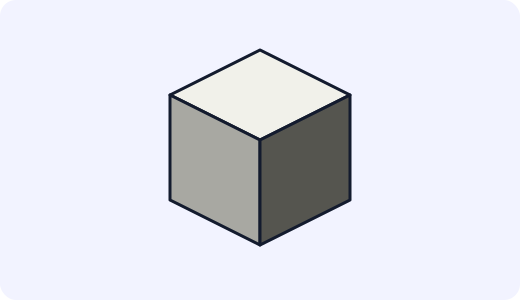
- From above and a little to the left
- From below
- From the right
Choose one
3.At midday the sun is almost straight above a steel cup standing on the ground. What does its cast shadow look like?
- Short and close to the base of the cup
- Very long, stretching far across the ground
- There is never a shadow
Choose one
4.A friend draws a mango with a heavy outline and no shading. The window is on the left. What is the best advice?
- Draw lightly, then shade from light on the left to dark on the right and add a cast shadow on the right
- Make the outline even thicker
- Colour the whole mango in one flat dark tone
Choose one
Answering and checking are for registered learners. Register to do this.
Your turn
Explain how shading works
Look at the object you drew in the offline activity (or any round object near you under a lamp). Write 8 to 10 sentences for a younger child who wants to learn to draw. Explain:
- Where the light was coming from and which parts of the object were lightest and darkest.
- Why the dark side is dark, and where the cast shadow fell and why.
- Two tips for making a flat drawing look solid, and one mistake to avoid.
How it's judged
- Light and shadow described
- Explains why
- Practical tips
Writing and submitting your answer is for registered learners. Register to do this.
Like what you see?
Register for free to answer the quick checks, do the activities and save your work. Your work is saved on your device and syncs to your account.