Unit 3
Notes and rhythm cycles
Sing the seven swaras, then keep the 8-beat Keherwa taal with claps and waves, and put a tune on top of it.
Read
Seven notes and a wheel of beats
A wedding band comes down the street. The dhol thumps. The shehnai sings. Everyone claps. Without anyone telling them, the whole crowd claps in the same rhythm and finds the same thump to come back to again and again.
Every piece of music is built from two things:
- Notes: what you sing or play, high and low.
- Beats: when you sing or play them, in time.
In this unit we learn the names of the notes in Indian music, and the wheel of beats that keeps everyone together.
The seven swaras
In Indian music, a musical note is called a swara. There are seven main ones. Their short names are called the sargam:
Sa Re Ga Ma Pa Dha Ni Shadja Rishabh Gandhar Madhyam Pancham Dhaivat Nishad After Ni comes Sa again, one step higher: the same note, in a higher voice. So going from Sa to the next Sa is called one saptak, a set of seven notes plus the one you start on again.
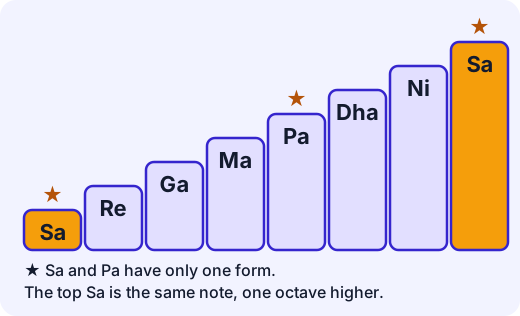
Three facts to keep in mind:
- Sa is your home note. It is not one fixed pitch. Each singer picks the Sa that suits their voice, and then all the other swaras are measured from it. That is why a child and her grandfather can sing the same tune, each starting from a different Sa.
- Sa and Pa have only one form. The others (Re, Ga, Dha, Ni) can be lowered a little and Ma can be raised a little to make different moods and ragas. Here we use the plain versions.
- The plain seven are very close to the do re mi fa sol la ti you may know from other songs. Sa Re Ga Ma Pa Dha Ni is a sister of that ladder.
Try it: Hum a comfortable note and call it Sa. Now climb: Sa Re Ga Ma Pa Dha Ni Sa, one note for each count of 1 to 8. Going up is aroha; coming down (Sa Ni Dha Pa Ma Ga Re Sa) is avroha. Listen for the "home" feeling when you reach Sa again.
Beat and taal
A beat (called a matra) is the steady pulse you tap your foot to. A taal is more than that: it is a pattern of beats that goes round and round, like the hands of a clock, and each time it comes back to the start. This repeating loop is a cycle or avartan.
Three words to know:
- Sam is the first beat of the cycle. It is the strongest, the "home" of the rhythm. We clap here.
- Khali means "empty". It is a beat where we wave a hand instead of clapping. The beat is still counted: only the sound is lighter.
- Vibhag is a section of the cycle, a small group of beats.
Keherwa: eight beats
Keherwa is a taal with 8 beats, in two halves of 4. You hear it in folk songs, bhajans, ghazals, film songs and many a wedding dhol. The tabla or dholak plays a pattern of drum syllables called the theka:
Beat 1 2 3 4 5 6 7 8 Bol Dha Ge Na Ti Na Ka Dhi Na Hands clap (sam) count count count wave (khali) count count count 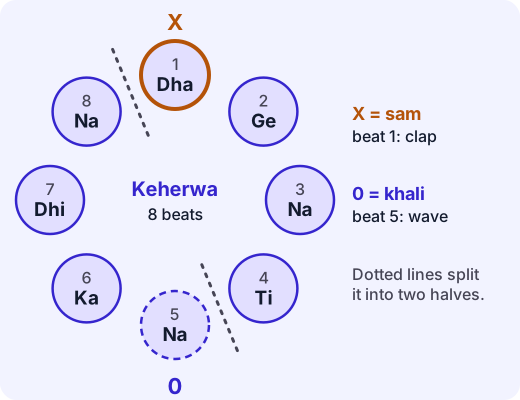
After beat 8, you go straight back to beat 1 with no gap. If you stop to breathe, you have broken the loop.
Example. Count three rounds of Keherwa: 3 × 8 = 24 beats. You clap on beat 1 of each round, so you clap 3 times (on counts 1, 9 and 17 of the 24), and you wave 3 times (on counts 5, 13 and 21).
Another way to count: 4/4
Many songs from around the world are counted in 4/4: four beats in every bar, counted 1-2-3-4, 1-2-3-4. Keherwa feels just like two bars of 4/4 joined together. The first beat of each bar is the strongest, but beat 1 of the cycle (the sam) is the strongest of all.
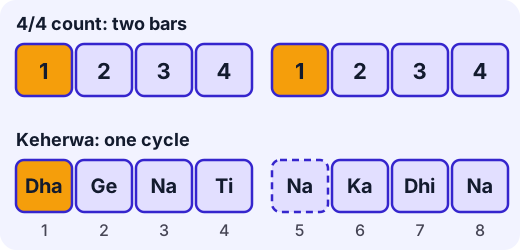
So if a friend says "just keep a steady 4/4 beat", you can tap 1-2-3-4 and count the bars. If they say "Keherwa", you count to 8 and clap on 1, wave on 5.
Putting a tune on a taal
Here is the best part. Choose one swara for each beat and sing it as the cycle goes round. For example:
Sa Re Ga Ma | Pa Ma Re Sa
That is one swara on each of the 8 beats, so the tune fits exactly one cycle. It begins on Sa at the sam and gets back to Sa as the cycle ends, so when the clap on beat 1 comes round again, it lands on the home note. Sing it twice and you have a whole little song.
Common mistakes
- Rushing. It is easy to speed up when you are excited. Start slowly and keep the same speed all the way round.
- Skipping the khali. The wave is a real beat, not a rest. Count it aloud: "five".
- Stopping at the end. The cycle never stops: 8 flows into 1.
- Shouting the notes. Sing gently from your chest. Straining your voice does not make the swaras any better. Drink water, and take a break if your throat feels tired.
Lab
Taal and tune maker
Find the sam and the khali in the Keherwa cycle, then put a swara on each of the 8 beats to make a tune that starts and ends on Sa, and play it over the taal.
Your goals
- Find the sam (beat 1) and the khali (beat 5) in Keherwa.
- Make an 8-swara tune that starts on Sa and ends on Sa, using at least 4 different swaras.
- Play the tune with the taal.
The interactive lab opens once you register. Register to do this.
Activity
Sing the swaras and keep the taal
Sing the seven swaras up and down, clap and wave the 8-beat Keherwa cycle, then do both together. About 30 minutes.
You'll need
- A quiet space where you can sing and clap
- A watch, clock or phone with a second hand or timer (to check your speed)
- A steel plate, tin or table to tap as a drum (optional)
- A glass of water
- A grown-up, friend or family member to sing or clap with (optional)
Steps
- Sit comfortably and take a few slow breaths. Hum one easy note and call it Sa. Choose one you can hold without straining.
- Sing "Sa" on "aaa" for a slow count of four. Then sing Sa Re Ga Ma Pa Dha Ni Sa slowly, one swara for each count, lifting your hand a little with each note. Sing back down, Sa Ni Dha Pa Ma Ga Re Sa. Do it three times.
- Sing the swaras with your eyes closed and listen. Which one feels like home? Is it Sa?
- Now the taal. Count aloud "1 2 3 4 5 6 7 8" with a steady beat, tapping your knee. Do this for 4 rounds at a slow speed.
- Add the hands. Clap on 1 (the sam). Wave your palm outward on 5 (the khali). Tap or count the other beats softly on your knee. Do 4 rounds without stopping.
- Say the bols as you go: Dha Ge Na Ti, then Na Ka Dhi Na. Clap on Dha (beat 1) and wave on the Na that starts the second line (beat 5). Do 4 rounds.
- Choose a tune of eight swaras that starts and ends on Sa, such as Sa Re Ga Ma Pa Ma Re Sa. Say it out loud, one swara for each beat, as you clap the taal.
- Sing it twice, keeping the beat steady all the way round. If you speed up, stop and start again more slowly.
- Make your own eight-swara tune, write it down, and sing it with the taal. Teach it to someone else if you can.
Safety
- Sing at a gentle volume. If your throat feels sore or dry, stop and drink water.
- Do not clap very hard. Gentle claps sound just as good.
- If you use a steel plate or tin as a drum, tap with your fingers, not with sharp or heavy objects, and keep it away from the edge of a table.
Keeping a log of the activity is for registered learners. Register to do this.
Quick check
Swaras and taal check
Eight questions about the swaras and the Keherwa taal.
1.How many beats are there in one cycle of the Keherwa taal?
Answer with a number
2.Put the seven swaras in order, from the lowest to the highest.
- Ga
- Ma
- Pa
- Dha
- Re
- Ni
- Sa
Put these in order
3.Match each word to its meaning.
- Sam
- Khali
- Theka
Match each to: The empty beat, marked with a wave instead of a clap · The first and strongest beat of the cycle · The pattern of drum syllables that defines the taal
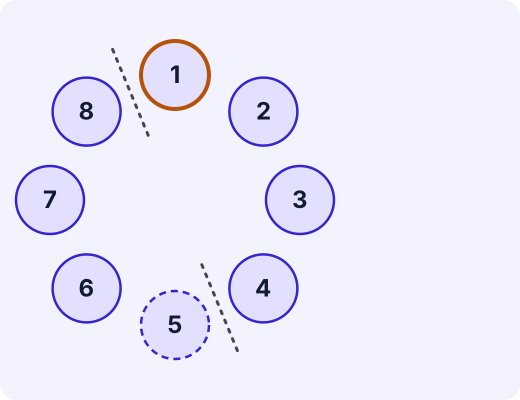
4.The dotted lines split this cycle into two equal halves. How many beats are in each half?
Answer with a number
5.The Keherwa theka is Dha Ge Na Ti Na Ka Dhi Na. Which bol is played on beat 7?
Answer with a word or phrase
6.On which beat of Keherwa do you wave your hand (the khali)?
- Beat 1
- Beat 4
- Beat 5
- Beat 8
Choose one
7.You keep Keherwa going for 16 beats without stopping. How many times do you land on the sam?
Answer with a number
8.Which statement about Sa is true?
- Sa is always exactly the same pitch for every singer
- Each singer chooses a comfortable Sa, and the other swaras are measured from it
- Sa is the highest note, and nothing comes after it
Choose one
Answering and checking are for registered learners. Register to do this.
Quick check
New puzzles
Notes and beat cycles in new situations. Can you use what you know?
1.A song is counted in 4/4, with four beats in every bar. How many beats are there in 3 bars?
Answer with a number
2.Ravi sings the tune Sa Ga Pa Ga Sa. Which swara in his tune is the highest?
Answer with a word or phrase
3.A taal called Teentaal has 16 beats, divided into 4 equal sections. How many beats are in each section?
Answer with a number
4.Neha counts Keherwa without stopping for 4 full cycles. How many beats does she count in all?
Answer with a number
5.Meera sings the tune Sa Re Ga Pa. Her uncle has a lower voice, so he chooses a lower Sa and sings the same four swaras. Is it the same tune?
- Yes. It is the same tune, just starting from a lower home note
- No. A different Sa makes it a completely different tune
- No. Only one Sa is allowed
Choose one
Answering and checking are for registered learners. Register to do this.
Your turn
Explain it to a friend
A friend has just joined a children's choir and has heard the words "swara" and "taal" but does not know what they mean. Write 8 to 10 sentences to explain:
- What the seven swaras are, and why Sa is called the home note.
- What a taal is and how it is different from a simple steady beat. Use Keherwa as your example: how many beats it has, where the sam and the khali are, and what you do with your hands.
- How you could put a short tune on a taal so that it fits one cycle.
How it's judged
- Swaras
- Taal and Keherwa
- Tune on a taal
Writing and submitting your answer is for registered learners. Register to do this.
Like what you see?
Register for free to answer the quick checks, do the activities and save your work. Your work is saved on your device and syncs to your account.