Unit 1
Working with living things
Run a garden, compost or animal-care project for a whole term, and let your daily records tell you what the living things need.
Read
Living things do not take weekends off
Meera's class planted climbing beans in old paint tins in the first week of term. They watered them every school day, and the beans shot up. Then came a long weekend. On Tuesday the leaves hung limp and brown at the edges. Nothing was wrong with the seeds, the soil or the sun. The problem was that three days passed with nobody looking.
That is the big idea of this unit. A living system (a plant, a compost heap, a hen, a fish tank) keeps changing whether or not you are watching. A project with living things is not something you build once and finish. It is something you look after, every day, for a while, and you keep records so you can see what is really happening instead of what you remember.
Choose a project
You will run one project for a term, about ten to twelve weeks. Pick one:
Project What you look after A good first choice if... Container garden Beans, moong, fenugreek (methi), tomato, tulsi or marigold in pots or tins you have a sunny window, balcony or school patch Compost A bin or pit where kitchen and garden waste turns into soil food you want something that works even in a small space Animal care A school or family animal that already has an owner, such as hens, a rabbit, fish or a goat shed. An adult stays responsible an adult already keeps animals and agrees to supervise Whatever you choose, ask an adult first. You are never the only person responsible for a living animal.
The care cycle
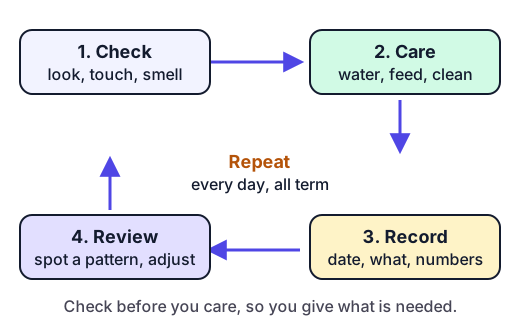
- Check. Look, touch and smell before you do anything. Is the soil dry an inch down? Is the water bowl empty? Does the compost smell sweet and earthy, or sour and rotten?
- Care. Give what the check says is needed: water, food, clean water, turning, moving into the light. Not a fixed routine done blindly.
- Record. Write the date, what you saw, what you did, and any numbers (height in cm, litres of water, number of eggs).
- Review. Once a week, read your records as a whole and look for a pattern. Then change one thing.
Misconception: "More care is better care." A plant given a mug of water every day can die of too much water. Soggy soil has no air, so roots cannot breathe and rot. The aim is not the most care but the right care, and checking first is how you find out what is right.
What good records look like
A record is useful only if someone could use it later without asking you what you meant. A simple log has columns like this:
Date Check (what I saw) Care (what I did) Number 3 Sep Soil damp, 5 of 6 seeds up Nothing needed 5 sprouted 4 Sep Soil dry on top Watered about 200 ml tallest 3 cm 5 Sep Leaves yellow low down Soil soggy: skipped water tallest 3 cm Notice the third row: the log shows a decision, not just an action. Also notice that "Nothing needed" is a perfectly good record. A blank row looks like you forgot.
Measure the same way every time. Measure a plant from the soil surface to the top of its tallest stem, in cm, on the same weekday. Otherwise the numbers you compare are not comparable.
Records answer questions
Meera's class grew two bean plants as a test. Plant A sat in a sunny window. Plant B sat in a dark corner. Everything else was kept the same: the same soil, the same pot size, the same water. They measured every week.
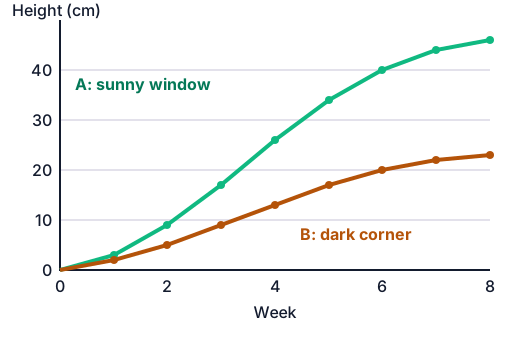
(The numbers are an example for learning, not a promise of what your beans will do.) Reading the chart:
- At week 8, plant A is 46 cm and plant B is 23 cm. A is twice as tall.
- Between week 2 and week 4, plant A grew from 9 cm to 26 cm.
Example. How fast did plant A grow between week 2 and week 4?
Growth: cm. Time: weeks. Rate: cm per week.
Plant B over the same two weeks went from 5 cm to 13 cm, so cm per week. Light is a likely cause because it is the only thing that differed. A good scientist still says "likely", and keeps measuring.
Another useful number is the germination rate, the share of seeds that sprout: if 7 of 10 seeds sprout, the rate is , or 70%. It tells you whether to plant a few extra seeds next time.
Project notes by type
Container garden. Choose a quick crop: moong and methi sprout in two to four days, beans in about a week. Pots need drain holes. Water when the top inch of soil is dry; water until a little leaks out, then empty the saucer. Plants lean toward light, so turn the pots now and then.
Compost. Compost is made by tiny living things (bacteria and fungi), plus worms and insects, eating waste. They need four things: food, air, water and the right mix.
- Greens (wet and nitrogen-rich): vegetable and fruit peels, used tea leaves, fresh grass.
- Browns (dry and carbon-rich): dry leaves, torn cardboard, sawdust, straw.
- Aim for a lot more brown than you would guess, roughly two to three parts brown to one part green by volume.
- Keep it as damp as a wrung-out sponge, and turn it every week or so to bring in air.
- Leave out meat, fish, dairy, oily or cooked food. They smell and draw rats and flies.
If it is wet, slimy and smelly, there are too many greens and too little air: add dry browns and turn it. If it is dry and nothing is happening, sprinkle water. Finished compost is dark, crumbly and smells of forest soil, typically after two to three months.
Animal care. Animals need food, clean water, shelter, space and gentle handling, every day. An adult decides what and how much to feed. Your job is to check (is the water clean? does the animal look and act as usual?), do the daily tasks, record, and tell the adult at once about anything unusual: not eating, limping, a new smell. You are the observer, not the vet.
Away for a day or two?
Living things need a plan for the days you cannot come. Write a care sheet (what, how much, when, who to call) and give it to a trusted person. Better still, make a rota at the start of the project so nobody has to improvise.
When something goes wrong
Sooner or later a seedling will wilt, a compost heap will smell or a fish will look unwell. This is not failure. It is data. The steps are:
- Look back through the log for a pattern: did the problem start after a change in weather, a missed day, or too much of something?
- Change one thing, and note it.
- Keep the log honest. Never delete the bad rows. Your final report is worth more if it says "three of six seedlings died; the ones in the shady corner died first, so next time I would...".
What you take away
Living systems need daily care because they keep changing, and you keep records because memory is a poor instrument. Check, care, record, review: repeated for a term, that cycle is the whole skill.
Activity
Run your term project
Run one living-things project (container garden, compost or animal care) for a term, about 10 to 12 weeks. Set-up takes about an hour. After that, about 10 minutes a day plus 20 minutes once a week to review.
You'll need
- A notebook, or paper stapled into a booklet, for your log
- Garden: pots, tins or bottles with drain holes, soil, seeds (moong, methi or beans), a ruler
- Compost: a bin, bucket with holes or a pit; dry leaves or torn cardboard; kitchen peels; a stick for turning
- Animal care: an animal already kept by a school or family, and an adult who is responsible for it
- A phone or camera for a photo each week, if one is allowed
Steps
- Agree your project with an adult. Write one sentence: what you will look after, where, and for how many weeks.
- Draw the log table: Date, Check (what I saw), Care (what I did), Number. Add a row for each day.
- Write the baseline on page 1: the date, what you start with (seed count, bin size, which animal), and a photo or sketch.
- Make a daily routine and a weekend or absence rota. Write a care sheet for a helper: what, how much, when, and who to call.
- Every day: check first, then care, then record. 'Nothing needed' is a valid record.
- Once a week, measure the same thing in the same way on the same day (plant height in cm, compost depth, number of eggs, animal weight if the adult weighs it). Add it to a table.
- Once a week, review. Read the week's rows, draw or update a simple graph, write one pattern you notice, and change at most one thing.
- Halfway through, write a mid-term note: one thing that is going well, one problem, and what you will change.
- At the end, write a one-page report: what you did, the numbers (such as germination rate or total growth), what went wrong, what the records showed, and what you would do differently.
Safety
- Wash hands with soap after handling soil, compost, animals, their food or their water. Cover cuts with a plaster and wear gloves for compost.
- Animal care only with an adult responsible for the animal. Never handle strange, wild or stray animals, and never feed them without an adult. Tell an adult at once about a bite or scratch.
- Do not taste any plant or seed you are growing unless an adult says it is safe to eat. Keep seeds and compost out of the reach of little children.
- Use no chemical fertiliser, pesticide or cleaning product without an adult. Use compost, water and sunlight.
- Water containers: never leave open buckets of water near toddlers. Mind slippery floors.
- Do not put meat, fish, dairy or cooked oily food in a compost heap.
Keeping a log of the activity is for registered learners. Register to do this.
Quick check
Living things check
Eight questions on running a project with living things.
1.Why does a living-things project run for a whole term rather than for one afternoon?
- Living things keep changing, so they need care again and again, and only a long record shows patterns.
- Because a longer project always earns a better mark.
- Because plants only grow when somebody is watching.
Choose one
2.You plant 10 methi seeds and 8 sprout. What is the germination rate, as a percentage?
Answer with a number
3.A bean plant is 4 cm tall in week 1 and 19 cm tall in week 4. On average, how many cm per week did it grow?
Answer with a number
4.Which of these can go into a home compost bin?
- Vegetable peels
- Dry leaves
- Cooked oily curry
- Fish bones
Choose all that apply
5.Put one pass of the care cycle in the right order.
- Give the care it needs
- Write it in the log with numbers
- Review the week and change one thing
- Check how the living thing looks
Put these in order
6.Match each sign to the most likely fix.
- Compost is wet, slimy and smelly
- Compost is dry and nothing is breaking down
- Soil is soggy and lower leaves are yellow
- Seedlings are tall, thin and pale and lean toward a window
Match each to: Hold off watering until the top dries, and check drainage · Give them more light · Sprinkle water until it feels like a wrung-out sponge · Add dry browns and turn it
7.You will be away from your garden pots for the whole weekend. What is the best plan?
- Ask a trusted person and leave a written care sheet.
- Pour in a double amount of water on Friday.
- Leave it, since plants look after themselves.
Choose one
8.Half of your seedlings died. What should you do with the log?
- Remove the bad rows so the project looks successful.
- Keep every row, look for a pattern in them, and report what you learned.
- Start a new log and throw the old one away.
Choose one
Answering and checking are for registered learners. Register to do this.
Quick check
New puzzles on living things
Four situations the reading did not show. Use the care cycle and your records.
1.A class grows tomatoes. The log shows they were watered Monday to Friday, with nothing written for Saturday or Sunday, and the leaves wilt every Monday. What is the best fix?
- Make a weekend rota with a named person for each day.
- Water twice as much on Friday.
- Change to a bigger pot and stop watering on weekdays.
Choose one
2.A class helps an adult look after 5 hens. They collect 21 eggs in 6 days. On average, how many eggs a day is that?
Answer with a number
3.Half of the compost bin is dry while the other half is damp. Which records would help you find out why?
- The dates when you watered and turned the heap
- Rain and hot, dry days
- Which side of the bin gets the afternoon sun
- The colour of the label on the bin lid
Choose all that apply
4.After eight weeks of daily care, 3 of your 6 seedlings died. Which response shows the most understanding?
- Read the log and notice that all three were in the shady corner, then report that and plan to move the pots.
- Say the project failed and stop keeping records.
- Replace them with new seedlings and write that all six were fine.
Choose one
Answering and checking are for registered learners. Register to do this.
Your turn
Explain what your records showed
Write in your own words. Use your own project if you ran one; otherwise use the bean example in the reading.
- Explain why living systems need daily care and why the care cycle begins with check rather than care. Use one example where giving the usual care would have been a mistake.
- Give two records from your project (or the bean chart) and say what each one shows. Include at least one calculation, such as a growth rate, a germination rate or an average.
- Describe one problem that happened or could happen, say how the log would help you work out the cause, and what one thing you would change.
How it's judged
- Why daily care
- Using records
- Diagnosing and changing
Writing and submitting your answer is for registered learners. Register to do this.
Like what you see?
Register for free to answer the quick checks, do the activities and save your work. Your work is saved on your device and syncs to your account.