Unit 5
The world of work
Interview a worker or visit a workplace, and find the skills hidden inside a job.
Read
A job is a bundle of skills
Watch a bus conductor on a busy morning route. In ten minutes she counts coins and gives change while the bus sways, remembers who got on at which stop, calls out the stops, helps an elderly man to a seat, settles an argument about a ₹10 note, and keeps an eye on the road ahead for her driver. Is that "just taking tickets"?
Almost no job is "just" anything. Every job is made of many smaller things that someone had to learn.
Occupation and skill
An occupation is the work a person does regularly, usually to earn a living: farmer, nurse, electrician, shopkeeper, software developer, potter, teacher. A skill is something a person can do well because they have learned and practised it: measuring cloth, adding quickly in your head, calming a frightened child, writing clear emails, soldering a wire.
The big idea. Every job is a set of skills you can learn. Nobody is born a good electrician or a good teacher; they became one.
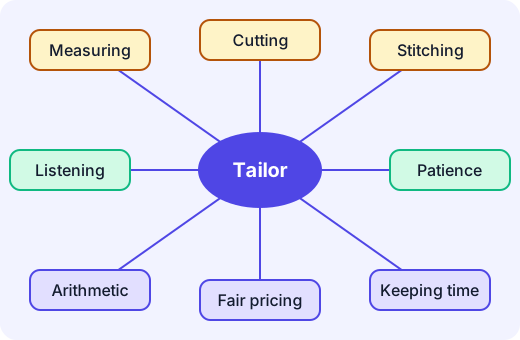
Take a tailor. The obvious skill is stitching. But look closer.
Kind of skill Example from tailoring Hands-on (practical) cutting straight, stitching evenly, pressing, using the machine safely Thinking measuring and calculating cloth, planning how to cut to waste little, working out a fair price People listening to what the customer wants, explaining delays honestly, being patient with changes Work habits finishing on time, keeping tools in order, honesty about mistakes Most jobs mix all four. A job that looks "only physical" asks you to think and deal with people, and a job that looks "only talking" asks for plenty of careful practice.
Skills are learned, and in many ways
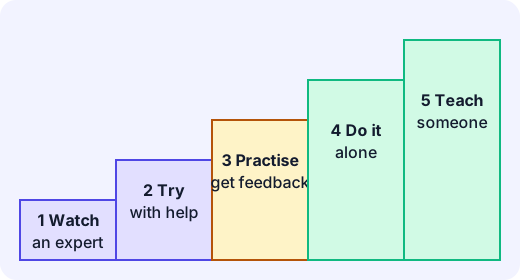
How did the tailor learn? Perhaps by watching a parent, then trying small jobs like hemming, then slowly taking on harder ones. Skills can be learned in several ways:
- Apprenticeship: learning on the job beside an experienced person, as many carpenters, cooks, potters and weavers do.
- School and college: theory and practice, as for doctors, engineers and teachers.
- Training courses and institutes: for example, Industrial Training Institutes (ITIs) in India teach trades such as electrician, fitter and welder.
- Practice and self-teaching: books, videos, experiments, helping at home or in the family business.
Often a worker learns in more than one way. Notice the common thread: watching, trying, practising, getting feedback.
Misconception 1. "Some jobs need no skill." Every job that serves a need takes skill. A street vendor must judge the best fruit, remember prices, decide how much to stock, and talk to hundreds of strangers. If it were easy, everyone would do it well. We sometimes say "unskilled" to mean "no formal certificate", but that does not mean no skill.
Misconception 2. "Skills are talents you are born with." Some people find a skill easier at first, but nearly everyone who is good at something practised it for a long time.
Misconception 3. "Only skills learned at school count." Cooking, driving a tractor, mending a pump or handling a customer are real skills, even if they were learned in a kitchen, field or workshop.
Many kinds of workplace
Work happens in many places: farms, shops, factories, offices, hospitals, schools, homes, markets, workshops, buses and trains, and online. Some people are employees (they work for someone else for a wage), some are self-employed (they work for themselves, like a cobbler or a freelance designer), and some run a business with employees. In India a very large share of work is in the informal sector: street vendors, farm labourers, domestic workers, small repairers. It is not covered by written contracts or regular benefits, but it is real, skilled work. Unpaid work at home, such as cooking or caring for children and elders, is also skilled and valuable, even though it is not paid.
Skills transfer between jobs. A bus conductor's mental arithmetic and dealing with people would suit a shop counter too. When someone changes careers, they carry their skills with them.
How to find out what a job takes: interview or visit
The best way to learn what a job needs is to ask someone who does it, or to see them at work. You will do this in the project for this unit. Here is how to do it well.
Before:
- Choose a worker you can reach safely through family, school or neighbours, and ask permission politely, with an adult's help.
- Write 8 to 10 questions. Mix easy ones with deeper ones.
- Decide how you will record answers (notes, or audio only if the person agrees).
Good questions (open questions, not yes/no):
- What does a normal day look like?
- What do you do that people might not notice?
- What was hardest to learn, and how did you learn it?
- What tools, machines or software do you use?
- Which skills matter most: using your hands, thinking, or dealing with people?
- What would you tell someone who wants to do this job?
During: introduce yourself, say why you are asking, listen more than you talk, and ask "Could you show me?" if it is safe. Do not distract someone doing a risky task; wait until they are free. Ask before taking any photo. Thank them.
After: write your notes up the same day, while you remember. Then turn them into a report: the job in one paragraph, a list of skills sorted into hands-on, thinking, people and habits, how the worker learned each skill, and one thing that surprised you.
Example report extract. Mr Joseph, bicycle repairer. A normal day: repairs punctures, adjusts brakes, replaces chains. Hands-on skills: finding a puncture by feel and by water test, truing a wheel. Thinking: estimating the price of a repair before starting. People: explaining to children what is wrong without scaring them. Learned: watching his uncle for two years, then taking small jobs. Surprise: he can tell what is wrong from the sound of a chain.
Why this matters for you
If every job is a set of skills, then every job is open to anyone willing to learn the skills. You can look at a job you admire and ask, which skills would I need, and which do I have already? You may find you already have several: counting, patience, explaining, steady hands. The gap between you and that job is a list of skills to practise.
Summary
- An occupation is regular work; a skill is something you can do well because you learned and practised it.
- Each job bundles hands-on, thinking and people skills, plus good work habits.
- Skills are learned by watching, trying, practising and getting feedback; apprenticeship, school and training all count.
- To find out what a job takes, interview a worker or visit a workplace, with permission and an adult's help, and report the skills you found.
Activity
Interview a worker or visit a workplace
Interview one person about their job, or visit a workplace with an adult, and write a one-page report on the skills the job takes. Allow about 30 to 45 minutes for the interview or visit, plus an hour to prepare and write up.
You'll need
- Notebook and pen (a phone for audio only if the person agrees)
- Your list of questions
- An adult who goes with you or knows where you are
Steps
- Choose a worker you can reach through family, school or neighbours (for example a tailor, nurse, driver, farmer, shopkeeper, electrician, cook, teacher or someone working online). Ask an adult to help you ask permission and agree a time.
- Write 8 to 10 open questions: a normal day, tools used, what is hardest, how they learned each main skill, which skills matter most, advice for a young person. Put the easiest first.
- At the interview or visit: introduce yourself, say why you are asking, and listen more than you speak. Write short notes. Ask 'Could you show me?' only if it is safe and they are not busy.
- Ask before taking any photo or recording, and do not photograph other people without permission.
- Thank the person. If they agree, offer to share your report with them.
- Write up your notes the same day. Make four lists of skills: hands-on, thinking, people, and work habits. Beside each skill write how the worker learned it (watching, apprenticeship, school, training, practice).
- Write the report in about one page: the job in one paragraph; the skills lists; how the worker learned; one skill you already have that the job needs; one thing that surprised you.
Safety
- Go only with a trusted adult, or to a place the adult knows and has agreed. Never go alone to a stranger's home or an isolated workplace.
- Keep out of the way of machines, vehicles, hot things, sharp tools and chemicals. Stand where the worker tells you.
- Do not distract anyone doing a risky task. Wait until they are free.
- Respect privacy. Ask before photos or recordings, and do not share names or places online without permission.
- Some workplaces (farms, building sites, factories) have rules for visitors. Follow them, including any protective gear.
Keeping a log of the activity is for registered learners. Register to do this.
Quick check
World of work check
Eight questions on occupations, skills and finding out what a job takes.
1.Which is the best description of a skill?
- Something you can do well because you learned and practised it
- A talent you are born with and cannot change
- A certificate on the wall
- A tool used in a job
Choose one
2.What is the word for the work a person does regularly, usually to earn a living? (one word)
Answer with a word or phrase
3.A tailor does these things. Match each to the kind of skill it mainly shows.
- Stitching a straight seam
- Working out how much cloth a kurta needs
- Listening to a customer's requests for changes
- Finishing on the day promised
Match each to: Hands-on skill · People skill · Thinking skill · Work habit
4.Someone says "A fruit seller needs no skill." Which reply is best?
- Agreed, anyone can do it
- No: she must judge ripeness, remember prices, decide how much to buy and deal with many customers
- No: she needs a college degree
Choose one
5.Put these in a sensible order for learning a skill.
- Watch someone skilled
- Practise and get feedback
- Try it with their help
- Do it on your own
Put these in order
6.You are interviewing a carpenter. Which are good interview questions? Pick all that apply.
- What was hardest to learn, and how did you learn it?
- Could you walk me through a normal day?
- You don't earn much, do you?
- Isn't it a boring job?
Choose all that apply
7.Neha says "Some people are just born good at cooking, so there is nothing to learn." What is the most accurate response?
- She is right; practice makes no difference
- Some may find it easier at first, but nearly everyone good at cooking practised for a long time
- Cooking is not a real skill
Choose one
8.At a workshop you want to photograph the worker. What should you do?
- Ask the worker first, and take the photo only if they agree
- Take it quietly so they act naturally
- Take it and post it online
Choose one
Answering and checking are for registered learners. Register to do this.
Quick check
New puzzles
Look for skills in jobs the reading did not describe.
1.An auto-rickshaw driver uses many skills. Match each to its kind.
- Steering safely through heavy traffic
- Picking the quickest route and judging the fare
- Staying calm with an angry passenger
- Using the meter honestly
Match each to: Work habit · Hands-on skill · Thinking skill · People skill
2.Ritu loves animals but says "I could never be a vet because I find science hard right now." What is the best advice, using the idea that every job is a set of skills you can learn?
- Choose another job; some people can't learn it
- List the skills a vet needs, see which she already has, and plan to practise the others, including science
- Wait to see if it gets easier by itself
Choose one
3.A bus conductor changes to working at a grocery counter. Which of her skills will help most straight away?
- Giving correct change quickly and dealing politely with many people
- Driving a bus
- None; the two jobs share no skills
Choose one
4.You plan to visit a local pharmacy to learn about the work. Which are sensible steps? Pick all that apply.
- Go with a trusted adult
- Ask the owner for permission and a good time
- Go behind the counter to look at the shelves
- Not ask or record anything about customers
Choose all that apply
Answering and checking are for registered learners. Register to do this.
Your turn
Skills map of a job
Read this description of a job you have not studied in this unit.
Sunita runs a small mobile-phone repair shop. Customers bring phones with cracked screens or batteries that don't last. She opens each phone with tiny tools, finds the fault, tells the customer what it will cost, and fixes it while they wait. She learned by helping her cousin at his shop, then watching videos about new phone models. Some customers are worried about their photos; she explains what she will and will not touch.
- List at least eight skills in the job, sorted into hands-on, thinking, people and work habits (at least one in each group).
- For three of the skills, say how Sunita probably learned it.
- Choose a different job (not a phone repairer). Name two of Sunita's skills that would be useful there, and explain why.
How it's judged
- Finding and sorting skills
- How skills are learned
- Transferring skills
Writing and submitting your answer is for registered learners. Register to do this.
Your turn
Every job is a set of skills
Use your interview or visit (or, if you could not do one, a worker you know well).
- Name the job and write the three most important skills it takes, with one sentence each on how the worker uses them.
- Which skill surprised you, and why?
- Explain in your own words what "every job is a set of skills you can learn" means. Use an example from your interview to show it.
- Pick one skill from the job that you could start practising now. Say what you would do, and how you would know you were improving.
How it's judged
- Identifying skills
- Explaining the big idea
- A plan to practise
Writing and submitting your answer is for registered learners. Register to do this.
Like what you see?
Register for free to answer the quick checks, do the activities and save your work. Your work is saved on your device and syncs to your account.