Unit 4
Banking and interest
Compare savings options and calculate simple interest, the price of using money.
Read
The price of using money
Meera has saved ₹5,000 from gifts and tutoring younger children. Her father says, "Keep it in a steel box, or put it in the bank, and the bank will pay you for keeping it." Pay her, for keeping her own money? Why would a bank do that?
The answer is the main idea of this unit: interest is the price of using money. When you put money in a bank, the bank uses it, mainly by lending it to people and businesses who need it, and it pays you a share of what it earns. When someone borrows money, they pay a price for using something that isn't theirs, just as you pay rent for a room. That price is interest.
Words you need
Word Meaning Savings account A bank account where you keep money safely and can take it out when you need it. It earns a small interest. Principal () The money you start with (or borrow). Rate () The interest as a percent of the principal for each year, for example 6% per annum (p.a., "each year"). Time () How long the money stays, measured in years. Interest () The extra money earned (or paid). Amount () Principal plus interest: . Children can usually have a savings account with a parent or guardian helping; the rules depend on the bank. Bank deposits in India are insured by law up to a limit (check the current limit with your bank), which is one reason people trust banks with savings.
Simple interest
With simple interest, interest is worked out each year on the original principal only. 6% of ₹5,000 is the same each year.
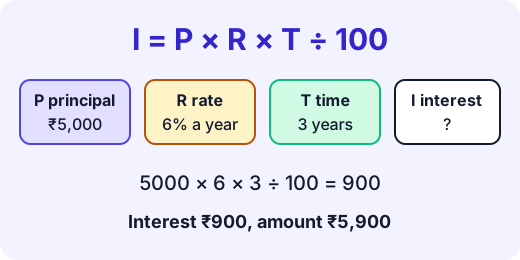
Example 1. Meera deposits ₹5,000 at 6% p.a. for 3 years. How much interest does she earn, and what is the amount? . The amount is .
You can also think it through with percents: 6% of ₹5,000 is ₹300 every year, and . This is why the formula works: is the interest for one year, and then you multiply by the number of years.
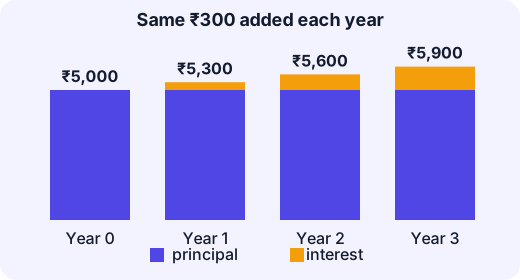
Because the interest is the same each year, simple interest grows in a straight line: ₹300, ₹600, ₹900.
Time must be in years
Misconception. "For 6 months, I just put 6 into the formula." The rate is per year, so time must be in years. Six months is years.
Example 2. ₹8,000 at 5% p.a. for 6 months. , so .
Example 3. ₹2,400 at 10% p.a. for 9 months. , so .
Misconception. "6% means ₹6." No: 6% means ₹6 for every ₹100 each year. On ₹5,000 that is ₹300 a year.
Finding a missing part
The formula has four quantities, so if you know three you can find the fourth.
Example 4 (find the rate). Ravi borrows ₹3,000 for 2 years and pays ₹360 interest. What is the rate? Put the numbers in: . So . The rate is 6% p.a. Check: ✓.
Example 5 (find the principal). What principal earns ₹500 in 2 years at 5% p.a.? Each year earns 5% of , so two years earn 10% of . Then , so .
Comparing savings options
Banks and the post office offer several ways to save.
Option How it works Savings account Money can be taken out any time; the interest rate is low. Fixed deposit (FD) You lock a sum for a fixed time (months or years); the rate is higher, and taking it out early usually costs you. Recurring deposit (RD) You put in a fixed amount every month for a set time. Good if you save a little at a time. Rates change from time to time and differ between banks; the numbers in this unit are made up for practice. To compare real ones, look at the bank's or post office's current rates.
To compare fairly, use the same principal and the same time.
Example 6. Bank A pays 4% p.a. for 3 years, and Bank B pays 5% p.a. for 2 years. Which gives more interest on ₹10,000?
- A:
- B:
A earns more in total, but only because the money stays for an extra year. The rate alone does not decide; ask also: How long is my money locked? Can I take it out if I need it?
Misconception. "The higher rate is always the better option." A higher rate for a shorter time might earn less. And a high-rate option that locks your money may not suit you if you may need it soon.
What about compound interest?
Real bank accounts often pay compound interest: the interest of each period is added to the principal, so next period you earn interest on the interest as well. That is a later topic. Simple interest is its starting point and is still used for many short-term loans.
Summary
- Interest is the price of using money: banks pay you for using your savings, and charge borrowers for using theirs.
- Simple interest: , with in years; .
- Check the units: months become years by dividing by 12.
- Compare options using the same principal and time, and also ask about safety and access.
Lab
The savings studio
Work through six savings challenges. Predict simple interest, compare two bank offers, and slide the rate or principal until the interest hits a target. Watch the bars grow the same amount every year.
Your goals
- Predict the interest for the first two challenges (one with time in months) before the bars appear.
- Choose the better of two offers after working out both interests.
- Find the rate and the principal that give a target interest.
The interactive lab opens once you register. Register to do this.
Quick check
Banking and interest check
Eight questions on simple interest and on comparing savings options.
1.Which sentence best describes interest?
- The price paid for using someone else's money
- A fee for opening an account
- A gift the bank gives every customer
- Money taken by the government
Choose one
2.What is the simple interest in rupees on ₹4,000 at 5% a year for 3 years?
Answer with a number
3.₹2,500 is deposited at 8% a year for 2 years. What is the amount (principal plus interest) in rupees?
Answer with a number
4.What is the simple interest in rupees on ₹6,000 at 8% a year for 9 months?
Answer with a number
5.A loan of ₹1,500 earns ₹270 simple interest in 3 years. What is the rate, in percent a year?
Answer with a number
6.A savings account pays 6% a year. How much interest does ₹2,000 earn in one year?
- ₹6
- ₹60
- ₹120
- ₹1,200
Choose one
7.You are comparing two savings offers. Which checks make the comparison fair and sensible? Pick all that apply.
- Compare the interest on the same principal for the same length of time
- Check whether you can take the money out early
- Pick the one with the biggest rate, whatever else it says
- Pick the bank with the tallest building
Choose all that apply
8.Match each word to its meaning.
- Principal
- Rate
- Amount
- Fixed deposit
Match each to: The money you start with · Principal plus interest · Interest as a percent of the principal for each year · A sum locked away for a set time at a fixed rate
Answering and checking are for registered learners. Register to do this.
Quick check
New puzzles
Use simple interest in situations the reading did not show.
1.A tea-stall owner borrows ₹12,000 for 18 months at 10% simple interest a year. How much does she repay in total, in rupees?
Answer with a number
2.₹5,000 earns ₹750 simple interest at 5% a year. For how many years was it saved?
Answer with a number
3.Asha may need her savings for school fees in one year. Option X pays 9% a year but locks the money for 5 years. Option Y pays 6% a year and lets her withdraw any time. Which suits her better?
- X, because 9% is higher
- Y, because she may need the money soon and can take it out
- Neither; they are the same
Choose one
4.Option P is ₹5,000 at 8% a year for 18 months. Option Q is ₹6,000 at 6% a year for 1 year. How many more rupees of interest does P earn than Q?
Answer with a number
Answering and checking are for registered learners. Register to do this.
Your turn
Which savings plan?
Show your working. The rates below are made up for practice.
Priya has ₹15,000 to save for 2 years. Three options are offered:
- Option 1: a savings account at 3% a year simple interest, with money available any time.
- Option 2: a 2-year fixed deposit at 6% a year simple interest, with a penalty for early withdrawal.
- Option 3: a 1-year fixed deposit at 5% a year simple interest; at the end of the year she can put the principal in another 1-year deposit at the same rate.
- Work out the interest Priya would have after 2 years from each option (for Option 3, assume she renews the principal only, so the interest is simple each year).
- Priya says she might need ₹5,000 after 8 months. Which option would you advise, and why? Say what you give up.
- Her cousin says "6% is the biggest, so Option 2 is best for everyone." Write a short reply to the cousin.
How it's judged
- Calculating interest
- Advising with a reason
- Reply to the cousin
Writing and submitting your answer is for registered learners. Register to do this.
Your turn
Explaining interest
Write in your own words, as if explaining to a friend in Class 5.
- Why does a bank pay you interest, and why does a borrower pay interest? Use the idea "interest is the price of using money".
- A friend says, "I put ₹1,000 at 5% for 6 months, so the interest is 1000 × 5 × 6 ÷ 100 = ₹300." What mistake did your friend make? Give the correct answer.
- Another friend says, "5% means I get ₹5." Explain what 5% a year really means, using an example.
How it's judged
- Why interest exists
- Finding the error
- Meaning of a rate
Writing and submitting your answer is for registered learners. Register to do this.
Like what you see?
Register for free to answer the quick checks, do the activities and save your work. Your work is saved on your device and syncs to your account.