Unit 7
Fractions live on the number line
See that a fraction is a number with its own place on the line, and learn to find that place.
Read
Where does a fraction live?
Aisha and her brother Imran walk to school along a straight road that is exactly 1 kilometre long. Their mother has put a bench at every quarter of the way. "We have passed three benches," says Imran. "How far is that?"
You know that and and have places on a number line. Today you will see that fractions have places on the number line too. A fraction is not only "part of a pizza". It is a number, and it sits at one exact spot between the whole numbers, just as 3 does.
Cut the line into equal parts
Take the stretch of a number line from 0 to 1. Cut it into equal parts. How many parts you cut it into gives the fraction its name:
- 2 equal parts: halves
- 3 equal parts: thirds
- 4 equal parts: fourths (also called quarters)
- 6 equal parts: sixths, and so on.
The parts must be equal. If they are not the same length, you cannot name them with a fraction.
The length of one part is a unit fraction: , , , . The number on the bottom, the denominator, tells how many equal parts the whole (from 0 to 1) is cut into. The number on the top, the numerator, counts the parts.
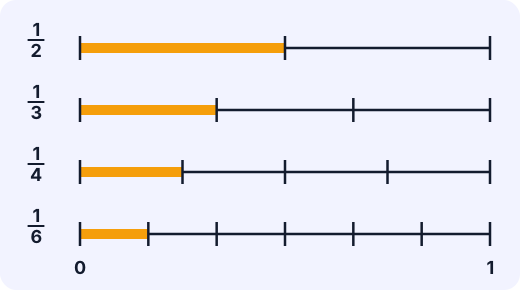
Look at the gold part on each line. As you cut the line into more parts, each part gets shorter. So is smaller than , which is smaller than , which is smaller than . The bigger the number on the bottom, the smaller each piece. If you share a roti among 6 people, each piece is smaller than if you share it among 2.
Hops from zero
Where is on the number line? Cut the line from 0 to 1 into 4 equal parts. Each part has length . Start at 0 and take hops of that length. After 1 hop you are at . After 2 hops, . After 3 hops, .
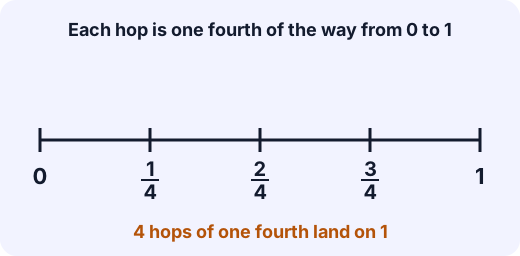
So means 3 hops of . A fraction with a numerator bigger than 1 is a non-unit fraction. It is the unit fraction, repeated. The numerator says how many hops, and the denominator says how big each hop is.
That also tells us where Imran is. After three benches, he has gone of a kilometre.
After 4 hops you land on . That is the end of the line, at 1. So . In the same way and . If you keep hopping you go past 1: is one more hop of past the 1.
Try it: Imagine a line from 0 to 1 cut into sixths. How many hops of get you to ? Is closer to 0 or to 1?
Worked examples
Example 1. Mark on a number line.
- The bottom number is 3, so cut the line from 0 to 1 into 3 equal parts.
- The top number is 2, so take 2 hops from 0.
- Put the dot at the end of the second hop. It is more than halfway along.
Example 2. What fraction does the dot show? The line from 0 to 1 is cut into 5 equal parts, and the dot is on the 3rd mark after 0.
- Count the parts (spaces), not the marks. There are 5 parts, so these are fifths.
- The dot is 3 hops from 0.
- So the dot shows .
Example 3. Which is farther from 0, or ?
- Thirds are bigger pieces than sixths, so one hop of is longer than one hop of .
- So is farther from 0.
Common mistakes
- " is bigger than because 4 is bigger than 3." The bottom number counts how many pieces the whole is cut into. More pieces means smaller pieces. .
- Counting marks instead of parts. A line cut into 5 parts has 6 marks, counting 0 and 1. Always count the spaces.
- Unequal parts. If the pieces are not the same length, none of them is a fourth, even if there are four of them.
- Forgetting that a fraction is a number. is a single point on the line, not "3 and 4".
Quick summary
- A fraction is a number with its own place on the number line.
- The denominator tells how many equal parts the whole is cut into; the numerator counts the hops.
- A unit fraction is one hop. is hops of from 0.
- More equal parts means smaller parts: .
- lands exactly on 1.
Lab
The fraction line
First choose how many equal parts to cut the line from 0 to 1 into, then hop along it to place each fraction. At the end, read two fractions from the line. There is no timer.
Your goals
- Place six fractions on the number line by cutting it into the right number of equal parts and taking the right number of hops.
- Name two points on a number line as fractions.
The interactive lab opens once you register. Register to do this.
Quick check
Fractions on the number line check
Seven questions. Remember to count the equal parts, not the marks.
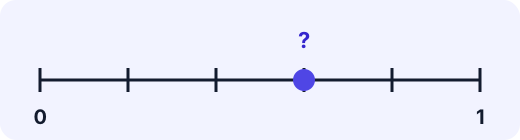
1.The number line from 0 to 1 is cut into equal parts. Which fraction does the dot show?
- 3/5
- 4/5
- 3/6
- 2/5
Choose one
2.How many hops of 1/4 does it take to get from 0 to 1?
Answer with a number
3.Which is the larger number, 1/3 or 1/6?
- 1/3
- 1/6
- They are the same
Choose one
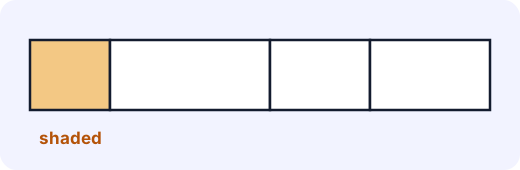
4.The bar is cut into 4 parts and the smallest part is shaded. Is the shaded part 1/4 of the bar?
- Yes, because there are 4 parts and 1 is shaded
- No, because the 4 parts are not equal
- No, because it should be 1/3
Choose one
5.A number line from 0 to 1 is cut into 8 equal parts. How many hops of 1/8 do you take from 0 to reach 5/8?
Answer with a number
6.Match each fraction to the number of equal parts the line from 0 to 1 must be cut into to place it.
- 2/3
- 5/6
- 3/8
- 1/4
Match each to: 6 parts (sixths) · 8 parts (eighths) · 4 parts (fourths) · 3 parts (thirds)
7.Which fraction lands at exactly the same place as the number 1?
- 1/4
- 3/4
- 4/4
- 5/4
Choose one
Answering and checking are for registered learners. Register to do this.
Quick check
New puzzles
Fractions on the number line turn up in new places. Can you use what you know?
1.A 1 km path from home (0) to school (1) has a bench every 1/5 of the way. Tara is sitting on the 3rd bench from home. How far has she walked?
- 3/5 of the path
- 3/3 of the path
- 5/3 of the path
- 1/5 of the path
Choose one
2.Where is 3/3 on the number line from 0 to 1?
- At 1
- At 3
- Between 0 and 1
- At 1/3
Choose one
3.Put these in order from the smallest number to the largest.
- 1/4
- 1/8
- 1/2
- 1/3
Put these in order
4.Point A is 5 hops of 1/6 from 0. Point B is 5 hops of 1/8 from 0. Which point is farther from 0?
- Point A
- Point B
- They are at the same place
Choose one
Answering and checking are for registered learners. Register to do this.
Your turn
Where is it, and why?
- Describe, step by step, how you would place and on a number line from 0 to 1. Say how many equal parts you cut the line into each time, and how many hops you take. Which of the two points is farther from 0?
- A friend says " is bigger than because 4 is bigger than 3". Explain what is wrong with that. Use a number line or a picture in words.
- In your own words, say what the numerator and the denominator of a fraction tell you.
How it's judged
- Placing fractions
- The misconception
- Numerator and denominator
Writing and submitting your answer is for registered learners. Register to do this.
Like what you see?
Register for free to answer the quick checks, do the activities and save your work. Your work is saved on your device and syncs to your account.