Unit 6
Rounding and estimating
Round numbers to the nearest 10 or 100 and use them to get a quick answer that is close enough.
Read
Close enough
At the Sunday market, Dev wants to buy a kite for ₹39, a ball for ₹58 and a top for ₹21. He has ₹130 in his pocket. Does he have enough?
He does not need the exact total. He thinks: "₹39 is nearly ₹40, ₹58 is nearly ₹60, ₹21 is nearly ₹20. That is . About ₹120, so ₹130 is enough." It took him a few seconds, and he did it in his head.
What Dev did is called estimating, and the tool he used is rounding. In this unit you will learn how to round a number to the nearest 10 or the nearest 100, and how to use rounded numbers to find a quick answer that is close enough.
What rounding means
To round a number means to swap it for a nearby "friendly" number, like a multiple of 10 or of 100. The new number is easy to use, and it is close to the old one.
To round 47 to the nearest ten, we ask: which tens is 47 between? It sits between 40 and 50. Which is it closer to?
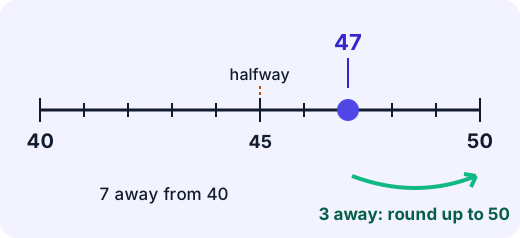
47 is 3 steps from 50 and 7 steps from 40. It is nearer to 50, so 47 rounds to 50.
The middle of 40 and 50 is 45. We call it the halfway number.
- Numbers below the halfway number round down to the lower ten: 41, 42, 43, 44 round to 40.
- Numbers at or above the halfway number round up: 45, 46, 47, 48, 49 round to 50.
The halfway rule. A number that is exactly halfway, such as 45, is the same distance from both. We agree to round it up. So 45 rounds to 50, 65 rounds to 70, and 135 rounds to 140. Nothing special about it; it is a rule we agreed on, so that everyone gets the same answer.
Try it: Round each number to the nearest ten: 23, 78, 85, 91. (Answers: 20, 80, 90, 90.)
Rounding to the nearest hundred
The same idea works for hundreds. You look at which two hundreds the number is between, and find the halfway number: 50 more than the lower hundred.
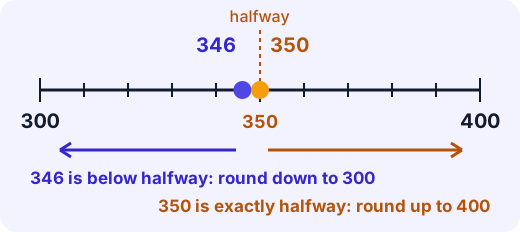
- 346 is between 300 and 400. The halfway number is 350. 346 is below it, so it rounds down to 300.
- 350 is exactly halfway, so it rounds up to 400.
- 782 is between 700 and 800, and the halfway number is 750. 782 is above it, so it rounds up to 800.
A quick way: to round to the nearest hundred, look at the tens digit. If it is 5 or more, round up. If it is 4 or less, round down. To round to the nearest ten, look at the ones digit the same way.
One special case: 996 rounded to the nearest ten is 1000, because rounding up 990 + 10 carries into the next place.
Estimating sums and differences
Rounding lets you estimate. Round each number first, then add or subtract the friendly numbers.
Example 1. Estimate .
- Round to the nearest ten: and .
- .
- The exact answer is 85, so the estimate is close.
Example 2. Estimate to the nearest hundred.
- and .
- . (The exact answer is 592.)
Example 3. Estimate .
- To the nearest hundred: . The exact answer is 323.
- To the nearest ten: . That is closer.
Rounding to a smaller place (tens) gives a closer estimate, but takes a little more work. Rounding to hundreds is faster but rougher. Pick the one that suits the job.
Example 4. When is "close enough" enough? A bag costs ₹250 and shoes cost ₹185. Meena has ₹400. Rounding to the nearest ten gives . That is more than 400, so Meena does not have enough, and we did not need the exact total (₹435) to know it.
Common mistakes
- Rounding the wrong way at halfway. 65 rounds to 70, not 60.
- Looking at the wrong digit. To round 462 to the nearest hundred, look at the tens digit (6), not the ones digit (2). 462 rounds to 500.
- Forgetting to change the other digits to zero. 462 rounds to 500, not 560.
- Treating the estimate as the exact answer. An estimate says "about". It will usually be a little different from the exact answer, and that is fine.
Quick summary
- Rounding swaps a number for a nearby multiple of 10 or 100.
- Find the two multiples the number is between and see which it is nearer to. Halfway rounds up.
- Round each number first, then add or subtract, to estimate.
- An estimate is a quick answer that is close enough, and it helps you spot answers that cannot be right.
Lab
The rounding line
Slide the marker along a number line and watch where each number rounds to. Then use the slider to find the smallest and largest numbers that round to a target, and finish by estimating four sums and differences. There is no timer.
Your goals
- Find the smallest and largest numbers that round to a given ten or hundred by moving the slider.
- Estimate four sums and differences by rounding first.
The interactive lab opens once you register. Register to do this.
Quick check
Rounding and estimating check
Eight questions. Picture the number line if it helps.
1.Round 63 to the nearest ten.
Answer with a number
2.Round 75 to the nearest ten.
Answer with a number
3.Round 462 to the nearest hundred.
Answer with a number
4.Round 349 to the nearest hundred.
Answer with a number
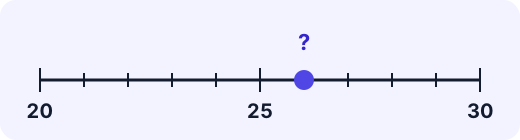
5.The dot is on the number line. Round the number it shows to the nearest ten.
Answer with a number
6.Estimate 48 + 33 by rounding each number to the nearest ten first.
Answer with a number
7.Estimate 612 − 289 by rounding each number to the nearest hundred first.
- 200
- 300
- 400
- 700
Choose one
8.Which of these numbers round to 700 when rounded to the nearest hundred? Pick all that apply.
- 649
- 650
- 749
- 750
Choose all that apply
Answering and checking are for registered learners. Register to do this.
Quick check
New puzzles
Rounding shows up in places that are not number lines. Can you use it?
1.A bus travels 38 km, then 47 km, then 52 km. Estimate the whole trip by rounding each distance to the nearest ten km first.
Answer with a number
2.What is the largest whole number that rounds to 80 when you round to the nearest ten?
Answer with a number
3.Ishaan says 395 rounded to the nearest ten is 400. His friend says it is 390 because "5 is not enough". Who is right?
- Ishaan: 395 is exactly halfway, so it rounds up to 400
- His friend: 395 rounds down to 390
- Both answers are correct
Choose one
4.A school has 705 books. 398 are out on loan. Estimate how many are on the shelves by rounding to the nearest hundred first.
Answer with a number
Answering and checking are for registered learners. Register to do this.
Your turn
Round it, estimate it, explain it
- Explain how you round 365 to the nearest ten and to the nearest hundred. Say which two numbers it is between each time and how you decide. Draw or describe a number line.
- Estimate in two ways: round to the nearest hundred, and round to the nearest ten. Find the exact answer too. Which estimate is closer, and why?
- Give one example of a time when an estimate is enough, and one example of a time when you need the exact answer.
How it's judged
- Rounding 365
- Two estimates
- When an estimate is enough
Writing and submitting your answer is for registered learners. Register to do this.
Like what you see?
Register for free to answer the quick checks, do the activities and save your work. Your work is saved on your device and syncs to your account.