Unit 1
What multiplication means
See how 4 × 6 means four groups of six, and build products with groups, arrays and tiles.
Read
Groups that are all the same size
Priya sells mangoes at a roadside stall in Nagpur. This morning she packed 4 baskets, and she put 6 mangoes in every basket. A customer asks, "How many mangoes do you have in all?"
Priya could count them one by one. Or she could add the baskets up: . But there is a shorter way to say the very same thing.
Four groups of six
When you have several groups and every group is the same size, you can write the total as a multiplication:
Read it as "four groups of six make twenty-four", or "four times six is twenty-four". The sign means "groups of".
Two names are worth knowing:
- The numbers you multiply are called factors. In , the factors are 4 and 6.
- The answer is called the product. Here the product is 24.
Words Repeated addition Multiplication 4 baskets of 6 mangoes 3 plates of 5 biscuits 7 bags of 2 oranges Look at the first number each time. It tells you how many groups. The second number tells you how many in each group.
Try it: Take 12 coins, buttons or pebbles. Make 3 groups of 4. Write the multiplication. Now push them into 4 groups of 3. What changed, and what stayed the same?
Arrays: groups in neat rows
Counting groups is easier when they are lined up. An array puts the objects in rows and columns, with the same number in every row.
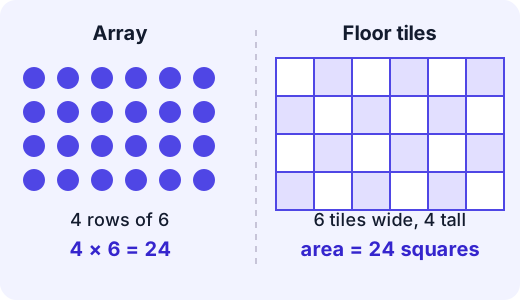
Each row is one group. The array above has 4 rows of 6, so it shows . You see arrays everywhere: seats in a cinema, eggs in a tray, windows on a building, stamps on a sheet.
Multiplication and area
Now imagine the dots are square floor tiles, each 1 metre wide. A floor that is 6 tiles wide and 4 tiles tall needs tiles. The number of unit squares that cover a flat shape is its area, so this floor has an area of 24 square metres. Arrays and areas are the same idea: rows of equal size.
Worked examples
Example 1. A tray holds 5 rows of 8 idlis. How many idlis?
- Rows are groups. There are 5 groups of 8.
- Write it: .
- Skip count by 8 five times: 8, 16, 24, 32, 40.
- So idlis.
Example 2. Write a story for and solve it.
- means 3 groups of 7. Story: "Three friends each pick 7 flowers."
- Add: .
- So the friends pick 21 flowers.
Example 3. A garden bed is 4 metres by 9 metres. How many 1-metre square tiles cover it?
- 4 rows of 9 tiles.
- .
- The bed needs 36 tiles.
Careful: the groups must be equal
Multiplication only works when every group has the same number. If Priya packs baskets with 6, 6, 5 and 7 mangoes, she still has 24 mangoes, but you cannot write that as "4 groups of something". You have to add: .
A second thing to watch: and both give 24, but they tell different stories. is four baskets of six mangoes. is six baskets of four mangoes. The totals match, yet the pictures are not the same, so say which one you mean when you draw. (Why the totals always match is something you will explore soon.)
Quick summary
- Multiplication counts equal groups quickly: groups size of each group.
- The numbers multiplied are factors; the answer is the product.
- An array shows equal groups as rows, and area counts unit squares in rows.
- Check: can you describe it as "__ groups of __"? If the groups are not equal, add instead.
Lab
The array builder
Each order asks for some groups of the same size. Set the number of rows and the number in each row, watch the array grow, then type the product.
Your goals
- Build the array that matches each of six orders.
- Type the product for every order you build.
- Finish with a free build where you make your own array and read it as groups.
The interactive lab opens once you register. Register to do this.
Quick check
Multiplication check
Seven questions about equal groups, arrays and products.
1.The stars are in an array. How many stars are there in all?

Answer with a number
2.Which is another way to say 5 × 3?
- 5 + 3
- 5 groups of 3
- 5 more than 3
- 5 take away 3
Choose one
3.Which repeated addition matches 4 × 6?
- 4 + 6
- 6 + 6 + 6 + 6
- 6 + 6 + 6
- 4 + 4 + 4
Choose one
4.A shelf has 8 rows of books. Each row holds 5 books. How many books are on the shelf?
Answer with a number
5.Which of these can be written as a multiplication because the groups are all equal?
- 3 bags with 4 apples in each bag
- 3 bags holding 4, 5 and 2 apples
- A sheet of stamps with 4 rows of 5 stamps
- 6 cars with 4 wheels each
Choose all that apply
6.Match each multiplication to its product.
- 2 × 8
- 3 × 6
- 4 × 5
Match each to: 18 · 20 · 16
7.A floor is covered with square tiles in 6 rows of 7 tiles. How many tiles cover the floor?
Answer with a number
Answering and checking are for registered learners. Register to do this.
Quick check
New puzzles
Four puzzles that use multiplication in new places.
1.Rahul says 7 × 4 = 28. He draws an array with 7 rows. How many dots are in each row?
Answer with a number
2.Which story is a multiplication story?
- A tray holds 3 rows of 6 cups.
- A bag has 3 red marbles and 6 blue marbles.
- Anil is 6 years older than his cousin, who is 3.
Choose one
3.9 + 9 + 9 + 9 + 9 + 9 = 6 × ___
Answer with a number
4.A path is 3 metres wide and 8 metres long. It is covered with 1-metre square tiles. How many tiles are needed?
Answer with a number
Answering and checking are for registered learners. Register to do this.
Your turn
Explain it to a friend
Your friend says, "Multiplication is just a hard way to add." Show your friend what multiplication really means.
- Choose the multiplication . Write a short story for it, and say how many groups there are and how many are in each group.
- Describe (or draw with text) an array for . Say what the rows and the columns show.
- Explain why cannot be written as a multiplication, but can.
How it's judged
- Story and meaning of the sentence
- Array
- Equal groups
Writing and submitting your answer is for registered learners. Register to do this.
Like what you see?
Register for free to answer the quick checks, do the activities and save your work. Your work is saved on your device and syncs to your account.