Unit 2
What division means
Share things out and make equal groups, and see why division is multiplication asked backwards.
Read
Sharing and grouping
It is Diwali week, and Aarav's mother has made 12 laddoos. Three cousins are coming. "Share them out fairly," she says, "so that everyone gets the same."
Aarav puts out three plates and deals the laddoos one at a time: one for this plate, one for that plate, one for the third. Round and round until none are left. Each plate has 4 laddoos.
That is division. We write it as
and say "twelve divided by three is four". The answer, 4, is called the quotient. To divide is to split a total into equal parts.
Two kinds of dividing
There are two different questions that both use .
Sharing. You know how many groups, and you ask how many in each. "12 laddoos shared equally among 3 plates: how many on each plate?"
Grouping. You know the size of each group, and you ask how many groups. "12 laddoos are put in boxes of 3: how many boxes?"
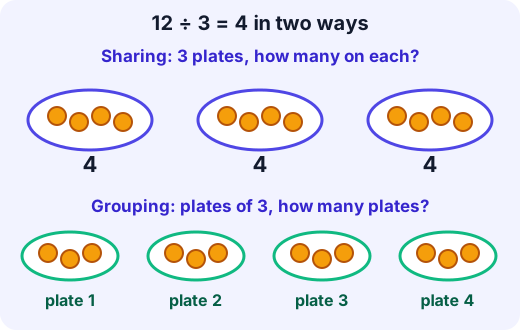
The answer is 4 both times, but it means something different: 4 laddoos on a plate, or 4 plates. You must always say what your answer counts.
Question What you know What you find Sum Share 12 among 3 plates 3 groups size of each group Put 12 in boxes of 3 size of group is 3 number of groups Try it: Take 15 buttons. First share them equally among 3 cups. Then put them back and make groups of 3. Do you get the same number each time? What does each number count?
Division is multiplication backwards
Multiplication starts with groups and finds the total: . Division starts with the total and one of the factors, and finds the missing factor.
So is really the question "". If you know your multiplication, you already know the answer: , so .
Numbers that belong together make a fact family. For 3, 4 and 12:
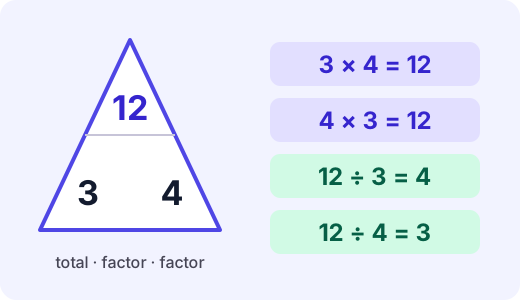
The biggest number (the total) always comes first in a division sentence, and it is the product in the multiplication.
Worked examples
Example 1 (sharing). 20 stickers are shared equally among 4 children. How many does each get?
- Total 20, groups 4. We want the size of each group.
- Ask: .
- , so .
- Each child gets 5 stickers.
Example 2 (grouping). A farmer packs 35 eggs into trays of 7. How many trays does she fill?
- Total 35, size of group 7. We want the number of groups.
- Ask: .
- Count in sevens: 7, 14, 21, 28, 35. That is 5 jumps.
- So trays.
Example 3 (fact family). You know . Write the two division facts.
- The total is 48 and the factors are 6 and 8.
- and .
Careful with the order
Unlike adding, the order matters in division. but is not 4. You cannot hand out 3 laddoos so that 12 people each get a whole laddoo! Always start with the total.
Also, not every number shares out evenly. 13 laddoos among 3 plates leaves 1 over. Sometimes there is a leftover, and you will learn how to deal with it later. For now, every division in this unit comes out exactly.
Quick summary
- Division splits a total into equal groups. The answer is the quotient.
- Sharing finds the size of each group; grouping finds how many groups.
- asks "": division is multiplication asked backwards.
- A fact family links two multiplications and two divisions with the same three numbers.
Lab
The fair-share kitchen
Share sweets onto plates one round at a time, or pack them into boxes of a set size. Then write the answer and the multiplication it comes from.
Your goals
- Finish five jobs, some sharing and some grouping.
- For every job, type the quotient, which is also the missing factor in the matching multiplication.
The interactive lab opens once you register. Register to do this.
Quick check
Division check
Seven questions about sharing, grouping and fact families.
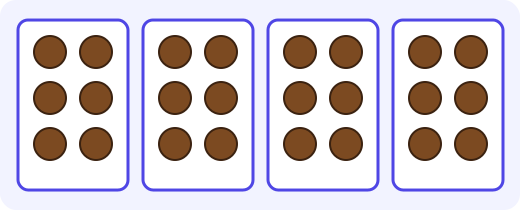
1.The 24 chocolates in the picture are shared equally between the 4 boxes. What is 24 ÷ 4?
Answer with a number
2.Which story is a grouping question (finding how many groups)?
- 20 pencils are put into boxes of 5. How many boxes?
- 20 pencils are shared among 5 children. How many does each get?
- There are 5 boxes with 4 pencils each. How many pencils?
Choose one
3.Which multiplication helps you work out 35 ÷ 7?
- 7 × ? = 35
- 35 × 7 = ?
- 35 + 7 = ?
- 7 − 35 = ?
Choose one
4.What is 42 ÷ 6?
Answer with a number
5.Match each division to its quotient.
- 18 ÷ 3
- 20 ÷ 5
- 16 ÷ 2
Match each to: 8 · 6 · 4
6.Which facts belong to the same family as 4, 7 and 28?
- 4 × 7 = 28
- 28 ÷ 7 = 4
- 28 ÷ 4 = 7
- 28 ÷ 14 = 2
Choose all that apply
7.A teacher has 27 stickers and gives 3 stickers to each child. How many children get stickers?
Answer with a number
Answering and checking are for registered learners. Register to do this.
Quick check
New puzzles
Four puzzles that use division in new places.
1.Zoya has 36 photos. She sticks 4 photos on each page of an album. How many pages does she fill?
Answer with a number
2.Mira says 8 ÷ 2 and 2 ÷ 8 are the same because they use the same numbers. Is she right?
- Yes, the order does not matter in division.
- No. 8 ÷ 2 = 4, but 2 sweets cannot give 8 children a whole sweet each.
Choose one
3.___ ÷ 6 = 5. What number goes in the gap?
Answer with a number
4.28 children make teams of 4. Each team is given 2 balls. How many balls are given out in all?
Answer with a number
Answering and checking are for registered learners. Register to do this.
Your turn
Two stories, one sum
The division can tell two different kinds of story.
- Write a sharing story for and say what the answer counts.
- Write a grouping story for and say what the answer counts.
- Use the numbers 6, 4 and 24 to write a fact family (four number sentences). Explain in a sentence how is a multiplication question backwards.
How it's judged
- Sharing and grouping stories
- Fact family
- Division as multiplication backwards
Writing and submitting your answer is for registered learners. Register to do this.
Like what you see?
Register for free to answer the quick checks, do the activities and save your work. Your work is saved on your device and syncs to your account.