Unit 2
Patterns in mathematics
Meet triangular and square numbers, spot their patterns, and explain why those patterns always work.
Read
Patterns and the reasons behind them
A new child at school is asked to add up the numbers from 1 to 100. Most classmates start writing . But one stops, grins, and writes the answer in under a minute. The story is told about the young mathematician Carl Gauss, and the trick is just a pattern: pair the first number with the last, , the second with the second-last, , and so on. Every pair makes 101, and there are 50 pairs, so the total is .
Mathematics is the search for patterns and for the reasons they work. Spotting a pattern is the start. Explaining it is the real prize.
Sequences
A sequence is a list of numbers in a fixed order, and each number is a term. The rule that makes the next term is the pattern.
Sequence Rule 2, 4, 6, 8, … add 2 each time (even numbers) 1, 3, 9, 27, … multiply by 3 each time 1, 1, 2, 3, 5, 8, … each term is the sum of the two before (Fibonacci, studied in India as Virahanka numbers long ago) Square numbers
Build squares from dots: a 1 by 1, a 2 by 2, a 3 by 3 and so on. The number of dots is .
Look at the differences between neighbours: , the odd numbers. Why? To grow a 4 by 4 square into a 5 by 5 square, add an L-shaped border of dots. Every new border has two equal sides plus one corner, which is always an odd number. So the sum of the first odd numbers is : .
Triangular numbers
Stack dots in rows of 1, 2, 3, ... to build a triangle. The number of dots is a triangular number:
The -th triangular number is . This is exactly Gauss's sum. So how do we find quickly?
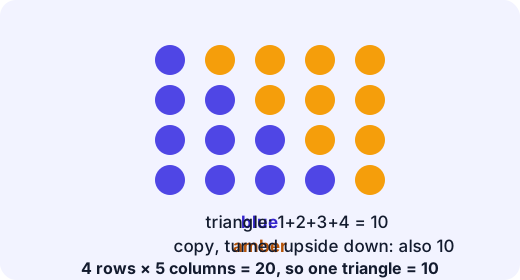
Take two copies of the same triangle and fit them together. They make a rectangle that is dots tall and dots wide. That rectangle has dots, and the triangle is half of it:
Example. .
We did not just notice the formula. We explained it with a picture, and the picture works for every , not only the ones we tried.
Two patterns to explain
Pattern 1. Add two neighbouring triangular numbers: , , . Always a square! Why? Put the triangle of 3 rows next to the triangle of 4 rows. Slide one against the other and they fit into a 4 by 4 square, because .
Pattern 2. Is the sum of the first even numbers special? , , . These are , the rectangle we made above, which is why they are twice a triangular number.
Checking is not proving
Here is a famous trap. Test : for you get 43, for you get 47, for you get 53. All prime! It stays prime for every from 0 to 39. But at : . Not prime!
Misconception. "It worked for the first ten, so it always works." A pattern that fits some cases is only a conjecture. A reason that works for every case is what makes it a fact.
Summary
- A sequence follows a rule. Find the rule, then find why.
- Square numbers differ by consecutive odd numbers.
- Triangular numbers are , because two triangles make an by rectangle.
- Examples are not proof. A picture or argument that works for all is.
Lab
Dot pattern explorer
Slide n to build triangles and squares out of dots, see how two triangles fit together, then answer four questions from what you see.
Your goals
- Explore at least five different values of n.
- Answer all four questions about triangular and square numbers correctly.
The interactive lab opens once you register. Register to do this.
Quick check
Patterns in mathematics check
Eight questions about sequences, square numbers and triangular numbers.
1.The triangular numbers start 1, 3, 6, 10, 15, 21. What is the next one?
Answer with a number
2.How many dots are in the 12th square number (a 12 by 12 square)?
Answer with a number
3.Use T = n(n+1)/2 to find the 20th triangular number.
Answer with a number
4.The square numbers 1, 4, 9, 16, 25 grow by 3, 5, 7, 9. Why are the gaps odd numbers?
- Each bigger square needs an L-shaped border with two equal sides and one corner, which is always an odd number of dots.
- Because squares are always odd.
- Because 1 is odd and odd plus odd is odd.
Choose one
5.What is the rule for 3, 6, 12, 24, 48, ...?
- Add 3 each time.
- Multiply by 2 each time.
- Add the two numbers before.
Choose one
6.A pattern is true for the first 10 cases you test. What can you say?
- It is proved true for all cases.
- It might be true, but you still need a reason that works for every case.
- It must be false.
Choose one
7.T₅ = 15 and T₆ = 21. Their sum is a square number. What is it?
Answer with a number
8.Match each sequence to its name.
- 1, 4, 9, 16, 25
- 1, 3, 6, 10, 15
- 2, 4, 6, 8, 10
- 1, 1, 2, 3, 5, 8
Match each to: Triangular numbers · Fibonacci numbers · Even numbers · Square numbers
Answering and checking are for registered learners. Register to do this.
Quick check
New puzzles with number patterns
Use triangles, squares and reasons in new settings.
1.At a party 8 people each shake hands once with everyone else. How many handshakes are there in all? (Think of the triangular numbers.)
Answer with a number
2.Use Gauss's pairing trick to find 1 + 2 + 3 + ... + 60.
Answer with a number
3.What is 1 + 3 + 5 + 7 + 9 + 11 + 13 (the first seven odd numbers)?
Answer with a number
4.Which of these is a triangular number?
- 36
- 40
- 50
Choose one
Answering and checking are for registered learners. Register to do this.
Your turn
Explain a pattern
Write your answers in your own words. Draw or describe dot pictures where they help.
- Explain, with a picture or words, why . Then use it for .
- Check that and are square numbers. Then explain why the sum of two neighbouring triangular numbers is always square.
- A friend says, " is prime for , so it is always prime." Show what is wrong with this argument.
How it's judged
- Explaining the triangular formula
- Reasoning about neighbouring triangles
- Examples versus proof
Writing and submitting your answer is for registered learners. Register to do this.
Like what you see?
Register for free to answer the quick checks, do the activities and save your work. Your work is saved on your device and syncs to your account.