Unit 3
Primes, HCF and LCM
Break any number into primes, then use those primes to find the biggest shared factor and the first shared multiple.
Read
Every number has one set of prime building blocks
Two lighthouses stand on a rocky coast. Lighthouse A flashes every 12 seconds. Lighthouse B flashes every 18 seconds. Right now they flash at the same moment. A sailor asks: when will I next see both flash together?
You could list the flash times of each lighthouse and look for the first match. That works, but it is slow. In this unit you will learn a faster and far more powerful way: take each number apart into its prime building blocks.
Primes and composites
A prime number has exactly two factors: 1 and itself. So 2, 3, 5, 7, 11, 13 are prime. A composite number has more than two factors: 12 has 1, 2, 3, 4, 6 and 12.
The number 1 is neither prime nor composite. It has only one factor, itself, and primes need exactly two. (This is not a trick. It is what makes the next big idea work cleanly.)
Misconception. "All odd numbers are prime." Not so: 9 = 3 × 3 and 15 = 3 × 5 are odd and composite. And 2 is prime and even; it is the only even prime.
Prime factorisation
Every composite number can be written as a product of primes. A factor tree shows how: split the number into any two factors, then keep splitting until every branch ends in a prime.
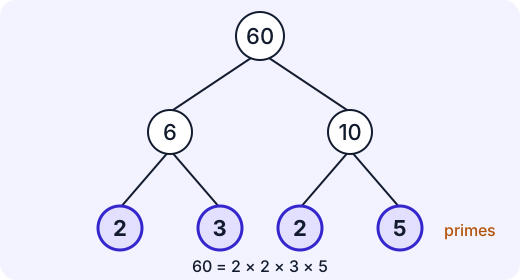
You could have started 60 = 4 × 15 or 60 = 3 × 20 instead. Try it. The tree looks different, but you land on the same primes: two 2s, one 3, one 5. This is the big idea of the unit:
Every number greater than 1 has exactly one prime factorisation (ignoring the order of the factors).
Mathematicians call this the Fundamental Theorem of Arithmetic. It is why primes are called the building blocks of the whole numbers, like atoms of numbers.
Example. Factorise 84. 84 = 2 × 42 = 2 × 2 × 21 = 2 × 2 × 3 × 7, so .
Quick divisibility tests
Before splitting, a test tells you which primes to try.
Divisible by Test Example 2 last digit is 0, 2, 4, 6 or 8 1,348 ✓ 3 digit sum is a multiple of 3 231: 2+3+1 = 6 ✓ 5 last digit is 0 or 5 4,065 ✓ 9 digit sum is a multiple of 9 4,725: 18 ✓ 10 last digit is 0 3,090 ✓ 4 last two digits make a multiple of 4 3,128: 28 ✓ 8 last three digits make a multiple of 8 5,128: 128 ✓ HCF: the biggest shared factor
The highest common factor (HCF), also called the greatest common divisor (GCD), is the biggest number that divides both numbers exactly.
Find the HCF of 24 and 36 using primes:
Keep the primes they share, each at the smaller power: and . Then .
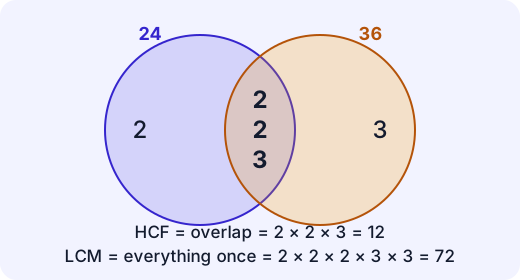
Use it. A teacher has 24 pencils and 36 erasers. She wants identical kits with nothing left over. The most kits she can make is the HCF, 12 kits, each with 2 pencils and 3 erasers.
LCM: the first shared multiple
The lowest common multiple (LCM) is the smallest number that both numbers divide into. With primes, keep every prime that appears in either number, each at the larger power:
Back to the lighthouses. and , so the LCM is . They flash together again after 36 seconds.
Try it: Find the HCF and LCM of 8 and 20. (Hint: , .)
A handy check
For any two numbers, the product of the numbers. For 24 and 36: . ✓ If your answers break this rule, one of them is wrong.
Which do I need, HCF or LCM?
- Splitting into equal groups or cutting to the biggest equal size → HCF (things get smaller).
- Two cycles meeting again or the first time both fit → LCM (things get bigger).
Summary
- A prime has exactly two factors. 1 is not prime.
- Every number greater than 1 has exactly one prime factorisation.
- HCF: shared primes, smaller powers. LCM: all primes, larger powers.
- Divisibility tests tell you which primes to try first.
Lab
The prime workshop
For each pair of numbers, build each prime factorisation by adding primes until the product matches. Then type the HCF and LCM and press Check.
Your goals
- Build the correct prime factorisation for both numbers in all four pairs.
- Find the HCF and LCM of each pair from the shared primes.
The interactive lab opens once you register. Register to do this.
Quick check
Primes, HCF and LCM check
Eight questions about primes, prime factorisation, HCF and LCM.
1.Which of these numbers is prime?
- 51
- 53
- 57
Choose one
2.Write 60 as a product of primes. How many prime factors are there, counting repeats?
Answer with a number
3.What is the HCF of 24 and 36?
Answer with a number
4.What is the LCM of 6 and 8?
Answer with a number
5.Which of these numbers are divisible by 3? Pick all that apply.
- 123
- 124
- 231
- 301
Choose all that apply
6.Why is 1 not a prime number?
- It has only one factor, and a prime needs exactly two.
- It is odd.
- It is too small to be a prime.
Choose one
7.Put the steps for finding the HCF of two numbers using prime factors in a sensible order.
- Find the primes both numbers share.
- Keep each shared prime at its smaller power.
- Multiply them together.
- Write each number as a product of primes.
Put these in order
8.Match each prime factorisation to the number it makes.
- 2 × 2 × 3 × 3
- 2 × 3 × 5
- 2 × 2 × 2 × 5
- 3 × 3 × 5
Match each to: 36 · 45 · 40 · 30
Answering and checking are for registered learners. Register to do this.
Quick check
New puzzles with primes, HCF and LCM
Decide whether each puzzle needs the biggest shared factor or the first shared multiple.
1.A school bell rings every 8 minutes and a temple bell every 12 minutes. They ring together at 9:00. After how many minutes do they next ring together?
Answer with a number
2.A teacher has 48 pencils and 72 erasers. She makes identical kits using every item, with none left over. What is the greatest number of kits she can make?
Answer with a number
3.Is 2 × 2 × 9 a prime factorisation of 36?
- Yes, because the factors multiply to 36.
- No, because 9 is not prime.
- No, because a prime factorisation must have exactly three factors.
Choose one
4.Three runners take 4, 6 and 10 minutes for one lap. They start together. After how many minutes are they next together at the start line?
Answer with a number
Answering and checking are for registered learners. Register to do this.
Your turn
Explain primes, HCF and LCM
Write your answers in your own words. Show your working.
- Mira says, "1 is prime because nothing except 1 and itself divides it." Do you agree? Explain what the definition of prime really requires.
- Find the prime factorisation of 180, and use it to find the HCF and LCM of 180 and 84. Show how you used the powers of the primes.
- Two ribbons, 180 cm and 84 cm long, are cut into equal pieces with no ribbon left over. What is the longest each piece can be? Explain why this is an HCF problem and not an LCM problem.
- Rohan found two different factor trees for 72. Explain why both trees must end in the same primes.
How it's judged
- Definition of prime
- HCF and LCM from prime powers
- Choosing HCF or LCM
- Uniqueness of factorisation
Writing and submitting your answer is for registered learners. Register to do this.
Like what you see?
Register for free to answer the quick checks, do the activities and save your work. Your work is saved on your device and syncs to your account.