Unit 3
Active every day
Find out why children need about an hour of active play a day, and keep a two-week log of yours.
Read
An hour of play
Kabir loved cartoons. One Sunday his aunt asked, "Did you run or climb or jump today?" Kabir thought hard. "I ran to the door when the delivery came."
His aunt laughed. "That's a start! Let's see how much you can fit into a day."
What is active play?
Active play is any play that makes your body work. You move your arms and legs, you breathe faster and your heart beats faster. Running, cycling, skipping rope, dancing, climbing, swimming, kicking a ball and playing tag are all active play. Walking fast to school counts too.
Sitting and watching a screen is resting. Resting is fine, and your body needs it, but it is not active play.
About an hour a day
Doctors and health experts say that children your age need about one hour of active play every day. (The World Health Organization says an average of at least 60 minutes a day.) That is 60 minutes.
An hour sounds long, but it does not have to be all at once. Short bursts add up:
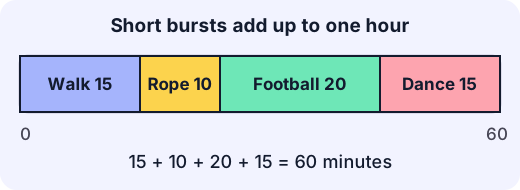
minutes. Break time, PE class, the walk to school and play after school can all be part of it.
Try it: Think about yesterday. What active things did you do? Roughly how many minutes was each one? Add them up. Did you get to an hour?
Example. Mia plays 30 minutes at break and PE, 20 minutes after school, and dances for 10 minutes. That is minutes. She has done her hour.
How being active feels
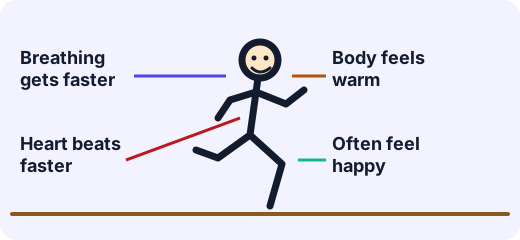
When you are active your heart beats faster, your breathing gets quicker and your body feels warm. Afterwards many children feel happy, proud and ready to sleep. If you feel dizzy, sick or sore in a sharp way, stop and tell a grown-up. Drink water when you are hot.
Not every day will be perfect. If it rains, you can dance indoors. If you feel unwell, rest. The goal is most days, not every minute.
Keep a two-week log
A log is a record you write down each day. For two weeks, write how many minutes of active play you did and a face for how you felt (happy, okay or tired). At the end, look back. How many days did you reach about an hour? Which things did you like best? Does being active make you feel different?
For the grown-up helping
Children this age need to move a lot; "about an hour" is a guide, an average over the week, not a rule to enforce every day. Count play, walking and chores, not just sport. Help your child fill in the log, but let them pick the faces. Praise the doing, not the number, and never use extra activity as punishment. If a child has a health condition or disability, ask their doctor what suits them; every child can be active in their own way.
Lab
Make an active hour
Tap activities to add them to your day and fill a bar up to 60 minutes. Try different things. Does sitting still count?
Your goals
- Add up active play to make 60 minutes.
- Use at least three different kinds of active play.
- Tap a resting activity, like watching TV, and read why it does not count as active play.
The interactive lab opens once you register. Register to do this.
Activity
My two-week play log
For 14 days your child writes down their active play and how it felt, then looks back. About 5 minutes a day, plus 10 minutes at the end.
You'll need
- A sheet of paper or a notebook
- Pencil or crayons
Steps
- Rule the paper into 14 rows or boxes, one for each day. For each day, leave room for: the day, what I played, about how many minutes, and a face.
- Each evening, ask: what did you play today that made you breathe faster? Write it down (or draw it). Together, work out about how many minutes. Add short bursts together, e.g. 15 + 10 + 20.
- Your child draws a face for how they felt: happy, okay or tired. Let them choose.
- Do not worry about days that are low. Rainy day? Try dancing, a freeze game or chasing a balloon indoors.
- After 14 days, count the days that reached about 60 minutes. Look at the faces. Ask: which activity do you like most? How do you feel after being active?
- Decide together on one new active thing to try next week.
Safety
- Play outdoors away from roads, water and steep steps, with a grown-up in sight.
- Offer water and shade. Wear a helmet for cycling or scootering and non-slip shoes.
- Stop and rest if your child feels dizzy, sick or has sharp pain. Rest on days they are unwell.
- Never use the log to compare children or to punish; it is just a record.
Keeping a log of the activity is for registered learners. Register to do this.
Quick check
Active every day check
Six questions about being active.
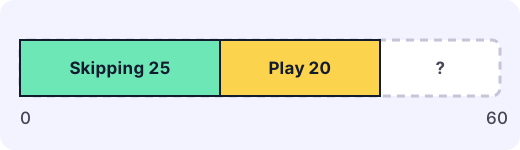
1.Kabir has done the coloured parts. How many more minutes does he need to reach one hour?
Answer with a number
2.About how much active play do children need each day?
- About 5 minutes
- About an hour
- All day without stopping
Choose one
3.Which of these are active play? Pick all that are.
- Running in the park
- Watching TV
- Cycling
- Lying in bed
- Dancing
Choose all that apply
4.Does the hour of active play have to happen all at once?
- Yes, or it doesn't count
- No, short bursts add up through the day
Choose one
5.Which is a sign you have been really active?
- Your breathing and heartbeat get faster
- Your heart stops beating for a while
- You breathe slower than when you were sitting still
Choose one
6.Nia's log says Monday 30 minutes, Tuesday 40 minutes, Wednesday 20 minutes. How many minutes is that altogether?
Answer with a number
Answering and checking are for registered learners. Register to do this.
Quick check
New puzzles
Use what you know about being active in new situations.
1.Rohan plays cricket for 25 minutes and cycles for 35 minutes. How many minutes of active play is that?
Answer with a number
2.It is raining hard and Sana cannot go out. What is a good way to be active?
- Watch TV all day
- Dance and play freeze games indoors
- Do nothing, because only outdoor play counts
Choose one
3.Sara walks fast for 10 minutes and says, "That's my whole hour!" What do you think?
- She is right; 10 minutes is an hour
- Not yet; she needs about 50 more minutes of active play
- Walking never counts as active play
Choose one
4.Dev wants an hour. He has 20 minutes of PE and 15 minutes of playground games. How many more minutes does he need?
Answer with a number
5.Imran runs fast around the field and his heart is pounding. What is happening?
- That is normal; being active makes your heart beat faster, and it will slow down when he rests
- He must never run again
- Nothing is happening in his body
Choose one
Answering and checking are for registered learners. Register to do this.
Activity
Tell it back
Your child explains, in their own words, how much active play they need and how it feels. Three minutes.
Steps
- Ask "How much active play do children need each day?" Let your child answer before you help.
- Ask "What does your body feel like when you are being active? What about afterwards?"
- Ask "What is your favourite way to be active? Which one would you like to try?"
- Write down what your child says, in their words.
Keeping a log of the activity is for registered learners. Register to do this.
Like what you see?
Register for free to answer the quick checks, do the activities and save your work. Your work is saved on your device and syncs to your account.