Unit 1
Run, hop, skip, balance, throw
Learn how to run, hop, skip, balance and throw and catch, and find out why practice makes your body better at them.
Read
Your body can learn new moves
Zoya stood at the edge of the playground. The other children were skipping across it, step-hop, step-hop, like bouncing balls. Zoya tried. Her feet got tangled and she sat down with a bump.
"I can't skip," she said.
Her older cousin Imran smiled. "You can't skip yet."
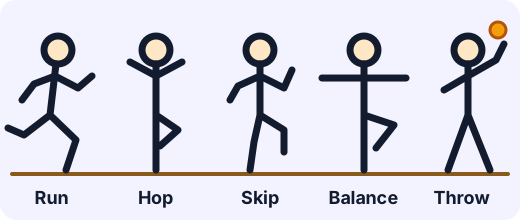
Five big moves
Your body knows many moves. Here are five to practise.
- Run. Fast steps, with a little moment in the air between each one. Swing your arms.
- Hop. Push off one foot and land on the same foot. Then try the other foot.
- Skip. Step, then hop, on one foot. Then step, then hop, on the other foot. Step-hop, step-hop.
- Balance. Stand on one foot and keep still. Hold your arms out wide to help you stay steady.
- Throw and catch. Look at your target when you throw. When you catch, hold your hands out, watch the ball, then close your hands and bring it in close.
Try it: Hop five times on your left foot. Now five times on your right foot. Is one side easier? That's normal. Most people have a stronger side.
How to catch
- Hands out, ready. Stand with your feet a little apart.
- Eyes on the ball. Watch it all the way, even when it wobbles.
- Close your hands around it.
- Bring it in close to your body.
To throw, look at where you want the ball to go, bring your arm back, then let go as your arm swings forward.
Practice makes you better
Zoya practised skipping for a few minutes every day. On the first day she fell. On the fifth day she skipped to the gate. On the tenth day she skipped all the way round the playground.
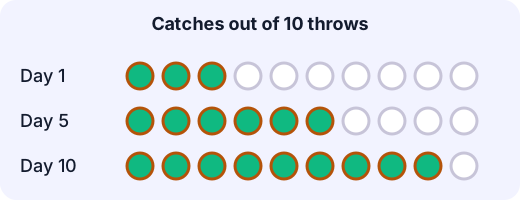
Look at the picture. A child tried to catch a ball ten times each day. On day 1 she caught 3. On day 5 she caught 6. On day 10 she caught 9. She didn't get a new body. Her body learned, because she kept practising.
Moving well is a skill. Everyone starts as a beginner, and everyone gets better with practice.
Wobbles are part of it
A wobble does not mean you are bad at it. Wobbles on a soft floor or grass are how your body finds out what to fix. Try a bit, rest a bit, try again. If something hurts, stop and tell a grown-up.
For the grown-up helping
Children this age are still building balance and coordination, and they learn at different speeds; comparing with other children is not helpful. Praise effort and trying again ("you kept going!") more than being the best. Practise in short bursts, on grass or a mat, with a soft ball. Skipping is often the last of these to arrive: hopping first, then step-hop on one foot only, is a good way in. If a child seems far behind other children of their age in several of these moves, mention it to a teacher or doctor; this is common and often easily helped.
Activity
Make a move course
Make a small course with five stations and move through it together, one move at a time. About 25 minutes, indoors or outdoors.
You'll need
- A flat open space, on grass or with a mat or rug
- 6 cushions, shoes or paper plates to mark spots
- A rope, a scarf or chalk to make a line on the ground
- A soft ball, or socks rolled into a ball
Steps
- Set out five stations in a loop. Station 1: a start line and a turn spot about 10 big steps away. Station 2: five spots in a row for hopping. Station 3: the rope line for skipping along. Station 4: a spot to stand on for balancing. Station 5: a throwing spot a few steps from a wall or a partner.
- Station 1, run: run to the turn spot and walk back. Swing your arms.
- Station 2, hop: hop on one foot across the five spots, then back on the other foot.
- Station 3, skip: skip along the line, step-hop, step-hop. If skipping is hard, hop on one foot at a time first. Show how.
- Station 4, balance: stand on one foot with arms out wide and count slowly to 5. Switch feet.
- Station 5, throw and catch: throw the soft ball gently to the wall or your partner, then catch it. Try five throws.
- Do the whole loop two or three times. Each time, ask: what felt easier than before?
- Another day, do it again. Count how many catches you make out of five and see if the number goes up.
Safety
- Clear the space of toys, furniture and anything sharp or hard.
- Use grass, a mat or a rug, not a slippery floor. Bare feet or non-slip shoes, not socks on a smooth floor.
- Outdoors, stay away from roads, water and steep steps.
- Use a soft ball or rolled socks, never a hard ball indoors.
- Offer rest and water. Stop if anything hurts or the child feels dizzy.
Keeping a log of the activity is for registered learners. Register to do this.
Quick check
Moves check
Six questions about moving. Ask a grown-up to read them with you if you like.
1.Why does the child hold both arms out wide?
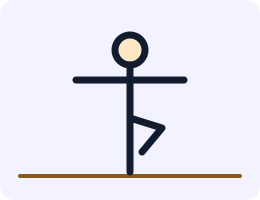
- Arms out make you jump higher
- Arms out help you stay steady
- Arms out make you run faster
Choose one
2.The ball is coming. Where should the catcher look?
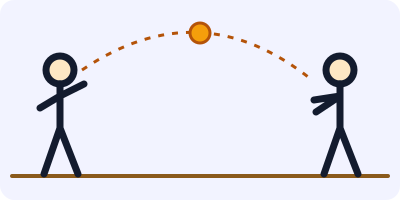
- At the ground
- At the ball
- Far away, at the clouds
Choose one
3.Put the steps of a catch in order, first to last.
- Close your hands on the ball
- Bring it in close to your body
- Eyes on the ball
- Hands out, ready
Put these in order
4.Match each move to what you do.
- Hop
- Skip
- Jump
Match each to: Step and hop, then switch feet · Push off two feet and land on two feet · Push off one foot and land on the same foot
5.Ravi can only balance on one foot for 2 seconds on the first day. What will probably happen if he practises a little every day?
- He will be able to balance for longer
- It will stay exactly the same forever
- Only tall children get better at balancing
Choose one
6.Which things help you get better at hopping? Pick all that help.
- Practise a little each day
- Stop and say "I can't" after the first wobble
- Try again after a wobble
- Hop in a very crowded place
Choose all that apply
Answering and checking are for registered learners. Register to do this.
Quick check
New puzzles
Use what you know about moving in new places.
1.Asha hops 5 times on her left foot and 5 times on her right foot. How many hops is that in all?
Answer with a number
2.Rohan wants to skip with a rope but he trips a lot. What is the best idea?
- Wait until he is much older
- Only watch other children skip
- Practise for a few minutes each day and try again after a trip
Choose one
3.Sana can throw a ball but misses most catches. Which practice is best?
- Throw the ball as hard as she can
- Throw a soft ball gently to a wall, catch it close, and step back a little as it gets easier
- Stop playing ball games
Choose one
4.On day 1 Kabir caught 2 balls. On day 6 he caught 7 balls. How many more catches did he make on day 6?
Answer with a number
5.Tara has never ridden a scooter and keeps wobbling. Which sentence is true?
- She was born bad at balance, so it won't get easier
- Balancing is a skill, so it will probably get easier with practice
- Wobbling means she should never try again
Choose one
Answering and checking are for registered learners. Register to do this.
Activity
Tell it back
Your child explains, in their own words, how they got better at something. Three minutes.
Steps
- Ask "Tell me something you could not do before but can do now." Walking, riding, tying shoes, skipping, anything.
- Ask "How did you learn it?" and "What happened the first time?" Don't suggest the answer; wait.
- Ask "What move would you like to get better at?" and "What will you practise?"
- Write down what your child says, in their words.
Keeping a log of the activity is for registered learners. Register to do this.
Like what you see?
Register for free to answer the quick checks, do the activities and save your work. Your work is saved on your device and syncs to your account.