Unit 1
Running, jumping, throwing
Learn the technique of a sprint, a long jump and a throw, then measure yourself and beat your own record.
Read
Faster, farther, better
On sports day at Nila's school, the ball throw had a surprise winner. Everyone expected Dev, the tallest and strongest boy in the class, to win. He gripped the ball, took a huge breath and heaved it almost straight up. It went very high, and landed almost at his feet.
Then Ibrahim, who is small, stepped up. He turned sideways, took one skipping step, swung his hips, then his shoulder, then his arm, and let the ball go at a gentle upward angle. It sailed far past Dev's mark.
"But Dev is so much stronger!" said Nila.
"Strength helps," said their teacher. "But technique decides how well you use it."
Technique means the way you move your body to do a skill. In this unit you will learn the technique for three events (a sprint, a long jump and a throw), and how to measure yourself so you can beat your own record.
Sprint: run fast for a short way
A sprint is a flat-out run over a short distance, such as 30 or 50 metres. It has three parts.
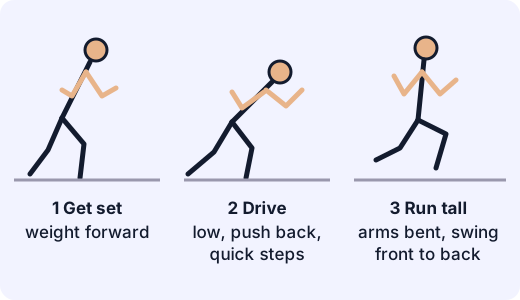
- Get set. Stand with one foot a little in front of the other and lean your weight forward, as if you are about to fall. Do not start until the signal.
- Drive. For the first few steps stay low and lean forward. Push the ground back with each foot, and take quick, strong steps. Do not stand up at once: that wastes your first push.
- Run tall. Rise gradually. Keep your arms bent like the letter L and swing them forwards and backwards (not across your body). Keep your hands and face relaxed. A tight, scrunched-up runner is a slow runner.
Always run through the finish line, not just to it. If you slow down early, you lose time.
Example. Tara runs 30 m in 6.8 s, an average of metres every second. A week later, with better arm swing, she runs it in 6.5 s: seconds faster.
Long jump: speed, spring, landing
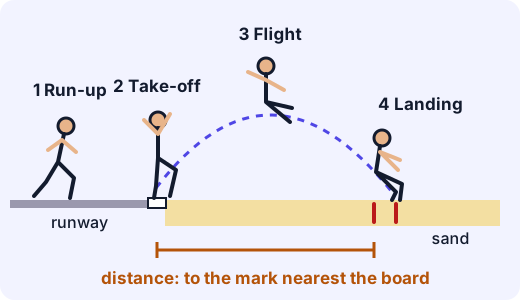
- Run-up. Count steps and use the same run-up every time so your take-off foot lands on the right spot. Build up speed smoothly.
- Take-off. Push off with one foot from the board, without stepping over the front of it. Drive the other knee up and swing your arms up. Do not slow down: speed becomes distance.
- Flight. Stay tall in the air and reach your legs forward.
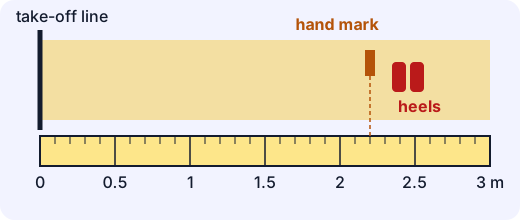
- Landing. Land on both feet together, bend your knees to soak up the landing, and let your body move forward past your feet. If you fall backwards, your hands leave a mark behind your feet, and that shorter mark is the one that counts.
How a jump is measured. Stretch a tape from the take-off line to the mark nearest the board made by any part of your body. Read it in metres and centimetres.
Example. Meera's best jumps in three weeks were 1.45 m, then 1.52 m, then 1.49 m. Her record is 1.52 m, not the last one. Her improvement over her first best is m, which is 7 cm.
Throw: a chain from the ground to the hand
A strong throw does not come from the arm alone. It is a chain: legs, hips, trunk, shoulder, arm, hand, each part speeding up the one after it, like cracking a whip.
Stand side-on to your target with your throwing arm back. Step towards the target with the foot opposite your throwing arm. Turn your hips first, then your chest, then bring your arm over the top, let go and follow through.
How high should you throw?
Suppose you can throw a ball at a certain speed. Does the angle matter? Yes, a lot.
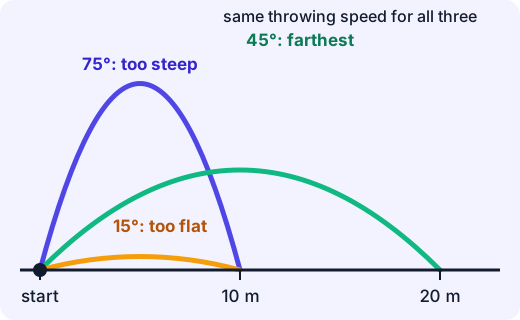
On flat ground, with the same throwing speed:
Throw angle How far compared with the best 15° (very flat) half as far 30° about 87% 45° the farthest 60° about 87% 75° (very steep) half as far A flat throw is fast but hits the ground too soon. A steep throw stays in the air a long time but goes mostly up. The best is in between. In real life the best angle is a little under 45° because your hand lets go above the ground, and long jumpers take off at only about 20°, because leaping steeply costs them running speed.
Technique beats strength
Try the numbers. Asha can throw at 12 metres per second. Bilal is stronger, at 14 metres per second.
- Asha at 45° throws about 14.7 m.
- Bilal at a rushed, flat 15° throws only about 10 m.
The weaker thrower wins by almost 5 metres. If Bilal also learns to throw at 45°, he beats Asha with about 20 m. The best result is strength plus technique. (These are neat numbers with no air and a release from the ground, so real throws go a bit farther.)
A mistake people make: "The strongest person always wins." Strength helps, but a tense body, a wrong angle or a bad landing wastes it.
Beat your own record
Keep a record book with the date, the event and the result. Measure the same way every time (same line, same tape). Change one thing at a time, such as your arm swing, so you know what helped. Compare yourself with yourself: a bad day does not erase your best.
Stay safe
- Warm up first: jog, swing your arms, do gentle leg stretches.
- Jump only into soft sand, grass or a mat.
- Throw only soft balls or beanbags, only when an adult says, and only when everyone stands behind the line and throws the same way. Nobody goes to fetch until the all-clear.
- Wear shoes that fit. Stop and tell an adult if something hurts or you feel dizzy.
Lab
The throw lab
Asha is weaker than Bilal, but who throws farther depends on the angle. Choose angles, throw, and look at the distances.
Your goals
- Find an angle at which Asha throws at least 14.3 m.
- Find an angle at which Bilal throws at least 19.4 m.
- Make a throw where weaker Asha goes farther than stronger Bilal, and explain why.
The interactive lab opens once you register. Register to do this.
Activity
Your record book
Measure yourself in a sprint, a long jump and a throw, practise one technique tip, and measure again to see if you beat your own record. Two sessions of about 30 minutes, a few days apart.
You'll need
- A measuring tape or a 1-metre stick (or a piece of string marked every 10 cm)
- A stopwatch or a phone timer, and a helper to time you
- Chalk, small stones or cones to mark lines (not for throwing)
- A soft ball, beanbag or pair of rolled-up socks to throw
- A notebook for your record book
Steps
- Warm up for five minutes: jog on the spot, swing your arms in big circles, and do gentle leg swings and calf stretches.
- Sprint: mark a start and a finish line 30 steps apart, and measure the distance with the tape. A helper says Ready, Set, Go and times you. Run three times with a rest in between. Write down all three times and circle the fastest.
- Long jump: mark a take-off line on grass, soft sand or a mat. Take a short run-up (count your steps), jump from one foot and land on both. A helper measures from the line to the mark nearest it. Do three jumps and write down the distances.
- Throw: stand behind a line and throw the soft ball or beanbag overarm three times, each at a different height: low and flat, medium, and high. Mark where each lands and measure from the line. Which angle went farthest? Does it match the throw lab?
- Choose one technique tip from the reading, such as a lean-forward drive for the sprint, the same run-up every time, or turning your hips before your arm. Practise it ten times over the next few days.
- Second session: repeat your best event (same lines, same tape, same helper) and write down the new result. Work out the difference from your record in seconds or centimetres.
- In your record book, write one sentence: what did you change, and did it help?
Safety
- Warm up first, and stop and tell an adult if anything hurts or you feel dizzy.
- Jump only onto soft ground, sand or a mat, never concrete or tiles, and clear the area of stones and sticks.
- Throw only soft objects such as a beanbag or rolled socks, never stones, sticks or hard balls.
- Everyone throws in the same direction from behind the line. Nobody goes to collect anything until the helper says all clear.
- Run on a flat, dry surface in shoes that fit, away from roads and other people. An adult should be nearby.
- Drink some water before and after, and rest in the shade on a hot day.
Keeping a log of the activity is for registered learners. Register to do this.
Quick check
Running, jumping, throwing check
Seven questions about technique and measuring.
1.You throw a ball at the same speed every time on flat ground. Which angle sends it farthest?
- About 15° (very flat)
- About 45°
- About 80° (almost straight up)
Choose one
2.Put the long jump in order, first to last.
- Run-up
- Flight
- Take-off from one foot
- Landing on both feet
Put these in order
3.How long is this jump, in metres? Remember where jumps are measured to.
Answer with a number
4.What should you do in the first few steps of a sprint?
- Stand straight up at once to look at the finish line
- Stay low, lean forward and push the ground back with quick, strong steps
- Take the longest leaps you can
Choose one
5.Leela's long jump record is 1.52 m. Today she jumps 1.61 m. By how many centimetres did she beat her record?
Answer with a number
6.Dev is very strong but throws a ball only a short way. Meera is less strong but throws it much farther. What is the most likely reason?
- Meera uses her legs, hips and body in a chain and lets go at a good angle
- Meera uses only her arm, because that is where the power is
- Meera is always lucky
Choose one
7.Which are safe rules for a group throwing practice? Pick all that apply.
- Everyone throws the same way from behind the line
- Nobody goes to fetch the balls until the all-clear
- A friend stands where the ball lands to catch it
- Use soft balls or beanbags
Choose all that apply
Answering and checking are for registered learners. Register to do this.
Quick check
Athletics: new puzzles
Use what you know about technique and measuring in new situations.
1.Kabir runs 40 m in 8 seconds. Zoya runs 30 m in 6 seconds. Who ran at the faster average speed?
- Kabir
- Zoya
- They ran at the same speed
Choose one
2.Ravi throws a ball at the same speed at four angles. Put the throws in order from the shortest distance to the longest.
- 15° (very flat)
- 80° (almost straight up)
- 45°
- 35°
Put these in order
3.Nadia's five jumps were 1.32 m, 1.40 m, 1.38 m, 1.47 m and 1.44 m. How many centimetres farther is her best jump than her first?
Answer with a number
4.Your friend says, "I'm not strong, so I will never be good at long jump." What is the best reply?
- Technique such as a steady run-up, a strong take-off and a forward landing can be practised, and it adds distance whatever your strength
- You are right, only strong children can jump far
- You must lift heavy weights first
Choose one
Answering and checking are for registered learners. Register to do this.
Your turn
Teach a younger child
A younger child says, "To win at sports day you just have to be the strongest."
Write a short explanation (6 to 10 sentences) that helps them see why technique matters.
- Pick one event: a sprint, a long jump or a throw.
- Give two technique tips for it, and say why each one helps.
- Use one number from your own record book, from the throw lab, or from the reading to show that technique can beat strength or improve a result.
- Say how the child could measure whether the tip is helping them.
How it's judged
- Technique tips
- Evidence
- Measuring and clarity
Writing and submitting your answer is for registered learners. Register to do this.
Like what you see?
Register for free to answer the quick checks, do the activities and save your work. Your work is saved on your device and syncs to your account.