Unit 2
Team games and fair play
Use simple tactics to play as a team, and show fair play whether you win or lose.
Read
Stronger together
In the school playground, Kabir's team was losing 3 to 0. Kabir was the fastest runner in Class 3, and every time he got the ball he dribbled it all the way down the pitch by himself. Two defenders always blocked him, and the other team took the ball back.
"Pass it!" shouted Zoya, who was standing alone near the goal with nobody near her.
Next time, Kabir passed. Zoya scored. After that, the team passed again and again, and the game ended 4 to 3, a win. Kabir had not become faster. His team had become smarter.
That is the big idea of this unit: a team is stronger than its best player. You will learn three things that make a team strong: tactics, teamwork and fair play.
Tactics: a plan, not just luck
A tactic is a simple plan for how to play. You do not need a fancy one. Here are four that work in football, basketball, handball, hockey and many other games.
- Spread out. Do not all crowd around the ball. When players spread out, there is space between them for passes, and defenders cannot watch everyone.
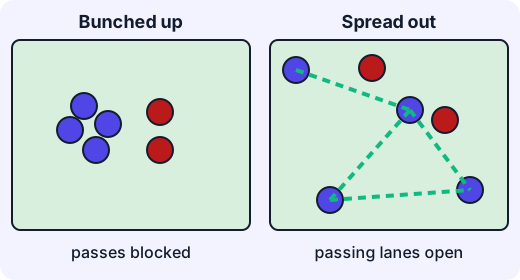
- Pass to the free player. A free player is one with no defender close by. Look up before you pass.
- Talk. Call your name ("Here, Zoya!") so a teammate knows where you are.
- Know your job. Attackers try to score, defenders try to stop the other side, and the goalkeeper (or the last defender) guards the goal. In games like kho-kho or kabaddi, each player has a job in the chain, too.
Why passing wins
Suppose three attackers play against two defenders. A defender can only mark one attacker at a time, so two defenders can mark at most two attackers. That leaves attacker free.
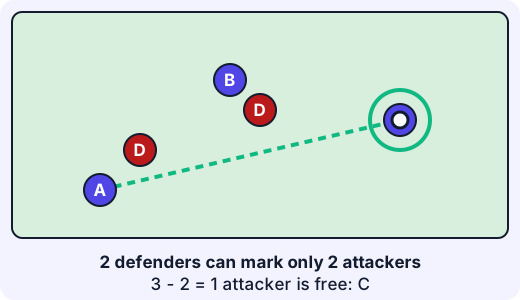
The same idea works for bigger teams. With 5 attackers against 3 defenders, at least attackers are free.
There is more good news. Every extra teammate gives the ball more places to go. Count the possible pairs of players who can pass to each other:
Players Pairs 2 1 3 3 4 6 5 10 You can find the number with . For 5 players: .
Example. Six friends play a passing game. How many pairs can pass to each other? pairs. A star who never passes uses none of them.
Try it: At your next game, count how many different players touch the ball in one attack. More players means a harder team to stop.
A mistake people make: "The best player should always take the shot." Sometimes the best shot belongs to the player nobody is watching.
Teamwork
Teamwork is more than passing. A strong team:
- plans together before the game ("Who will stay back?") and talks about what worked afterwards,
- cheers for teammates who make mistakes ("Next one!") instead of blaming them,
- gives everyone a turn, including the quieter players,
- accepts different jobs: the player who stops a goal is as important as the one who scores it.
Fair play
Winning feels good, but a win only counts if you won fairly. Fair play means playing by the rules, being honest, and treating everyone with respect, whether you are winning or losing.
Moment Fair play looks like Before the game Agree the rules. Shake hands or say "good luck". A foul or a close call Tell the truth, even if the referee did not see it. Accept the decision and carry on. Winning Say "good game" and name something the other team did well. Do not boast. Losing Congratulate the winners. Say what you will practise, not who to blame. Always Include everyone. Never push, trip or shout at players or the referee. If you are angry after a bad decision, take three slow breaths, as you will learn in the yoga unit, before you speak. If you think a decision was wrong, ask your captain or teacher to talk about it calmly after the game.
Fair play is a kind of strength. A team that wins by cheating has not really won, and nobody wants to play with it again.
Stay safe
- Play on flat, clear ground with no stones, holes or traffic.
- Play non-contact versions: intercept the ball, do not grab or tackle.
- Wear shoes that fit, warm up first and drink water.
- Stop and tell an adult if someone is hurt.
Activity
The three-versus-two passing game
Play a small passing game, try a tactic in each round, and practise fair play with a captain's card. You need at least 5 players, a safe flat space and about 30 minutes.
You'll need
- A soft ball (a foam or beach ball is ideal)
- Four cones, bottles or chalk marks for a square about 10 steps by 10 steps
- Paper and a pencil for the scorer
- A helper or teacher to be referee
Steps
- Agree the rules together before you start. Write them on a card as the captain's card: no pushing or grabbing, the referee's decision is final, we say good game at the end. The captain reads them out loud.
- Set up the square. Three attackers play against two defenders. Everyone else waits at the side and swaps in after each round. Attackers score a point for every 5 passes in a row that the defenders do not touch. If a defender touches the ball, or it leaves the square, the defenders and attackers swap.
- Round 1, no talking: play for 3 minutes and let the scorer write down how many points the attackers get.
- Round 2, spread out and call names: attackers must stay at least a few steps apart and say the name of the player they are passing to. Play 3 minutes and score again.
- Round 3, find the free player: before each pass the passer looks up and passes to the attacker with no defender close by. Play 3 minutes and score again.
- Talk it through for two minutes: Which round scored most? What made the difference? Did every player get the ball?
- Fair play check: when a ball goes out and the referee did not see who touched it last, the player who touched it says so. End by lining up to shake hands or high-five and saying one good thing about the other team.
Safety
- Play on flat, clear ground with no stones, holes, traffic or hard edges. A grass field or a school playground is best.
- Use a soft ball. Defenders may only step in to intercept, never grab, push or tackle.
- Warm up first, wear shoes that fit and drink water. Rest in the shade on hot days.
- Stop the game at once if someone is hurt and tell an adult.
- An adult or teacher should be in charge and act as referee.
Keeping a log of the activity is for registered learners. Register to do this.
Quick check
Team games and fair play check
Seven questions about tactics, teamwork and fair play.
1.Which attacker (blue) is free, with no defender close, to receive a pass?
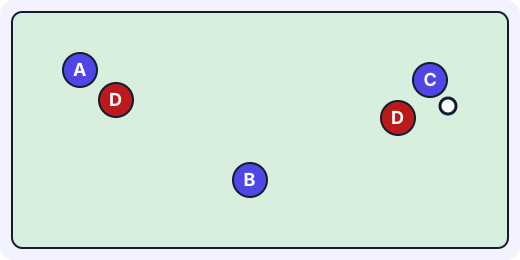
- A
- B
- C
Choose one
2.Five attackers play against three defenders, and each defender can mark one attacker. At least how many attackers are free?
Answer with a number
3.A star player never passes and always tries to dribble past everyone alone. Why does this usually hurt the team?
- The defenders can all watch one player, and free teammates are never used
- The star will get too hot
- Dribbling is against the rules
Choose one
4.Match each team habit to the reason it helps.
- Spread out
- Call your name
- Pass to the free player
- Say good game
Match each to: Respects the other team, win or lose · Opens space so passes can get through · Teammates know where to pass · Beats defenders without dribbling past them
5.Which of these show fair play? Pick all that apply.
- Congratulating the winners when you lose
- Blaming a teammate for the mistake
- Telling the referee you touched the ball last
- Making sure everyone gets a turn
Choose all that apply
6.You stepped over the line, but the referee did not see it. Your team would get a free point if you say nothing. What does fair play ask?
- Say nothing, because the referee did not see
- Tell the referee, even though it costs your team
- Say the other team did it
Choose one
7.Four players in a team can each pass to any other player. How many different pairs of players can pass to each other?
Answer with a number
Answering and checking are for registered learners. Register to do this.
Quick check
Team games and fair play: new puzzles
Use tactics, teamwork and fair play in situations you have not seen yet.
1.Six friends are in a passing circle and any two of them can pass to each other. How many different pairs of players are there?
Answer with a number
2.Your team has 4 attackers near the ball and the other team has 3 defenders there. Each defender can mark one attacker. At least how many of your players are unmarked?
Answer with a number
3.A 4-person relay. Team A's runners take 9, 9, 9 and 9 seconds. Team B has the fastest runner in school, who takes 7 seconds, but the other three take 12, 11 and 12 seconds. By how many seconds does Team A beat Team B?
Answer with a number
4.Your team won 5 to 0. A player on the other team is upset. What is the best fair play response?
- Cheer loudly in front of them
- Go over, say well played, and name something good they did
- Ignore them and leave
Choose one
Answering and checking are for registered learners. Register to do this.
Your turn
Why a team beats a star
A friend says, "If we have one really great player, we don't need anyone else, and the other team is just being unfair if they complain when we win."
Write a short reply (6 to 10 sentences) in which you:
- Explain, using a tactic, why a team is stronger than its best player. Include a number (for example the free player idea, or the passing pairs).
- Describe one thing the great player can do that helps the whole team.
- Explain what fair play means when your team wins, and give one example of what you would say or do.
How it's judged
- Explains why a team beats a star
- Helping the team
- Fair play when winning
Writing and submitting your answer is for registered learners. Register to do this.
Like what you see?
Register for free to answer the quick checks, do the activities and save your work. Your work is saved on your device and syncs to your account.