Unit 3
Yoga and focus
Hold balancing poses and use a short breathing practice to settle your body before a task.
Read
Still body, clear mind
Before every exam, Isha's hands used to feel cold and her tummy fluttered. Her heart beat fast, and when she opened the paper, the words seemed to jump around.
Her aunt showed her a trick. "Sit tall. Breathe in slowly for four counts. Breathe out even more slowly for six. Do it five times."
Isha tried it. The flutters did not vanish, but they got smaller. She could read the first question. That small calm was enough to start.
In this unit you will learn two tools from yoga that help your body and mind work together: balancing asanas and breathing practice. Yoga comes from India and is thousands of years old. An asana (AH-sa-na) is a yoga pose. Asana means a steady, comfortable seat or posture.
Balance: standing steady on one foot
Balancing poses train you to stay steady while your body is a little wobbly.
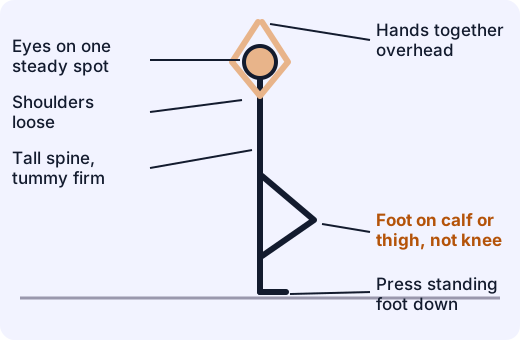
Tree pose (Vrikshasana)
- Stand tall with your feet together. Fix your eyes on one spot ahead of you, such as a mark on the wall.
- Shift your weight onto your left foot. Press it into the floor.
- Lift your right foot and rest it on your left calf or inner thigh. Never place it on the knee, which can hurt the joint.
- Bring your palms together at your chest. If you feel steady, raise them overhead.
- Breathe slowly. Stay for 5 to 10 breaths. Then change sides.
Two other balancing poses to try are eagle pose (Garudasana), where you wrap one leg and arm round the other, and airplane pose, where you tip forward from the hips with arms out like wings and one leg lifted behind you. Do these near a wall or a chair that you can touch for support.
Why do we wobble, and how do we balance?
Your body keeps you upright using three helpers: your eyes, the balance organs in your inner ears, and the feelings from your feet and muscles. When you stand on one foot, hundreds of tiny muscle movements go on without you noticing. Wobbling is not failing. It is your body working!
Tips that help:
- Gaze at one steady spot. Your eyes give your brain a fixed point to measure against. Looking around, or closing your eyes, makes it much harder.
- Press your standing foot down and spread your toes.
- Stand tall and gently tighten your tummy muscles.
- Breathe smoothly. Holding your breath makes you stiff and unsteady.
- If you fall out, smile and start again. Practise both sides: your second side is often weaker.
Example. Isha holds tree pose for 9, 12 and 15 seconds in three tries on her right side. She improves by seconds. On her left side she manages only 6 seconds. That tells her to practise the left side a little more.
Breathing to calm the body
When you are worried or in a hurry, your breathing gets quick and shallow. When you slow your breathing, with a longer breath out, your body gets the message that you are safe. Your heartbeat tends to slow and your muscles loosen. Many people find it easier to think clearly after a few slow breaths.
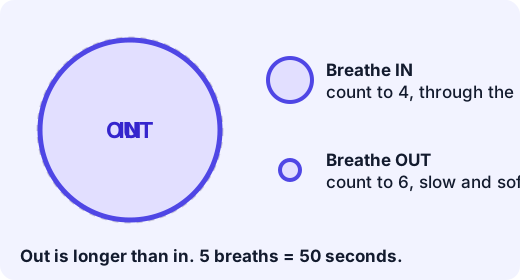
A short breathing practice
- Sit comfortably with your back tall and your shoulders loose. Rest your hands on your lap.
- Breathe in slowly through your nose while you count to 4.
- Breathe out slowly, through your nose or softly through your mouth, while you count to 6.
- Repeat five times.
- Notice how you feel, then begin your task.
Example. One breath takes seconds. In one minute (60 seconds) you take breaths. Most people breathe much faster than that when they are playing or worried, often 15 to 25 breaths a minute, so six slow breaths feel very calm.
Try it: Rate how calm you feel from 1 (very jumpy) to 5 (very calm). Do five slow breaths. Rate again.
Calm body, focused mind
The big idea: a calm body helps a focused mind. When your body is not racing, your mind has more room to pay attention to one thing, such as a spelling test, a drawing or a game. Balancing poses train this in another way: to stay steady you have to pay attention to one thing, your gaze and your breath, and let other thoughts pass by.
You can use these tools whenever you need them: before a test, when you feel cross, or before you start homework.
A mistake people make: "Yoga is about bending as far as you can." It is not. Yoga is about paying attention and being steady. The point is how you do it, not how far you go.
Stay safe
- Practise on a flat, non-slippery floor, barefoot or on a mat, and near a wall or chair for balance poses.
- Wait until your tummy is settled after a meal.
- Never force a stretch or hold your breath. If something hurts or you feel dizzy, stop and rest.
- Breathe slowly and gently, never by force.
- If you have asthma or any health condition, ask a doctor or your teacher which practices are right for you.
Lab
The breath pacer
Rate how calm you feel, follow five slow breaths with a longer breath out, then rate yourself again. Breathe gently and stop if you feel dizzy.
Your goals
- Rate how calm you feel before you start.
- Choose a pace where you breathe out for longer than you breathe in, and follow five breaths.
- Rate how calm you feel afterwards and notice whether anything changed.
The interactive lab opens once you register. Register to do this.
Activity
A week of balance and breath
Practise tree pose on both sides and a short breathing practice before homework for five days, and keep a small diary. About 10 minutes a day.
You'll need
- A flat, non-slippery floor or a yoga mat, and a wall or sturdy chair to touch
- A clock or phone with a seconds timer, and a helper to time you (or count breaths instead)
- A notebook for your diary
Steps
- Day 1: Stand near a wall. Do tree pose (Vrikshasana) with your foot on the calf or thigh, never on the knee, eyes on one spot ahead. Have your helper time how long you hold it on each side, or count slow breaths. Do two tries on each side and write down the longest.
- Days 2 to 5: Repeat tree pose, then try one more balance pose such as eagle pose or airplane pose, with a hand near the wall. Practise your weaker side one extra time.
- Every day, before you start homework or reading, do the breathing practice: sit tall, breathe in through your nose for 4 counts, breathe out slowly for 6 counts, and repeat five times.
- Before and after the breathing practice, give yourself a calm score from 1 (very jumpy) to 5 (very calm). Write both scores in your diary.
- On day 5, test tree pose again. Compare with day 1 on each side, and add up whether your calm score went up, stayed the same or went down on most days.
- Write three sentences: what helped you balance, what the breathing did, and whether you would use it again before a test.
Safety
- Practise on a flat, non-slip floor, barefoot or on a mat, with a wall or chair within reach. Move any sharp or hard objects out of the way.
- Wait until your tummy has settled after a meal.
- Never place your foot on the knee. Do not force any stretch, and stop if something hurts.
- Breathe slowly and gently, never by force or holding your breath. If you feel dizzy, stop and breathe normally.
- If you have asthma or any health condition, ask a doctor or your teacher which practices are right for you.
Keeping a log of the activity is for registered learners. Register to do this.
Quick check
Yoga and focus check
Seven questions about balancing poses and breathing.
1.What is this balancing pose called?
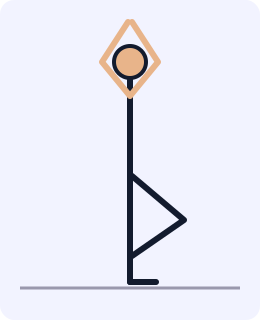
- Tree pose (Vrikshasana)
- Eagle pose (Garudasana), with legs and arms wrapped
- Child's pose, sitting on the heels
Choose one
2.In tree pose, where should the lifted foot rest?
- Against the side of the knee joint
- On the inner calf or inner thigh
- Anywhere, it does not matter
Choose one
3.What helps most to stay steady on one foot?
- Looking at one steady spot ahead
- Looking quickly around the room
- Closing your eyes and moving fast
Choose one
4.You breathe in for 4 seconds and out for 6 seconds, again and again. How many full breaths do you take in one minute?
Answer with a number
5.Which things help you balance? Pick all that apply.
- Fixing your eyes on a still spot
- Breathing smoothly
- Holding your breath
- Pressing the standing foot into the floor
Choose all that apply
6.Put a short breathing practice before a task in order.
- Repeat about five times
- Sit with your back tall and shoulders loose
- Begin your task
- Breathe out slowly, for longer than you breathed in
- Breathe in slowly through your nose
Put these in order
7.You wobble a lot in tree pose. What does this mean?
- It is normal: your body is making tiny balance adjustments, so keep breathing and try again
- You are bad at yoga and should give up
- You should hold your breath to stop it
Choose one
Answering and checking are for registered learners. Register to do this.
Quick check
Yoga and focus: new puzzles
Use balance and breath in situations you have not seen yet.
1.Rohan feels jittery before reading his poem aloud to the class. Which is the best choice?
- Sit tall and take five slow breaths, breathing out for longer than in
- Run around the room as fast as he can
- Pretend nothing is wrong and breathe quickly
Choose one
2.Sana does five breaths. Each one is 3 seconds in and 5 seconds out. How many seconds does her whole practice take?
Answer with a number
3.Isha holds tree pose for 14 seconds on her right foot but only 5 seconds on her left. What is the best plan?
- Practise the left side a bit more, since balance improves with practice
- Only ever stand on the right foot
- Hold her breath on the left side
Choose one
4.Standing on a moving bus, you hold the pole and look ahead through the front window instead of looking down at the road rushing past. Which idea from yoga is this like?
- Gazing at one steady spot makes balancing easier
- Holding your breath
- Resting a foot on the knee
Choose one
Answering and checking are for registered learners. Register to do this.
Your turn
Calm body, focused mind
A friend says, "Yoga is just stretching. How could breathing slowly help me do better at a test?"
Write a short reply (6 to 10 sentences) in which you:
- Explain what happens to your body when you breathe in slowly and out for longer, and how that can help your mind focus.
- Describe one balancing pose you tried and one tip that helped you stay steady.
- Give one example from your own practice (your calm scores, balance times or something you noticed), or from the breath pacer lab.
- Say honestly when it helped and when it did not.
How it's judged
- Explains breath and focus
- Balance pose and tip
- Evidence from own practice
Writing and submitting your answer is for registered learners. Register to do this.
Like what you see?
Register for free to answer the quick checks, do the activities and save your work. Your work is saved on your device and syncs to your account.