Unit 1
Counting to 100
Count real things to 100, in ones and in tens, and read and write the numbers.
Read
How many are there?
Ravi has a jar of buttons. He tips them onto the table. How many are there?
He starts to count: one, two, three… but the buttons roll around, and he counts some of them twice. When he finishes, he has said "forty-one". His sister counts too and gets "thirty-eight". Who is right?
Touch, move, say
Good counters have a trick. Every time you say a number, you touch one thing and move it to a new pile. Then you can't count it twice, and you can't miss one.
When you stop, the last number you said tells you how many there are. That's the whole secret of counting.
Counting in tens
Counting to 100 one by one takes a long time, and it's easy to lose your place. So we make groups of ten.
Put ten buttons in a cup. Then another ten in the next cup. Now count the cups: ten, twenty, thirty, forty… and then count the buttons left over: forty-one, forty-two…
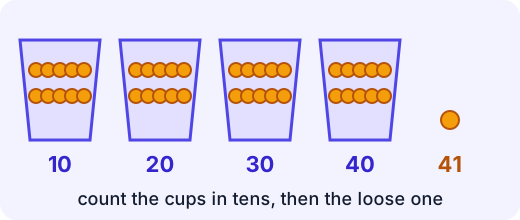
Try it: Count these stars in tens, then in ones.
⭐⭐⭐⭐⭐⭐⭐⭐⭐⭐ ⭐⭐⭐⭐⭐⭐⭐⭐⭐⭐ ⭐⭐⭐
Ten, twenty, twenty-one, twenty-two, twenty-three. There are 23 stars.
Counting in twos and fives
You can also count in twos (2, 4, 6, 8, 10…) and in fives (5, 10, 15, 20…). Counting socks? Count in twos. Counting fingers? Count in fives.
Reading and writing numbers
The number 47 has two digits. The 4 tells you how many tens, and the 7 tells you how many ones. You say it "forty-seven".
For the grown-up helping
At this age, counting real objects matters more than reciting numbers. Watch for one touch per number and for knowing that the last number said is the total. Count together every day: stairs, spoons, cars that pass. When your child is ready, do the Count the room activity next.
Activity
Count the room
Your child counts a big pile of real objects, first one by one and then in tens. It takes about 20 minutes.
You'll need
- 40 to 100 small objects of one kind (dried beans, buttons, pasta shapes, bottle caps)
- 10 small cups or bowls
- Paper and a pencil
Steps
- Pour the objects into one big pile. Ask "How many do you think there are?" and write the guess down.
- Your child counts the pile one by one, moving each object to a new pile as they say its number.
- Now they put the objects into cups of ten. Leftovers stay on the table.
- Count the cups together in tens ("ten, twenty, thirty…"), then count on with the leftovers.
- Compare the two counts and the guess. If the counts differ, ask "Why might that be?" and count again together.
- Your child writes the final number on the paper, and says it aloud.
Safety
- Small objects are a choking hazard for babies and toddlers. Keep them out of reach of younger children.
Keeping a log of the activity is for registered learners. Register to do this.
Quick check
Counting check
Seven quick questions. Read them aloud together if that helps.
1.How many apples? 🍎🍎🍎🍎🍎🍎🍎🍎🍎🍎 🍎🍎🍎🍎
Answer with a number
2.What number comes just after 39?
Answer with a number
3.Counting in tens: 10, 20, 30, __. What comes next?
- 31
- 40
- 300
Choose one
4.Which number is forty-seven?
- 74
- 47
- 407
Choose one
5.Which of these do you say when you count in fives? Pick all that are right.
- 15
- 12
- 25
- 33
Choose all that apply
6.Put these numbers in counting order, starting with the smallest.
- 57
- 59
- 58
- 56
Put these in order
7.Match each number to its name.
- 20
- 12
- 60
Match each to: twenty · sixty · twelve
Answering and checking are for registered learners. Register to do this.
Quick check
New puzzles
Counting helps in lots of places. Try these.
1.There are 8 pairs of socks on the washing line. How many socks is that? Count in twos.
Answer with a number
2.Six children hold up both hands. Count the fingers in fives. How many fingers?
Answer with a number
3.A book's pages go 68, 69, __, 71. What page is missing?
Answer with a number
Answering and checking are for registered learners. Register to do this.
Activity
How do you know?
Your child explains why counting in tens gives the same answer as counting in ones. Two minutes.
Steps
- Put 23 small things in two groups of ten and three loose ones.
- Ask "If we count these one by one, will we get the same number as counting in tens? Why?"
- Let them try both ways. Then ask them to tell you what they found.
- Write down what your child says, in their words.
Keeping a log of the activity is for registered learners. Register to do this.
Like what you see?
Register for free to answer the quick checks, do the activities and save your work. Your work is saved on your device and syncs to your account.