Unit 2
Tens and ones
Bundle things into tens, and find out why the 3 in 35 is worth thirty.
Read
Where a digit sits
Meena is helping her grandfather sell sticks of sugarcane at the market. A customer asks for thirty-five sticks.
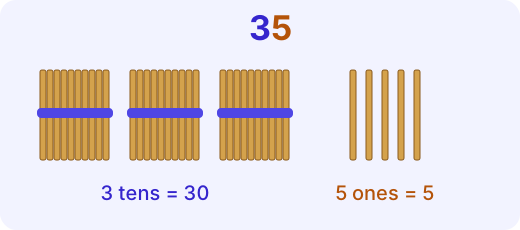
Counting thirty-five sticks one by one is slow. So Grandfather ties the sticks into bundles of ten with a string. Three bundles and five loose sticks: that's thirty-five.

A bundle is one ten
When you tie ten ones together, you get one ten. It's still ten sticks; you just carry and count them as one bundle.
Bundles of ten Loose sticks How many? We write 3 5 thirty-five 35 5 3 fifty-three 53 4 0 forty 40 The place tells the value
Look at 35 and 53. They use the same digits, 3 and 5, but they are different numbers!
- In 35, the 3 is on the left, in the tens place. It means 3 bundles: thirty.
- In 53, the 3 is on the right, in the ones place. It means 3 loose sticks: three.
So a digit's value depends on where it sits. The left digit counts tens. The right digit counts ones.
What about zero?
Forty is written 40. The 0 says "no loose sticks". Without it, 40 would look like 4, and that's only four sticks!
For the grown-up helping
Use real things your child can bundle: sticks, straws, pencils with a rubber band. Say numbers both ways: "35 is 3 tens and 5 ones" and "3 tens and 5 ones make 35". Mixing up 35 and 53 is normal at this age; bundling real objects is the fix, not more worksheets.
Lab
The bundle machine
Make the number on the order card with bundles of ten and loose sticks. When you have ten loose sticks, tie them into a bundle.
Your goals
- Fill five orders by making each number with bundles and loose sticks.
- Use the fewest pieces you can (tie every ten loose sticks into a bundle).
The interactive lab opens once you register. Register to do this.
Activity
Bundle and build
Your child bundles real sticks into tens and builds two-digit numbers you call out. About 15 minutes.
You'll need
- About 60 sticks, straws or pencils
- Rubber bands or string
- Paper and a pencil
Steps
- Together, count out ten sticks and tie them with a rubber band. Say "ten ones make one ten."
- Your child makes four more bundles of ten.
- Call out a number, such as 34. Your child builds it with bundles and loose sticks, then writes it.
- Do five numbers, including one with a 0 (like 40) and a pair that swap digits (like 25 and 52).
- For the swapped pair, ask "Same digits, so why are they different?" Listen to the answer.
Safety
- Keep rubber bands away from babies and toddlers.
Keeping a log of the activity is for registered learners. Register to do this.
Quick check
Tens and ones check
Six questions. Look at the pictures carefully.
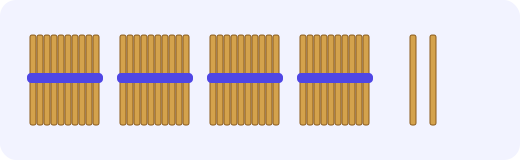
1.How many sticks are there in all?
Answer with a number
2.How many tens are in 68?
Answer with a number
3.In the number 73, what is the 7 worth?
- 7
- 70
- 3
Choose one
4.Which one shows 25?
- 2 bundles of ten and 5 loose sticks
- 5 bundles of ten and 2 loose sticks
- 25 bundles of ten
Choose one
5.9 tens and 0 ones make which number?
Answer with a number
6.Match each number to its tens and ones.
- 46
- 64
- 60
Match each to: 4 tens and 6 ones · 6 tens and 0 ones · 6 tens and 4 ones
Answering and checking are for registered learners. Register to do this.
Quick check
New puzzles
Tens and ones show up in new places. Can you use what you know?
1.Eggs come in trays of 10. Amma has 3 full trays and 7 eggs in a bowl. How many eggs does she have?
Answer with a number
2.Rohan has some ₹10 coins and some ₹1 coins. He has ₹52 in all, using as few coins as possible. How many ₹10 coins does he have?
Answer with a number
3.Lila's number has 8 ones and 2 tens. Sam says her number is 82. Is Sam right?
- Yes, it is 82
- No, it is 28
- No, it is 10
Choose one
4.Which number has more tens, 49 or 51?
- 49
- 51
- They have the same number of tens
Choose one
Answering and checking are for registered learners. Register to do this.
Activity
Tell it back
Your child explains, in their own words, why 35 and 53 are different numbers. Two minutes.
Steps
- Write 35 and 53 on paper. Ask "Are these the same number? How do you know?"
- Let your child use sticks if they want. Don't give the answer; ask "What does the 3 mean here? And here?"
- Write down what your child says, in their words.
Keeping a log of the activity is for registered learners. Register to do this.
Like what you see?
Register for free to answer the quick checks, do the activities and save your work. Your work is saved on your device and syncs to your account.