Unit 11
Measuring length
Find out which is longer, and measure it with paper clips or cubes so everyone gets the same answer.
Read
How long is it?
Kabir and Noor are flying kites on the roof. Kabir says, "My string is longer!" Noor says, "No, mine is longer!"
How can they find out? They could argue all day. Or they could measure.
Longer and shorter
To compare two things, put them side by side. Make them start at the same line. Then you can see which one sticks out further.
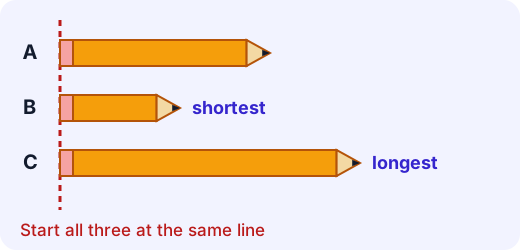
- The pencil that reaches furthest is the longest.
- The pencil that stops soonest is the shortest.
- Pencil A is longer than B but shorter than C.
Try it: Find three things at home: a spoon, a pencil and a book. Line them up at the edge of the table. Which is longest? Which is shortest?
Measuring means counting units
Sometimes you cannot put two things side by side. Maybe one is on the roof and one is in the kitchen. Then you need a unit: a small thing that is always the same size, like a paper clip, a cube or a hand span.
To measure, lay the units along the object, one after another, and count them. That is all measuring is: counting equal units.
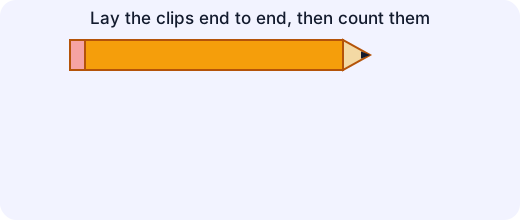
Example. Noor lays paper clips along her pencil. She counts 6. So her pencil is 6 paper clips long.
Always say the unit! "6" is not enough. Six clips is very different from six giraffes.
Do it carefully
Measuring only works if you measure the same way every time:
- Start at one end of the thing you are measuring.
- Put the units end to end, touching.
- Leave no gaps and let nothing overlap.
- Use units that are all the same size.
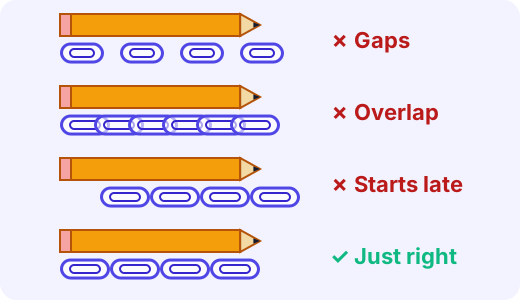
If there are gaps, you count too few. If the clips overlap, you count too many. Either way, someone else would get a different answer.
Different units, different numbers
Example. Noor's pencil is 6 paper clips long. Suppose the cubes are bigger than the paper clips. Then the same pencil might be only 4 cubes long. Both are true! The pencil did not change. The unit changed.
This is why people agree to use the same units, like centimetres. You will meet those later. For now, remember: a bigger unit means you need fewer of them.
A common mistake is to think the bigger number always means the longer thing. It only means that when both things were measured with the same unit. Noor's 9 hand spans might be shorter than her father's 6 hand spans, because his hand is bigger.
For the grown-up helping
Use things your child can touch: paper clips, cubes, blocks or buttons in a row. Let them make the common mistakes on purpose (a gap, an overlap) and see why the count changes. Ask "How do you know?" more than "What's the answer?". If your child leaves gaps or starts from the wrong end, that is normal; we use real units before rulers.
Lab
Clips and cubes
Measure two ribbons with paper clips, then with cubes. Lay the units end to end with no gaps, and count them. Watch what happens to the number when the unit changes.
Your goals
- Measure the red and the blue ribbon with paper clips, laying them end to end to the end of the ribbon.
- Measure the same two ribbons with cubes.
- Say why the same ribbon gave a smaller number with cubes.
The interactive lab opens once you register. Register to do this.
Activity
Measuring hunt
Your child measures five things around the home with small units, then puts them in order from shortest to longest. About 20 minutes.
You'll need
- About 20 identical small things, such as paper clips, cubes, buttons or coins of the same kind
- Five things to measure, such as a spoon, a pencil, a shoe, a book and a toothbrush
- Paper and a pencil
Steps
- Show your child how to measure the pencil. Start at one end, place units end to end with no gaps and no overlaps, then count. Write "pencil, 8 clips".
- Your child measures the other four things the same way and writes each one down with its unit.
- Ask them to put the five things in order from shortest to longest. Check using the numbers, then check by lining things up side by side.
- Now measure one thing with a different unit, for example hand spans. Ask "Why is the number different now?"
- Play "Oops". You measure something with a gap or an overlap. Ask your child to spot the mistake and fix it.
Safety
- Keep small units such as buttons and coins away from babies and toddlers, who may put them in their mouths.
Keeping a log of the activity is for registered learners. Register to do this.
Quick check
Length check
Six questions about longer, shorter and measuring with units.
1.How many paper clips long is the pencil?
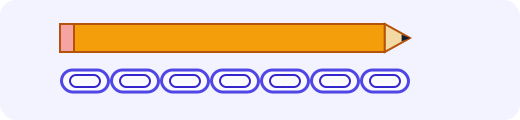
Answer with a number
2.Which ribbon is the longest?
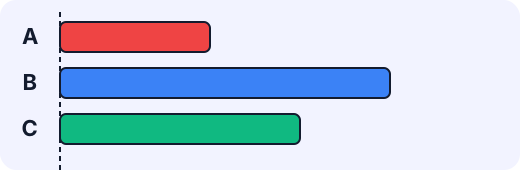
- Ribbon A
- Ribbon B
- Ribbon C
Choose one
3.Which crayon is measured the right way?
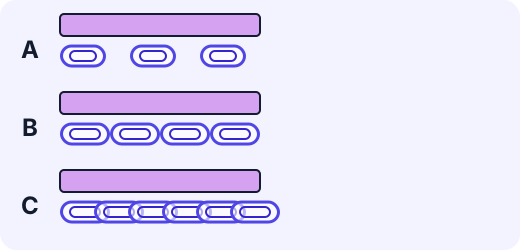
- A
- B
- C
Choose one
4.Put these cube snakes in order from shortest to longest.
- A snake 4 cubes long
- A snake 9 cubes long
- A snake 6 cubes long
Put these in order
5.Aarav measured his book with paper clips and got 8. Mira measured the same book with cubes and got 5. Can they both be right?
- No, one of them counted wrong
- Yes, because they used different units
- No, the book changed size
Choose one
6.Which of these help you measure well? Pick all that apply.
- Start at one end of the thing
- Leave small gaps so the units fit
- Use units that are all the same size
- Let the units overlap a little
- Put the units end to end, touching
Choose all that apply
Answering and checking are for registered learners. Register to do this.
Quick check
New puzzles
Measuring shows up in new places. Use what you know.
1.A ribbon is 12 paper clips long. A rope is 5 paper clips longer than the ribbon. How many paper clips long is the rope?
Answer with a number
2.Dev's pencil is 8 cubes long and his eraser is 3 cubes long. How many cubes longer is the pencil than the eraser?
Answer with a number
3.Meera measured a bench with her hand spans and got 9. Her father measured the same bench with his hand spans and got 6. Whose hand span is longer?
- Meera's
- Her father's
- They are the same
Choose one
4.Two small clips fit exactly along one big clip. A string is 4 big clips long. How many small clips long is the same string?
Answer with a number
Answering and checking are for registered learners. Register to do this.
Activity
Tell it back
Your child explains, in their own words, how to measure something so that anyone gets the same answer. Three minutes.
You'll need
- A pencil or spoon
- Some paper clips or cubes
Steps
- Ask "How would you find out how long this pencil is?" Let your child show you with the units.
- Ask "What goes wrong if I leave gaps between the clips?" and "What if they overlap?"
- Ask "If I measure with cubes and you measure with clips, why might we get different numbers?"
- Write down what your child says, in their words.
Keeping a log of the activity is for registered learners. Register to do this.
Like what you see?
Register for free to answer the quick checks, do the activities and save your work. Your work is saved on your device and syncs to your account.