Unit 12
Time and the calendar
Read a clock at the hour and half hour, and find your way around the days, weeks and months of a calendar.
Read
Clocks and calendars go round and round
Every morning, Priya's school bus comes at the same time. Every Sunday, her family goes to the market. Every year, her birthday comes back. Time keeps going round in cycles that repeat. Clocks and calendars help us keep track of them.
The clock has two hands
A clock face shows the numbers 1 to 12. It has two hands:
- The short, thick hand is the hour hand. It tells us the hour.
- The long, thin hand is the minute hand. It tells us how far into the hour we are.
O'clock
When the long hand points straight up, to the 12, it is exactly the hour. We say o'clock. Then the short hand tells us which hour.
Half past
When the long hand points straight down, to the 6, half the hour has gone. We say half past. A half is one of two equal parts, so half an hour is half of the way round the clock.
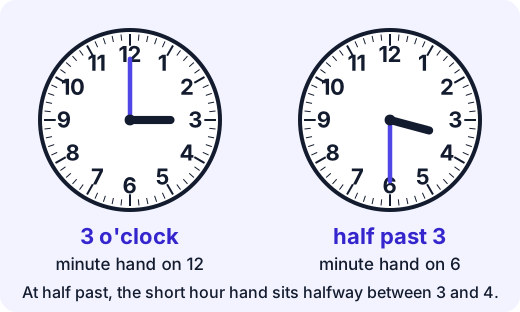
Example. Look at the second clock. The long hand is on 6, so it is half past something. The short hand is between 3 and 4. It has already passed the 3 but has not reached the 4. So it is half past 3.
Try it: Say the time on the clock you have at home. Is the long hand on 12, on 6, or somewhere else?
One hour is one trip round
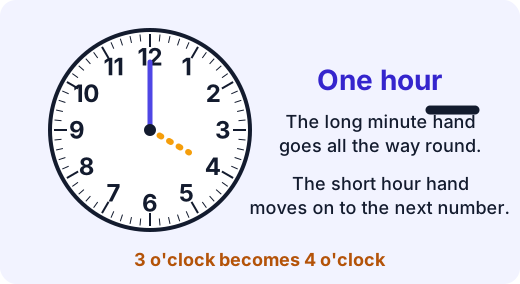
When the long hand goes all the way round the clock, one hour has passed. At the same time, the short hand moves on to the next number. So 3 o'clock becomes 4 o'clock.
A common mix-up is saying "half past 8" for a clock where the short hand is between 7 and 8. Remember: the hour hand has not reached the 8 yet, so the hour is still 7. It is half past 7.
Days and weeks
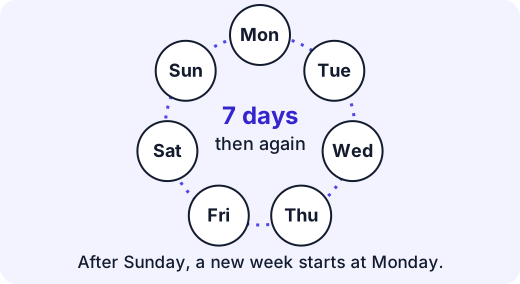
A week has 7 days. They always come in the same order:
Monday, Tuesday, Wednesday, Thursday, Friday, Saturday, Sunday
After Sunday, the next day is Monday again. The week goes round and round. (Some calendars start the week on Sunday, others on Monday. The order is the same.)
Months and the year
A year has 12 months:
January, February, March, April, May, June, July, August, September, October, November, December
After December comes January of the new year. Another cycle!
Reading a calendar
A calendar page shows one month. Each row is one week, and each column is one day of the week.
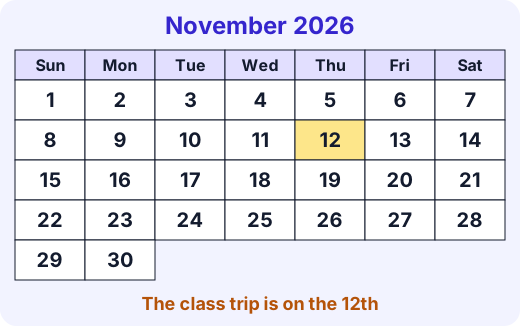
Example. Find the 12th. Go up its column to the top: it says Thu. So the class trip is on a Thursday. To find the date one week later, go down one row: the 19th.
For the grown-up helping
Use a real clock with moving hands (a toy one is fine) and your own wall calendar. Say the time out loud during the day: "It's 5 o'clock, time for the park." Let your child cross off each day on the calendar and say the day's name. Children this age often confuse the two hands. A helpful clue is that the short hand moves slowly and the long hand moves fast. Digital clocks come later, so there is no need to hurry.
Lab
The clock setter
Set the clock hands to the time you are given, then read clocks that are already set. Watch where the short hand goes at half past.
Your goals
- Set the clock to four times, o'clock and half past, using the hour and the long hand.
- Read four clocks and pick the right time.
The interactive lab opens once you register. Register to do this.
Activity
My day and my calendar
Your child matches three things in their day to clock times, and finds dates on a real calendar. About 20 minutes.
You'll need
- A clock with moving hands (a toy one is fine)
- A wall or paper calendar for this month
- Paper and a pencil
Steps
- Pick three things your child does every day, such as waking up, eating lunch and going to bed. Ask "What time do you do this?" Together, set the clock hands to each time at the hour or half hour. If the real time is not on the hour or half hour, pick the closest one.
- Your child draws or writes each thing with its time, for example "Lunch, half past 1".
- Open the calendar. Ask your child to find today's date, say the day of the week, and name the month.
- Ask "What day is it tomorrow? What day was it yesterday?" and "How many days are in a week?"
- Find a special day coming up, such as a birthday or festival. Your child puts a mark on it and counts how many days to go, one box at a time.
Keeping a log of the activity is for registered learners. Register to do this.
Quick check
Time check
Six questions about clocks, days and months. Look at the pictures carefully.
1.What time does this clock show?
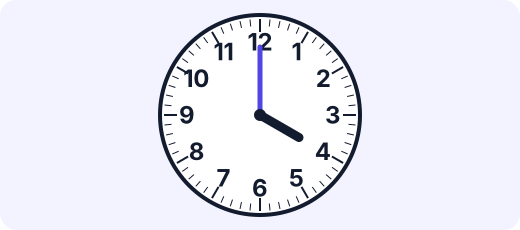
- 4 o'clock
- 12 o'clock
- Half past 4
Choose one
2.What time does this clock show?
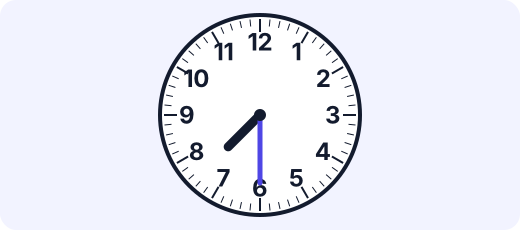
- 7 o'clock
- Half past 7
- Half past 8
- 6 o'clock
Choose one
3.How many days are in one week?
Answer with a number
4.Which day comes right after Saturday?
Answer with a word or phrase
5.How many months are in one year?
Answer with a number
6.On this calendar, which day of the week is the 12th?
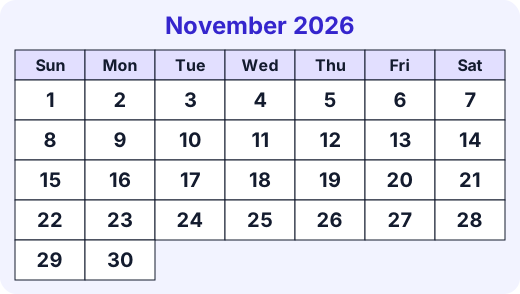
Answer with a word or phrase
Answering and checking are for registered learners. Register to do this.
Quick check
New puzzles
Time shows up in new places. Use what you know about clocks and calendars.
1.School starts at 8 o'clock. The break bell rings one hour later. At what o'clock does the bell ring?
Answer with a number
2.Lunch is at half past 12. Where is the long hand pointing?
- At the 12
- At the 6
- At the 1
Choose one
3.Today is Friday. What day will it be in 3 days?
Answer with a word or phrase
4.Tomorrow is Thursday. What day was yesterday?
Answer with a word or phrase
Answering and checking are for registered learners. Register to do this.
Activity
Tell it back
Your child explains, in their own words, how a clock or a calendar repeats. Three minutes.
You'll need
- A clock with moving hands, or draw one
- A calendar
Steps
- Set the clock to 6 o'clock. Ask "How do I know it is exactly 6 o'clock?" Then set it to half past 6 and ask "What changed?"
- Ask "What happens after Sunday?" and "What happens after December?"
- Ask "Why do we need clocks and calendars?"
- Write down what your child says, in their words.
Keeping a log of the activity is for registered learners. Register to do this.
Like what you see?
Register for free to answer the quick checks, do the activities and save your work. Your work is saved on your device and syncs to your account.