Unit 13
Money
Know your coins and notes, make the same amount in different ways, and work out change from ten rupees.
Read
Coins, notes and change
Rani goes to the shop to buy a pencil box. It costs ₹6. In her hand she has two coins. Will she have enough? To find out, she needs to know what each coin is worth.
In India, money is counted in rupees. We write the rupee sign like this: ₹. So "₹6" means six rupees.
Coins and notes
Here are the coins and notes you will meet most often:
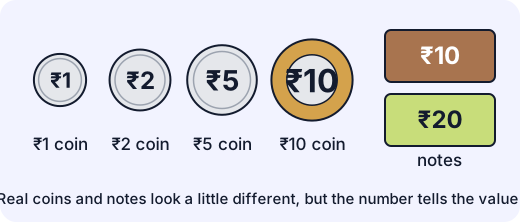
Money Worth ₹1 coin 1 rupee ₹2 coin 2 rupees ₹5 coin 5 rupees ₹10 coin or note 10 rupees ₹20 note 20 rupees The number on the coin tells you its value. A big coin is not always worth more! Look at the number, not the size.
A common mistake: thinking that more coins always means more money. Three ₹1 coins make only ₹3, but one ₹5 coin makes ₹5. One coin can be worth more than three.
Many ways to make the same amount
How can you make ₹10? Lots of ways!
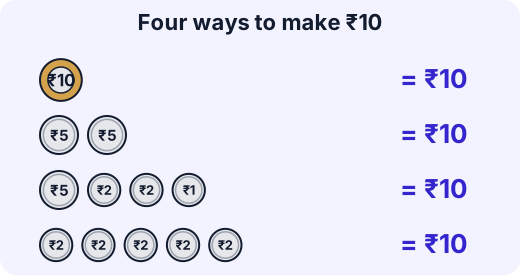
Example. Make ₹7. One way: ₹5 + ₹2 = ₹7. Another way: ₹2 + ₹2 + ₹2 + ₹1 = ₹7. Check: 2 + 2 + 2 is 6, and 6 + 1 is 7. Both ways make ₹7. Different coins, same amount!
Try it: Make ₹9 in two different ways. (Hint: one way uses a ₹5 coin.)
To add coins, start with the biggest and count on. For a ₹5, a ₹2 and a ₹1 coin, say "5, then 7, then 8". That makes ₹8.
Giving change
Sometimes you pay with more money than the thing costs. The shopkeeper gives some back. That is change.
Rani pays with a ₹10 note for the ₹6 pencil box. How much change should she get? Start at 6 and count up to 10. That is 4 hops, so her change is ₹4.
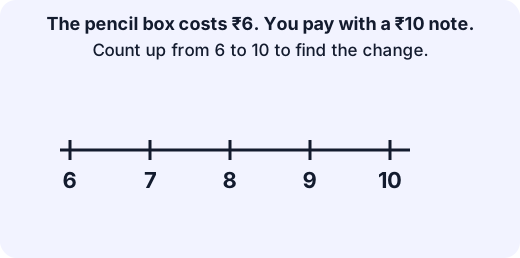
We can also write it as a take-away: 10 − 6 = 4. Both ways give ₹4. The shopkeeper could give her a ₹2 coin and two ₹1 coins, or two ₹2 coins: always ₹4 in all.
Example. A toffee costs ₹3. You pay ₹10. Count up from 3: that is 7 hops, so the change is ₹7. A ₹5 coin and a ₹2 coin make ₹7.
Where you live, coins and notes may have other names and pictures. The ideas are the same: each one has a value, many sets can make the same amount, and change is what's left after you pay.
For the grown-up helping
Real coins are best. Let your child sort them, name them and count them, and play shop with price tags up to ₹20. Use the words "worth", "cost" and "change". It's normal to think a bigger coin must be worth more; sorting coins by value, not size, helps. Take care with small coins around babies and toddlers.
Lab
The coin shop
Put coins in the tray to make an amount in two different ways, then give change from a ten rupee note.
Your goals
- Make three amounts, each in two different ways.
- Give the right change from a ten rupee note three times.
The interactive lab opens once you register. Register to do this.
Activity
Play shop
Your child plays shopkeeper and customer with real coins and price tags up to ten rupees. About 20 minutes.
You'll need
- Real coins (₹1, ₹2, ₹5 and ₹10) or card copies
- Five small things from home to sell, such as a spoon, a toy, a book, a cup and a ball
- Sticky notes or paper for price tags
- Paper and a pencil
Steps
- Together, sort the coins by value and say each one aloud. Ask "Which is worth the most? Which is worth the least?"
- Your child writes a price tag from ₹2 to ₹9 for each thing.
- You are the customer. Ask for one thing and pay the exact price, using any coins. Your child checks that it is right by adding. Then pay again for another thing using different coins.
- Now pay with a ₹10 coin. Your child gives you the change in coins and says how they worked it out ("6 and 4 more makes 10").
- Swap roles. Your child pays and you give change, making one mistake on purpose. Can your child catch it?
Safety
- Keep coins away from babies and toddlers, who may put them in their mouths.
Keeping a log of the activity is for registered learners. Register to do this.
Quick check
Money check
Six questions about coins, amounts and change. Prices are in rupees (₹).
1.How many rupees are these coins worth in all?

Answer with a number
2.Which coins make ₹7?
- ₹5 and ₹2
- ₹5 and ₹1
- ₹2, ₹2 and ₹2
- ₹5 and ₹5
Choose one
3.Which sets of coins make ₹10? Pick all that apply.
- ₹5 + ₹5
- ₹5 + ₹2 + ₹2 + ₹1
- ₹5 + ₹2 + ₹2
- ₹2 + ₹2 + ₹2 + ₹2 + ₹2
- ₹5 + ₹2 + ₹1
Choose all that apply
4.Ravi pays ₹10 for a pencil that costs ₹6. How many rupees of change should he get?
Answer with a number
5.Which is worth more?
- One ₹5 coin
- Three ₹1 coins
- They are worth the same
Choose one
6.Match each set of coins to its total.
- ₹10 + ₹5 + ₹1
- ₹10 + ₹5 + ₹2
- ₹10 + ₹2 + ₹1
Match each to: ₹17 · ₹13 · ₹16
Answering and checking are for registered learners. Register to do this.
Quick check
New puzzles
Money shows up in new places. Use what you know about coins and change.
1.Sneha has two ₹5 coins. A toy costs ₹12. How many more rupees does she need?
Answer with a number
2.You have lots of ₹1, ₹2, ₹5 and ₹10 coins. What is the fewest number of coins that make ₹9?
Answer with a number
3.A ₹7 eraser is paid for with a ₹10 note. Which coins are the right change?
- ₹2 and ₹1
- ₹2 and ₹2
- A ₹5 coin
Choose one
4.Kiran has a ₹5 coin, a ₹2 coin and a ₹1 coin. Dev has four ₹2 coins. Who has more money?
- Kiran
- Dev
- They have the same
Choose one
Answering and checking are for registered learners. Register to do this.
Activity
Tell it back
Your child explains, in their own words, how different coins can make the same amount. Three minutes.
You'll need
- A few real coins (₹1, ₹2, ₹5)
Steps
- Put out a ₹5 coin. Ask "Can you make the same amount with different coins?" Let your child try.
- Ask "Is it true that more coins always means more money? Show me."
- Ask "How do you know how much change you get from ten rupees?"
- Write down what your child says, in their words.
Keeping a log of the activity is for registered learners. Register to do this.
Like what you see?
Register for free to answer the quick checks, do the activities and save your work. Your work is saved on your device and syncs to your account.