Unit 1
Hundreds, tens and ones
Ten tens make a hundred. Use it to read, write, compare and take apart numbers up to 1000.
Read
Ten tens make a hundred
Farida helps in her aunt's stationery shop in Pune. Pencils come in a box of 10. When ten boxes are packed together, they go into a big carton. "That's one hundred pencils in one carton," says Aunty.
Today Farida must count the pencils on the shelf: 3 cartons, 4 boxes and 6 loose pencils. She doesn't count them one by one. She counts hundreds, then tens, then ones.
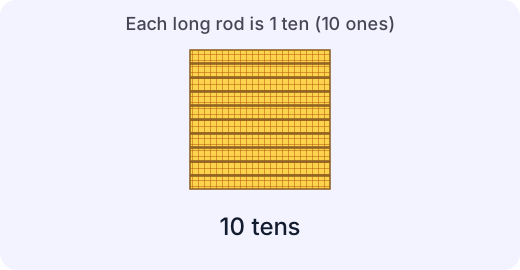
Ten tens make a hundred
You already know that ten ones make one ten. Now there is a bigger bundle:
- 10 ones make 1 ten
- 10 tens make 1 hundred
So 1 hundred is the same as 100 ones. In a drawing we show a hundred as a flat square, a ten as a long rod and a one as a small cube.
Three digits, three places
Farida has 3 hundreds, 4 tens and 6 ones. That is the number 346, which we say as "three hundred and forty-six".
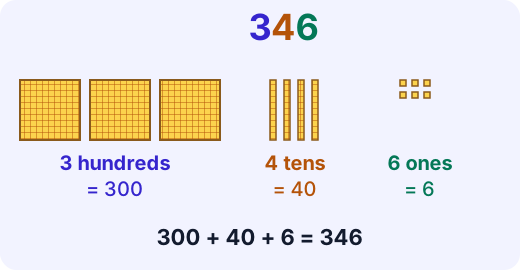
Hundreds Tens Ones 3 4 6 Each digit has a place, and the place tells you what the digit is worth. In 346 the 3 is worth 300, the 4 is worth 40 and the 6 is worth 6.
Expanded form
Taking a number apart by its places is called expanded form:
Example. Write 205 in expanded form. There are 2 hundreds, 0 tens and 5 ones, so , or just .
That 0 matters. It holds the tens place and says "no tens". Without it, 205 would look like 25, a much smaller number!
Try it: What number is ? (Check: 7 hundreds, 3 tens, 9 ones.)
Comparing numbers
To find which number is bigger, start on the left, with the hundreds.
Example. Compare 298 and 312. Hundreds: 2 and 3. Since 2 hundreds is less than 3 hundreds, 298 is less than 312. You can stop. The tens and ones don't matter.
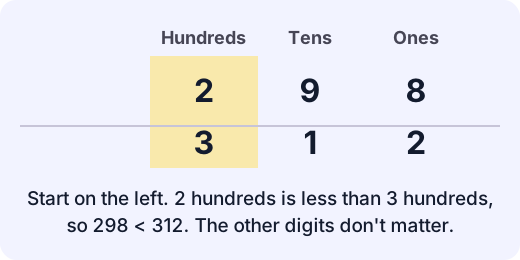
If the hundreds are the same, look at the tens. If those are the same too, look at the ones.
Example. Compare 452 and 457. Hundreds are the same (4). Tens are the same (5). Ones: 2 and 7. So 452 is less than 457.
We write this with symbols. The open mouth faces the bigger number:
- means "298 is less than 312"
- means "312 is greater than 298"
- means "equal"
A common mistake: "298 has a 9 and an 8, big digits, so it's bigger." The size of a digit is not what counts. The place counts first. A hundred is worth much more than any pile of tens and ones that is less than a hundred.
For the grown-up helping
Use real things in tens and hundreds: dried beans in cups, paper clips in rows, coins. Ask "How many hundreds? How many tens? How many ones?" before reading the number out. Let your child build a number, then change one digit and say what changed. Writing 205 as 25, or 300 + 4 as 34, is a very common slip at this age; it goes away when children build the number with blocks and see the empty tens place.
Lab
The block builder
Fill six orders with hundreds, tens and ones blocks. When you have ten of one kind, trade them for one block of the next kind.
Your goals
- Fill six orders by building each number with hundreds, tens and ones.
- Trade ten ones for a ten, and ten tens for a hundred, so that no place has more than nine blocks.
The interactive lab opens once you register. Register to do this.
Activity
Make a hundred
Your child makes a hundred out of ten tens with real things, then builds three-digit numbers that you call out. About 20 minutes.
You'll need
- About 150 small things to count, such as paper clips, pebbles, buttons or dried beans
- Ten small cups or bowls
- Five paper squares, each with 100 written on it
- One big tray or sheet of paper
- Paper and a pencil
Steps
- Your child counts out ten things into a cup. Do this ten times, so there are ten cups with ten in each.
- Say "Ten tens". Then pour all ten cups onto the big tray together and say "That's one hundred." Count the pile in tens to check. Then put the things back into the cups. One paper square marked 100 now stands for a whole pile of one hundred.
- Call out 243. Your child builds it with 2 paper squares marked 100, 4 cups of ten and 3 loose things, then writes the number.
- Do the same with 305 and 460. For 305, ask "How many tens are there? How do you write that?"
- Write 258 and 285 on paper. Your child builds both and says which is greater and how they know.
- Finally, change one digit in a number your child has built (for example 243 to 343) and ask "What did you change? How much bigger is it now?"
Safety
- Small things are choking hazards for babies and toddlers. Keep them away from little ones, and never put them in mouths.
- Don't eat the dried beans; they are not for eating raw.
Keeping a log of the activity is for registered learners. Register to do this.
Quick check
Hundreds, tens and ones check
Seven questions about hundreds, tens and ones. Take your time with the picture.
1.What number do these blocks show?
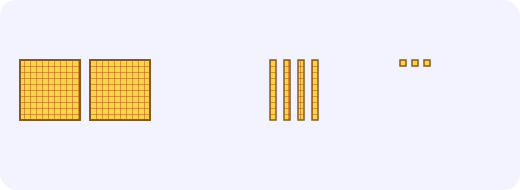
Answer with a number
2.In the number 538, what is the digit 3 worth?
Answer with a number
3.Ten tens are the same as how many ones?
Answer with a number
4.Which number is greater?
- 298
- 312
- They are equal
Choose one
5.Which makes this true? 405 ___ 450
- 405 < 450
- 405 > 450
- 405 = 450
Choose one
6.Put these numbers in order, from least to greatest.
- 502
- 520
- 205
- 250
Put these in order
7.Match each expanded form to its number.
- 400 + 30 + 5
- 400 + 50 + 3
- 300 + 40
Match each to: 340 · 453 · 435
Answering and checking are for registered learners. Register to do this.
Quick check
New puzzles
Hundreds, tens and ones turn up in new places. Use what you know.
1.A shop packs 10 pencils in a box and 10 boxes in a carton. It has 2 cartons, 13 boxes and 4 loose pencils. How many pencils is that in all?
Answer with a number
2.Use the digits 4, 0 and 7 once each to make the smallest three-digit number you can.
Answer with a number
3.Use the digits 3, 9 and 5 once each to make the greatest number you can.
Answer with a number
4.Anita says "99 is greater than 101, because 9 is bigger than 1." Is she right?
- Yes, 9 is bigger than 1
- No, 101 has a hundred and 99 does not
- No, they are equal
Choose one
5.How many tens are there in 230?
Answer with a number
Answering and checking are for registered learners. Register to do this.
Activity
Tell it back
Your child explains, in their own words, why ten tens make a hundred and how they know which of two numbers is bigger. About five minutes.
Steps
- Write 298 and 312 on paper. Ask "Which is greater? How do you know?" Don't say whether they are right until they have explained.
- Ask "Why does a ten need ten ones? And a hundred needs how many tens?" Let your child use things or blocks if they want.
- Ask "If I write 205 as 25, what goes wrong?" Write down what your child says in their own words.
Keeping a log of the activity is for registered learners. Register to do this.
Like what you see?
Register for free to answer the quick checks, do the activities and save your work. Your work is saved on your device and syncs to your account.