Unit 2
Skip counting, even and odd
Count in 2s, 5s, 10s and 100s, and find out why some numbers pair up and others have one left over.
Read
Hops, pairs and patterns
Imran has a jar of ₹5 coins. "How much money is that?" asks his sister Noor. Imran starts to count: "One, two, three..." Noor laughs. "That counts coins. I want to know how many rupees. Count the way a shopkeeper does!"
So Imran counts each coin as five: "Five, ten, fifteen, twenty..." This is skip counting. Instead of one at a time, you skip ahead by the same amount each time.
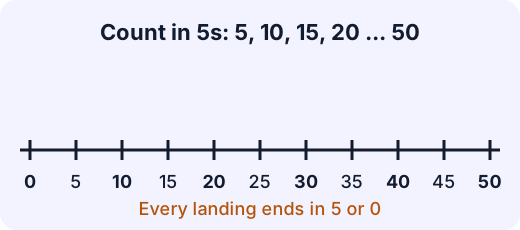
Counting in 2s, 5s, 10s and 100s
Each hop is the same size. Only the size of the hop changes.
Count in What you say 2s 2, 4, 6, 8, 10, 12, 14, 16, 18, 20 5s 5, 10, 15, 20, 25, 30, 35, 40, 45, 50 10s 10, 20, 30, 40, 50, 60, 70, 80, 90, 100 100s 100, 200, 300, 400, 500, 600, 700, 800, 900, 1000 You don't have to start at zero. Count in 10s from 34: 34, 44, 54, 64, 74. Look at the pattern: the ones digit stays 4, and only the tens digit grows. Count in 100s from 250: 250, 350, 450, 550. Now only the hundreds digit grows.
Try it: Count in 5s from 15 up to 60. Which numbers end in 5, and which end in 0?
Skip counting is a fast way to count a big pile. Count shoes in 2s (a pair is 2), fingers on a few hands in 5s, and coins or notes of ten in 10s.
Even and odd
Imran has 8 mangoes and wants to share them fairly between himself and Noor. He puts them in pairs: 4 pairs, nothing left over. Each child gets 4. Eight is an even number.
Then he finds 7 guavas. He makes 3 pairs, and one is left over. Seven is an odd number.
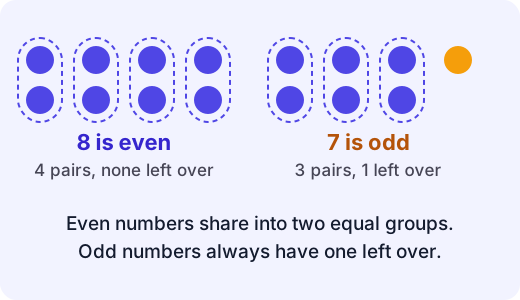
- An even number can be split into two equal groups, or made of pairs with none left over.
- An odd number always has one left over.
When you count in 2s from 0, you say only even numbers: 2, 4, 6, 8... If you count in 2s from 1, you say only odd numbers: 1, 3, 5, 7...
A fast way to tell
For big numbers you don't need to make pairs. Look at the ones digit only.
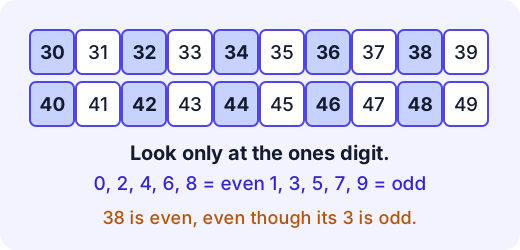
If the ones digit is 0, 2, 4, 6 or 8, the number is even. If it is 1, 3, 5, 7 or 9, it is odd.
Example. Is 38 even or odd? The ones digit is 8, so it is even. Check: 38 is 3 tens and 8 ones. Every ten is five pairs, so the tens always make pairs. The 8 ones make 4 pairs. Nothing is left over.
A common mistake: "38 has a 3 in it, and 3 is odd, so 38 is odd." The tens digit does not matter, because tens can always be split into pairs. Only the ones digit decides.
For the grown-up helping
Skip count with real things: shoes, socks, coins, stairs. Let your child touch each thing as you count, then say the pattern together in a rhythm. Chant the 5s and 10s with a clap. For even and odd, let your child pair real objects up and see the lonely one for themselves; do not just give the "last digit" rule until they have seen why it works. Losing the pattern after 50 or 100 is normal; going back to 10s and 100s on a number line helps.
Lab
Hops and pairs
Hop along the number chart in 2s, 5s and 10s, then sort eight numbers into even and odd by looking at their pairs.
Your goals
- Skip count in 2s, 5s and 10s on the chart without missing a number.
- Decide whether each of eight numbers is even or odd, and see why.
The interactive lab opens once you register. Register to do this.
Activity
Pairs and hops at home
Your child counts a pile of things by skipping, then finds out which piles can be paired up with none left over. About 20 minutes.
You'll need
- A pile of about 30 small things, such as spoons, pebbles, buttons or coins
- Pairs of shoes or socks from around the house
- Paper and a pencil
Steps
- Line up 5 pairs of shoes or socks. Your child counts the shoes in 2s, touching each pair, and writes the numbers they say.
- Put out 10 coins or buttons in groups of 5. Count them in 5s. Then make groups of 10 from the pile and count in 10s.
- Make a small pile (any number up to 20) and ask your child to put the things in pairs. Is anything left over? Write the number and "even" or "odd".
- Do this for four piles of different sizes. Make at least two odd and two even piles.
- Now write 38, 41, 56 and 73. Ask your child to predict "even" or "odd" before making the pairs. Check with real things if you have enough, or by thinking about the ones digit.
- Ask "How can you tell without making pairs?" Listen for the ones digit.
Safety
- Small things are choking hazards for babies and toddlers. Keep them away from little ones.
- Only use coins that are clean, and do not put them in mouths.
Keeping a log of the activity is for registered learners. Register to do this.
Quick check
Skip counting, even and odd check
Seven questions about skip counting, even numbers and odd numbers.
1.Count in 5s. What comes next? 5, 10, 15, 20, __
Answer with a number
2.Count in 10s. What comes next? 46, 56, 66, __
Answer with a number
3.Count in 100s. What comes next? 650, 750, 850, __
Answer with a number
4.You are counting in 5s from zero and you say 35. Which number did you say just before it?
Answer with a number
5.Which of these is an even number?
- 27
- 34
- 51
Choose one
6.Choose every odd number.
- 13
- 20
- 45
- 68
- 77
Choose all that apply
7.The dots are put in pairs. Is 11 even or odd?

- Even, because there are pairs
- Odd, because one is left over
Choose one
Answering and checking are for registered learners. Register to do this.
Quick check
New puzzles
Skip counting and pairs help in everyday problems. Use them to solve these.
1.A sticker sheet has 5 stickers. Meera has 7 sheets. How many stickers does she have?
Answer with a number
2.A shoe rack has 9 pairs of shoes. How many shoes are there in all?
Answer with a number
3.13 children line up and each one finds a partner. Nobody can have two partners. How many children are left without a partner?
Answer with a number
4.Rani says "52 is odd, because 5 is an odd digit." What do you tell her?
- She is right, 52 is odd
- 52 is even, because its ones digit is 2
- 52 is even, because its tens digit is 5
Choose one
5.Rahul counts his ₹5 coins one at a time, saying "5, 10, 15, ..." and so on. On the last coin he says 45. How many coins does he have?
Answer with a number
Answering and checking are for registered learners. Register to do this.
Activity
Tell it back
Your child explains, in their own words, what makes a number even and how they skip count. About five minutes.
Steps
- Ask "What does even mean? Show me with some things." Let your child pair up 6 things and then 7 things.
- Write 38 and say "My friend says 38 is odd because it has a 3 in it. Is that right? What would you tell my friend?"
- Ask "If I count in 5s from zero, what numbers do I say? What do you notice about them?" Write down what your child says, in their words.
Keeping a log of the activity is for registered learners. Register to do this.
Like what you see?
Register for free to answer the quick checks, do the activities and save your work. Your work is saved on your device and syncs to your account.