Unit 4
Early humans
Find out how early people hunted, made tools and used fire, and how farming let them settle in villages.
Read
From the hunt to the field
Imagine a night so long ago that nobody has a name for it. There are no houses, no shops and no lamps. A small group of people sits close together. Beyond the dark, there are hyenas and wolves. Then someone pokes a stick into a glowing heap of wood, and a flame jumps up. Suddenly the dark is a little less scary.
That scene is not from a story. Our early ancestors really did live like this for tens of thousands of years. In this reading you will find out how early people got food, made tools, used fire, and then made a huge change: they began to farm.
Who were early humans?
The kind of people we are, Homo sapiens, first appeared in Africa about 300,000 years ago. Other human species lived before us, and they were making simple stone tools more than two million years ago. Over a very long time, people spread across the world, including India. Early humans were not "cavemen" who were slow or stupid. They were as clever as we are, and they knew their land perfectly. Also, no human ever met a dinosaur: dinosaurs died out about 66 million years ago.
Archaeologists, who study the past from things people left behind, call the long age before metals the Stone Age, because stone was the most important material for tools.
Hunter-gatherers
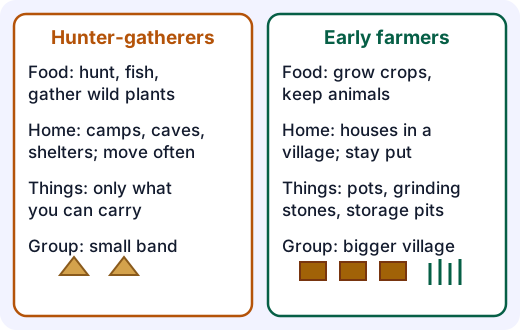
For most of history, people found food by hunting animals, fishing, and gathering wild plants such as fruit, nuts, roots, seeds and honey. People who live this way are called hunter-gatherers. They did not plant anything. They moved from place to place in small groups, called bands, following animals and the seasons. When the fruit ran out in one valley, they walked to another.
Because they moved so much, they owned only what they could carry.
Tools
A tool is something made to do a job. Early people shaped stones by chipping them to get sharp edges. They also used wood, bone and antler.
Tool What it was used for Hand axe Chopping, cutting meat, digging Scraper Cleaning animal skins to make clothes Spear (a stone point on a wooden shaft) Hunting Digging stick Pulling up roots and tubers Bone needle Sewing skins together Stone lasts for a very long time, so many stone tools survive. Wood, cloth and leather rot away, so we have lost most of what early people made from them. This means we know the Stone Age through the parts that were left behind, and we are always guessing about the rest.
Fire
Making and using fire changed everything. People learned to keep fires going hundreds of thousands of years ago.
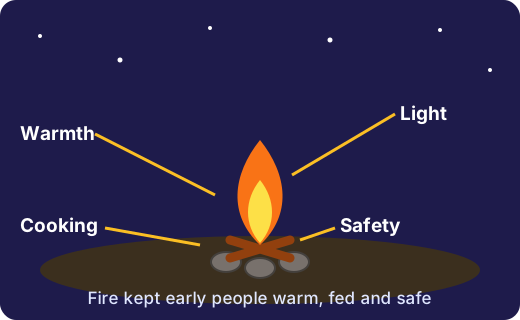
Fire gave warmth in cold weather, light after dark and protection from animals. It was also used for cooking. Cooked food is softer, easier to chew and safer to eat, and it gave people more energy from the same food. Evenings round a fire gave people time to talk and share stories. In India, the rock shelters at Bhimbetka in Madhya Pradesh are covered with paintings of animals, hunters and dancers made by people who lived there thousands of years ago.
The big change: farming
About 10,000 to 12,000 years ago, in several parts of the world, people started to farm. This did not happen in one day. Over many years, people may have noticed that seeds dropped near camp grew into new plants. They began to save seeds, plant them and keep the plants watered. They also tamed wild animals such as goats, sheep and cattle, and kept them for milk, meat and wool. In South Asia, one of the earliest known farming villages is Mehrgarh, about 9,000 years old. It is in what is now Pakistan.
Example. How did farming let people settle in one place?
- A hunter-gatherer band must follow wild food, because the food grows in different places in different seasons.
- Farmers grow their food in a field that stays in one place. Their crops are ready at a known time of year.
- So farmers must stay near their fields to plant, water, guard and harvest. They build lasting houses, and so they form villages.
- Farmers can store grain in pots and pits. With stored food, they can get through winter, and a few people can spend time making pots, tools and houses instead of growing food.
So the answer is: farming let people settle, because food now came from fields that stay in one place.
What farming changed
- Villages and houses replaced temporary camps.
- Pots were invented for storing grain and water, and for cooking.
- More people could be fed from a small area of land, so villages grew bigger.
- New jobs appeared: potters, builders, traders, leaders.
- Some things got harder: farming means long hours of work, crops can fail when it does not rain, and many people living together can spread diseases.
Try it: Think of three things in your home that a hunter-gatherer band could not easily carry from camp to camp. Why would a farming village want them?
Farming did not end hunting and gathering. Some groups kept living this way in many places, and a few still do. But after farming, the world was never the same: villages grew into towns, and towns into cities.
Activity
Be the first farmer
Plant seeds and watch them grow for a week, then think about how the first farmers learned to do it. About 15 minutes at the start, then 5 minutes a day for a week.
You'll need
- A handful of dry whole mung beans (moong), wheat grains, or other seeds from the kitchen
- A shallow dish or old plastic tub, soil or kitchen paper, water
- A notebook and pencil
Steps
- Wet a layer of soil or folded kitchen paper in the dish. Scatter ten seeds on top and cover them lightly. Keep them damp, not soaking, and put the dish on a bright windowsill.
- Each day, look at the seeds. Draw them and write the date and what has changed (swelling, a root, a green shoot).
- After about a week, count how many seeds grew. Pull up one plant gently and look at the root.
- Suppose you were a hunter-gatherer who found this by chance. Write three sentences about what you would do next. Would you stay or move? Why?
- Talk it through with an adult. How is growing food different from gathering wild plants? What would you need to stay and look after the plants?
Safety
- Wash your hands after touching soil or seeds.
- Do not eat the seeds or sprouts raw unless an adult tells you it is safe.
- Keep small seeds away from babies and pets.
Keeping a log of the activity is for registered learners. Register to do this.
Activity
Paint like the rock shelters
Make a rock-shelter painting with natural colours, as early people did at places like Bhimbetka. About 40 minutes.
You'll need
- A rough flat stone, a piece of brown cardboard or the inside of a paper bag
- Drawing charcoal, or a burnt-out stick that an adult has checked is completely cold (not barbecue briquettes, which can contain chemicals), turmeric or red clay, a little water
- Twigs and a feather or leaf to use as brushes
Steps
- Think of a scene from daily life of an early band: hunting, gathering, dancing or sitting around the fire. Plan it first on paper.
- Mix a little turmeric or clay with water to make red or yellow paint. Use charcoal for black.
- Paint your scene with simple shapes (animals, stick-figure people) using twigs and leaf brushes.
- Let it dry. Then write a short caption for archaeologists of the future: what does your painting tell them?
- Ask someone else to look at your painting and say what they can learn about how your band lived.
Safety
- Use charcoal only when it is completely cold. Do not light any fire for this activity.
- Turmeric stains clothes and skin; wear old clothes and cover the table.
- Wash your hands afterwards.
Keeping a log of the activity is for registered learners. Register to do this.
Quick check
Early humans check
Eight questions about food, tools, fire and the start of farming.
1.Put these steps in order, from the earliest to the latest, to show how life changed.
- People gather wild plants and hunt animals
- People stay beside their fields
- Villages grow bigger and people trade
- People notice seeds grow, and start planting them
Put these in order
2.What is a hunter-gatherer?
- A person who finds food by hunting, fishing and gathering wild plants, and moves with the seasons
- A person who grows wheat in a field
- A person who sells goods in a market
- A person who makes pots in a village
Choose one
3.Which of these did early people use fire for? Pick all that apply.
- Keeping warm
- Cooking food
- Light after dark
- Keeping animals away
- Making electricity
Choose all that apply
4.Match each early tool to its job.
- Scraper
- Spear
- Digging stick
- Bone needle
Match each to: Cleaning animal skins · Sewing skins together · Pulling up roots · Hunting animals
5.Why did farming let people settle in one place?
- Their food now came from fields that stay in one place, so they had to stay near them
- People got tired of walking
- There were no animals left to hunt anywhere
- Houses were invented before farming
Choose one
6.About how long ago did farming begin?
- About 100 years ago
- About 1,000 years ago
- About 10,000 years ago
- About 10 million years ago
Choose one
7.Ten thousand years from now, which of these things made by early people is most likely to survive in the ground?
- A stone arrowhead
- A woven grass basket
- A leather bag
- A wooden spear shaft
Choose one
8.Look at the picture. Which group stores grain in pits and lives in a village?
- Early farmers
- Hunter-gatherers
Choose one
Answering and checking are for registered learners. Register to do this.
Quick check
New puzzles
Think like an archaeologist. Use what you know about hunter-gatherers and farmers on new evidence.
1.A band of hunter-gatherers moves camp every few weeks. Which of these would they be LEAST likely to own?
- A huge, heavy grinding slab
- A bone needle
- A spear
- A small skin bag
Choose one
2.Archaeologists dig up a site with the remains of mud-brick houses, grinding stones and pits full of burnt wheat grains. What kind of people lived there?
- Farmers who settled in a village
- A hunter-gatherer band passing through for one night
- Sailors on a ship
- Nobody can say anything from these finds
Choose one
3.Pots are found mostly at farming villages, not at hunter-gatherer camps. What is the best reason?
- Pots are heavy and can break, but they are very useful for storing grain and water in one place
- Hunter-gatherers never needed water
- Hunter-gatherers did not know about fire
- Hunter-gatherers could not make anything
Choose one
4.A farming village has a year with almost no rain. Which problem is a result of depending on farming?
- If the crops fail, the village may have too little food, because it depends on a few crops
- Farmers cannot use fire
- Farmers must walk far every day
- Farming never causes any problems
Choose one
Answering and checking are for registered learners. Register to do this.
Your turn
How farming changed life
Imagine two children who lived about 12,000 years ago. Asha belongs to a hunter-gatherer band. Ravi lives in one of the first farming villages.
Write a short story or diary entry (8 to 12 sentences) that compares one day in their lives. Include:
- How each of them gets food.
- One tool or use of fire in each child's day.
- Where each of them sleeps, and what happens when the food runs out near them.
- One way farming made life better for Ravi's village and one way it made life harder.
Then finish with one sentence that explains why farming let people settle in one place.
How it's judged
- Accurate picture of the two ways of life
- Tools and fire
- Explaining the change
Writing and submitting your answer is for registered learners. Register to do this.
Like what you see?
Register for free to answer the quick checks, do the activities and save your work. Your work is saved on your device and syncs to your account.